

6.2 Theory
143
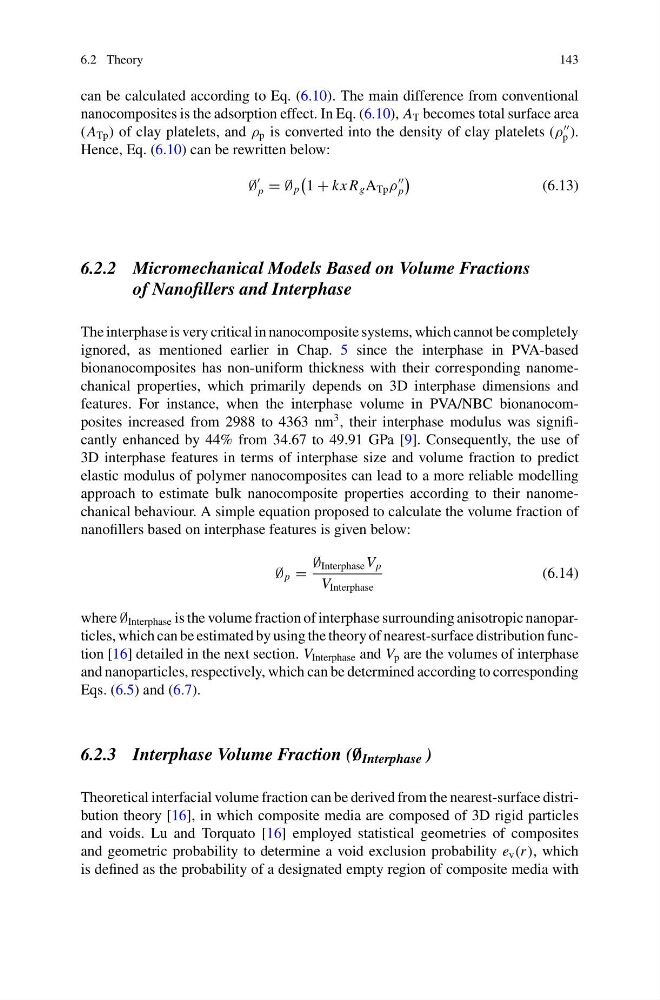
can be calculated according to Eq. (6.10). The main difference from conventional
nanocomposites is the adsorption effect. In Eq. (6.10), A T becomes total surface area
(A Tp ) of clay platelets, and ρ p is converted into the density of clay platelets (ρ
p ).
Hence, Eq. (6.10) can be rewritten below:
∅
p = ∅ p
1 + kx R g A Tp ρ
p
(6.13)
6.2.2 Micromechanical Models Based on Volume Fractions
of Nanofillers and Interphase
The interphase is very critical in nanocomposite systems, which cannot be completely
ignored, as mentioned earlier in Chap. 5 since the interphase in PVA-based
bionanocomposites has non-uniform thickness with their corresponding nanomechanical properties, which primarily depends on 3D interphase dimensions and
features. For instance, when the interphase volume in PVA/NBC bionanocomposites increased from 2988 to 4363 nm
3 , their interphase modulus was significantly enhanced by 44% from 34.67 to 49.91 GPa [9]. Consequently, the use of
3D interphase features in terms of interphase size and volume fraction to predict
elastic modulus of polymer nanocomposites can lead to a more reliable modelling
approach to estimate bulk nanocomposite properties according to their nanomechanical behaviour. A simple equation proposed to calculate the volume fraction of
nanofillers based on interphase features is given below:
∅ p =
∅ Interphase V p
V Interphase
(6.14)
where ∅ Interphase is the volume fraction of interphase surrounding anisotropic nanoparticles, which can be estimated by using the theory of nearest-surface distribution function [16] detailed in the next section. V Interphase and V p are the volumes of interphase
and nanoparticles, respectively, which can be determined according to corresponding
Eqs. (6.5) and (6.7).
6.2.3 Interphase Volume Fraction (∅ Interphase )
Theoretical interfacial volume fraction can be derived from the nearest-surface distribution theory [16], in which composite media are composed of 3D rigid particles
and voids. Lu and Torquato [16] employed statistical geometries of composites
and geometric probability to determine a void exclusion probability e v (r ), which
is defined as the probability of a designated empty region of composite media with
143
can be calculated according to Eq. (6.10). The main difference from conventional
nanocomposites is the adsorption effect. In Eq. (6.10), A T becomes total surface area
(A Tp ) of clay platelets, and ρ p is converted into the density of clay platelets (ρ
p ).
Hence, Eq. (6.10) can be rewritten below:
∅
p = ∅ p
1 + kx R g A Tp ρ
p
(6.13)
6.2.2 Micromechanical Models Based on Volume Fractions
of Nanofillers and Interphase
The interphase is very critical in nanocomposite systems, which cannot be completely
ignored, as mentioned earlier in Chap. 5 since the interphase in PVA-based
bionanocomposites has non-uniform thickness with their corresponding nanomechanical properties, which primarily depends on 3D interphase dimensions and
features. For instance, when the interphase volume in PVA/NBC bionanocomposites increased from 2988 to 4363 nm
3 , their interphase modulus was significantly enhanced by 44% from 34.67 to 49.91 GPa [9]. Consequently, the use of
3D interphase features in terms of interphase size and volume fraction to predict
elastic modulus of polymer nanocomposites can lead to a more reliable modelling
approach to estimate bulk nanocomposite properties according to their nanomechanical behaviour. A simple equation proposed to calculate the volume fraction of
nanofillers based on interphase features is given below:
∅ p =
∅ Interphase V p
V Interphase
(6.14)
where ∅ Interphase is the volume fraction of interphase surrounding anisotropic nanoparticles, which can be estimated by using the theory of nearest-surface distribution function [16] detailed in the next section. V Interphase and V p are the volumes of interphase
and nanoparticles, respectively, which can be determined according to corresponding
Eqs. (6.5) and (6.7).
6.2.3 Interphase Volume Fraction (∅ Interphase )
Theoretical interfacial volume fraction can be derived from the nearest-surface distribution theory [16], in which composite media are composed of 3D rigid particles
and voids. Lu and Torquato [16] employed statistical geometries of composites
and geometric probability to determine a void exclusion probability e v (r ), which
is defined as the probability of a designated empty region of composite media with