

142
6 Micromechanical Models of PVA-Based Bionanocomposite Films
Mori–Tanaka model given by:
E c ∼ = 0.375E 11 + 0.625E 22
(6.9)
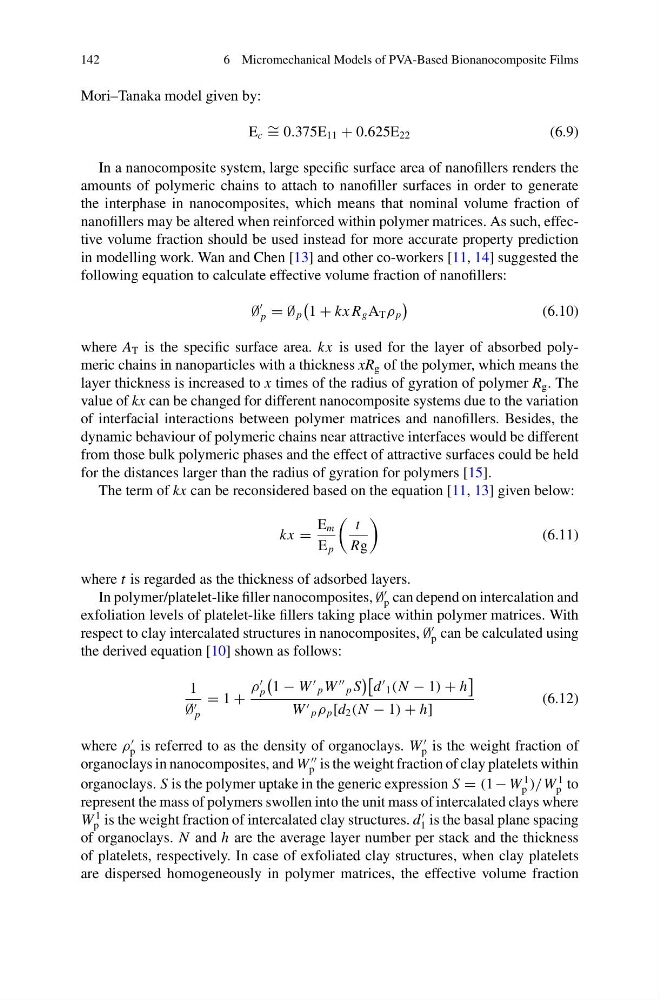
In a nanocomposite system, large specific surface area of nanofillers renders the
amounts of polymeric chains to attach to nanofiller surfaces in order to generate
the interphase in nanocomposites, which means that nominal volume fraction of
nanofillers may be altered when reinforced within polymer matrices. As such, effective volume fraction should be used instead for more accurate property prediction
in modelling work. Wan and Chen [13] and other co-workers [11, 14] suggested the
following equation to calculate effective volume fraction of nanofillers:
∅
p = ∅ p
1 + kx R g A T ρ p
(6.10)
where A T is the specific surface area. kx is used for the layer of absorbed polymeric chains in nanoparticles with a thickness xR g of the polymer, which means the
layer thickness is increased to x times of the radius of gyration of polymer R g . The
value of kx can be changed for different nanocomposite systems due to the variation
of interfacial interactions between polymer matrices and nanofillers. Besides, the
dynamic behaviour of polymeric chains near attractive interfaces would be different
from those bulk polymeric phases and the effect of attractive surfaces could be held
for the distances larger than the radius of gyration for polymers [15].
The term of kx can be reconsidered based on the equation [11, 13] given below:
kx =
E m
E p
t
Rg
(6.11)
where t is regarded as the thickness of adsorbed layers.
In polymer/platelet-like filler nanocomposites, ∅
p can depend on intercalation and
exfoliation levels of platelet-like fillers taking place within polymer matrices. With
respect to clay intercalated structures in nanocomposites, ∅
p can be calculated using
the derived equation [10] shown as follows:
1
∅
p
= 1 +
ρ
p
1 − W
p W
p S
d
1 (N − 1) + h
W p ρ p [d 2 (N − 1) + h]
(6.12)
where ρ
p is referred to as the density of organoclays. W
p is the weight fraction of
organoclays in nanocomposites, and W
p is the weight fraction of clay platelets within
organoclays. S is the polymer uptake in the generic expression S = (1 − W
1
p )/W
1
p to
represent the mass of polymers swollen into the unit mass of intercalated clays where
W
1
p is the weight fraction of intercalated clay structures. d
1 is the basal plane spacing
of organoclays. N and h are the average layer number per stack and the thickness
of platelets, respectively. In case of exfoliated clay structures, when clay platelets
are dispersed homogeneously in polymer matrices, the effective volume fraction
6 Micromechanical Models of PVA-Based Bionanocomposite Films
Mori–Tanaka model given by:
E c ∼ = 0.375E 11 + 0.625E 22
(6.9)
In a nanocomposite system, large specific surface area of nanofillers renders the
amounts of polymeric chains to attach to nanofiller surfaces in order to generate
the interphase in nanocomposites, which means that nominal volume fraction of
nanofillers may be altered when reinforced within polymer matrices. As such, effective volume fraction should be used instead for more accurate property prediction
in modelling work. Wan and Chen [13] and other co-workers [11, 14] suggested the
following equation to calculate effective volume fraction of nanofillers:
∅
p = ∅ p
1 + kx R g A T ρ p
(6.10)
where A T is the specific surface area. kx is used for the layer of absorbed polymeric chains in nanoparticles with a thickness xR g of the polymer, which means the
layer thickness is increased to x times of the radius of gyration of polymer R g . The
value of kx can be changed for different nanocomposite systems due to the variation
of interfacial interactions between polymer matrices and nanofillers. Besides, the
dynamic behaviour of polymeric chains near attractive interfaces would be different
from those bulk polymeric phases and the effect of attractive surfaces could be held
for the distances larger than the radius of gyration for polymers [15].
The term of kx can be reconsidered based on the equation [11, 13] given below:
kx =
E m
E p
t
Rg
(6.11)
where t is regarded as the thickness of adsorbed layers.
In polymer/platelet-like filler nanocomposites, ∅
p can depend on intercalation and
exfoliation levels of platelet-like fillers taking place within polymer matrices. With
respect to clay intercalated structures in nanocomposites, ∅
p can be calculated using
the derived equation [10] shown as follows:
1
∅
p
= 1 +
ρ
p
1 − W
p W
p S
d
1 (N − 1) + h
W p ρ p [d 2 (N − 1) + h]
(6.12)
where ρ
p is referred to as the density of organoclays. W
p is the weight fraction of
organoclays in nanocomposites, and W
p is the weight fraction of clay platelets within
organoclays. S is the polymer uptake in the generic expression S = (1 − W
1
p )/W
1
p to
represent the mass of polymers swollen into the unit mass of intercalated clays where
W
1
p is the weight fraction of intercalated clay structures. d
1 is the basal plane spacing
of organoclays. N and h are the average layer number per stack and the thickness
of platelets, respectively. In case of exfoliated clay structures, when clay platelets
are dispersed homogeneously in polymer matrices, the effective volume fraction