

6.2 Theory
141
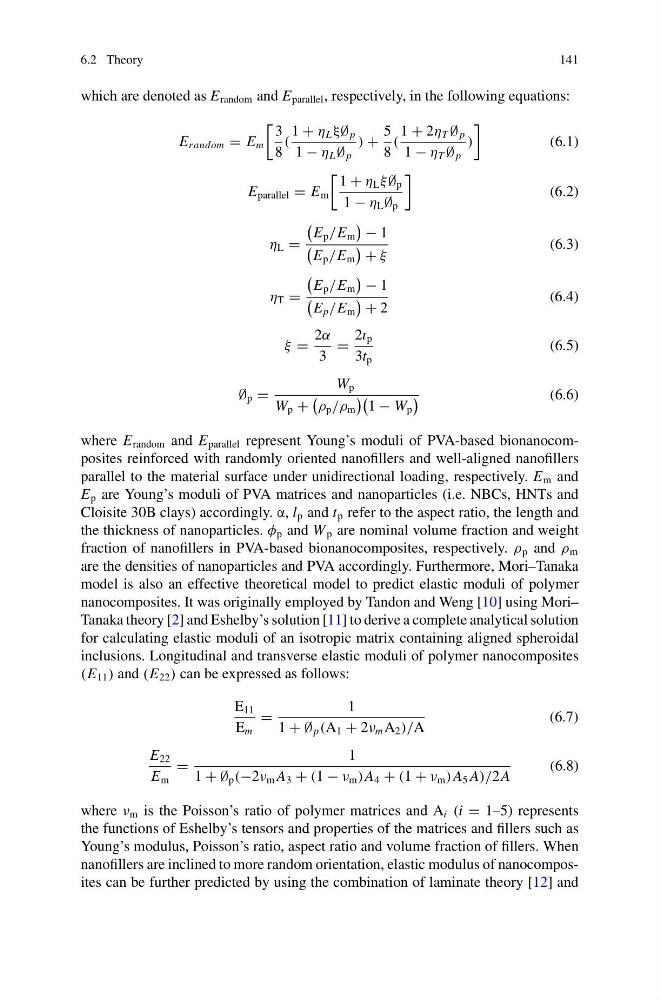
which are denoted as E random and E parallel , respectively, in the following equations:
E random = E m
3
8
(
1 + η L ξ∅ p
1 − η L ∅ p
) +
5
8
(
1 + 2η T ∅ p
1 − η T ∅ p
)
(6.1)
E parallel = E m
1 + η L ξ ∅ p
1 − η L ∅ p
(6.2)
η L =
E p /E m
− 1
E p /E m
+ ξ
(6.3)
η T =
E p /E m
− 1
E p /E m
+ 2
(6.4)
ξ =
2α
3
=
2ı p
3t p
(6.5)
∅ p =
W p
W p +
ρ p /ρ m
1 − W p
(6.6)
where E random and E parallel represent Young’s moduli of PVA-based bionanocomposites reinforced with randomly oriented nanofillers and well-aligned nanofillers
parallel to the material surface under unidirectional loading, respectively. E m and
E p are Young’s moduli of PVA matrices and nanoparticles (i.e. NBCs, HNTs and
Cloisite 30B clays) accordingly. α, l p and t p refer to the aspect ratio, the length and
the thickness of nanoparticles. φ p and W p are nominal volume fraction and weight
fraction of nanofillers in PVA-based bionanocomposites, respectively. ρ p and ρ m
are the densities of nanoparticles and PVA accordingly. Furthermore, Mori–Tanaka
model is also an effective theoretical model to predict elastic moduli of polymer
nanocomposites. It was originally employed by Tandon and Weng [10] using Mori–
Tanaka theory [2] and Eshelby’s solution [11] to derive a complete analytical solution
for calculating elastic moduli of an isotropic matrix containing aligned spheroidal
inclusions. Longitudinal and transverse elastic moduli of polymer nanocomposites
(E 11 ) and (E 22 ) can be expressed as follows:
E 11
E m
=
1
1 + ∅ p (A 1 + 2ν m A 2 )/A
(6.7)
E 22
E m
=
1
1 + ∅ p (−2ν m A 3 + (1 − ν m )A 4 + (1 + ν m )A 5 A)/2 A
(6.8)
where ν m is the Poisson’s ratio of polymer matrices and A i (i = 1–5) represents
the functions of Eshelby’s tensors and properties of the matrices and fillers such as
Young’s modulus, Poisson’s ratio, aspect ratio and volume fraction of fillers. When
nanofillers are inclined to more random orientation, elastic modulus of nanocomposites can be further predicted by using the combination of laminate theory [12] and
141
which are denoted as E random and E parallel , respectively, in the following equations:
E random = E m
3
8
(
1 + η L ξ∅ p
1 − η L ∅ p
) +
5
8
(
1 + 2η T ∅ p
1 − η T ∅ p
)
(6.1)
E parallel = E m
1 + η L ξ ∅ p
1 − η L ∅ p
(6.2)
η L =
E p /E m
− 1
E p /E m
+ ξ
(6.3)
η T =
E p /E m
− 1
E p /E m
+ 2
(6.4)
ξ =
2α
3
=
2ı p
3t p
(6.5)
∅ p =
W p
W p +
ρ p /ρ m
1 − W p
(6.6)
where E random and E parallel represent Young’s moduli of PVA-based bionanocomposites reinforced with randomly oriented nanofillers and well-aligned nanofillers
parallel to the material surface under unidirectional loading, respectively. E m and
E p are Young’s moduli of PVA matrices and nanoparticles (i.e. NBCs, HNTs and
Cloisite 30B clays) accordingly. α, l p and t p refer to the aspect ratio, the length and
the thickness of nanoparticles. φ p and W p are nominal volume fraction and weight
fraction of nanofillers in PVA-based bionanocomposites, respectively. ρ p and ρ m
are the densities of nanoparticles and PVA accordingly. Furthermore, Mori–Tanaka
model is also an effective theoretical model to predict elastic moduli of polymer
nanocomposites. It was originally employed by Tandon and Weng [10] using Mori–
Tanaka theory [2] and Eshelby’s solution [11] to derive a complete analytical solution
for calculating elastic moduli of an isotropic matrix containing aligned spheroidal
inclusions. Longitudinal and transverse elastic moduli of polymer nanocomposites
(E 11 ) and (E 22 ) can be expressed as follows:
E 11
E m
=
1
1 + ∅ p (A 1 + 2ν m A 2 )/A
(6.7)
E 22
E m
=
1
1 + ∅ p (−2ν m A 3 + (1 − ν m )A 4 + (1 + ν m )A 5 A)/2 A
(6.8)
where ν m is the Poisson’s ratio of polymer matrices and A i (i = 1–5) represents
the functions of Eshelby’s tensors and properties of the matrices and fillers such as
Young’s modulus, Poisson’s ratio, aspect ratio and volume fraction of fillers. When
nanofillers are inclined to more random orientation, elastic modulus of nanocomposites can be further predicted by using the combination of laminate theory [12] and