

6.2 Theory
145
d =
4R
1 − η
+
ρR
2
2π (1 − η)
2
(6.22)
g =
4
3(1 − η)
+
4ρRS
3(1 − η)
2
+
mρ
2
S
3
27π (1 − η)
3
(6.23)
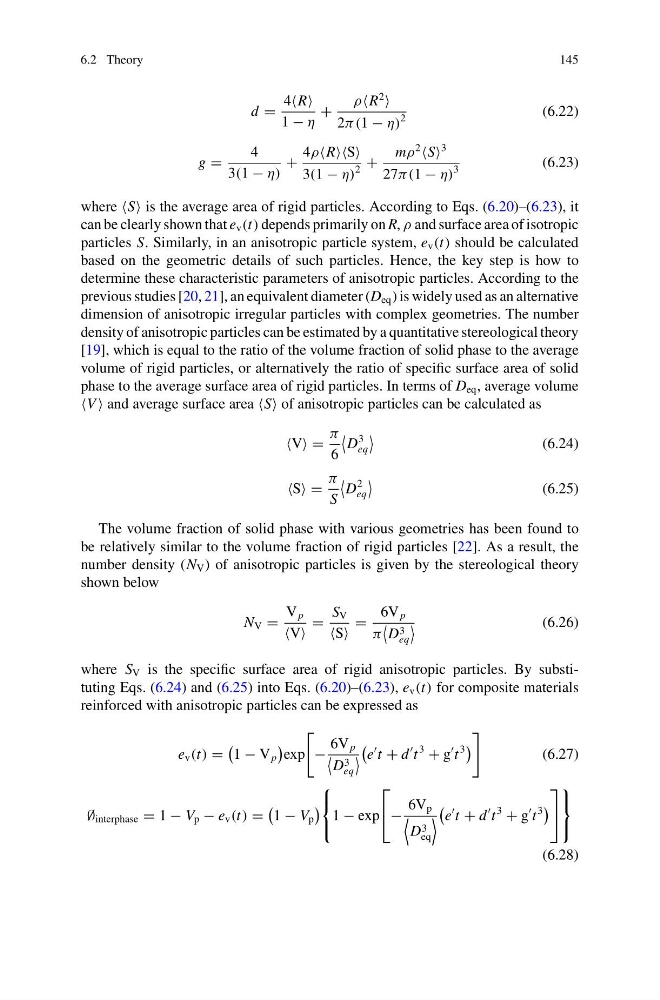
where S is the average area of rigid particles. According to Eqs. (6.20)–(6.23), it
can be clearly shown that e v (t) depends primarily on R, ρ and surface area of isotropic
particles S. Similarly, in an anisotropic particle system, e v (t) should be calculated
based on the geometric details of such particles. Hence, the key step is how to
determine these characteristic parameters of anisotropic particles. According to the
previous studies [20, 21], an equivalent diameter (D eq ) is widely used as an alternative
dimension of anisotropic irregular particles with complex geometries. The number
density of anisotropic particles can be estimated by a quantitative stereological theory
[19], which is equal to the ratio of the volume fraction of solid phase to the average
volume of rigid particles, or alternatively the ratio of specific surface area of solid
phase to the average surface area of rigid particles. In terms of D eq , average volume
V and average surface area S of anisotropic particles can be calculated as
V =
π
6
D
3
eq
(6.24)
S =
π
S
D
2
eq
(6.25)
The volume fraction of solid phase with various geometries has been found to
be relatively similar to the volume fraction of rigid particles [22]. As a result, the
number density (N V ) of anisotropic particles is given by the stereological theory
shown below
N V =
V p
V
=
S V
S
=
6V p
π
D 3
eq
(6.26)
where S V is the specific surface area of rigid anisotropic particles. By substituting Eqs. (6.24) and (6.25) into Eqs. (6.20)–(6.23), e v (t) for composite materials
reinforced with anisotropic particles can be expressed as
e v (t) =
1 − V p
exp
−
6V p
D 3
eq
e
t + d
t
3
+ g
t
3
(6.27)
∅ interphase = 1 − V p − e v (t) =
1 − V p
⎧
⎨
⎩
1 − exp
⎡
⎣ −
6V p
D 3
eq
e
t + d
t
3
+ g
t
3
⎤
⎦
⎫
⎬
⎭
(6.28)
145
d =
4R
1 − η
+
ρR
2
2π (1 − η)
2
(6.22)
g =
4
3(1 − η)
+
4ρRS
3(1 − η)
2
+
mρ
2
S
3
27π (1 − η)
3
(6.23)
where S is the average area of rigid particles. According to Eqs. (6.20)–(6.23), it
can be clearly shown that e v (t) depends primarily on R, ρ and surface area of isotropic
particles S. Similarly, in an anisotropic particle system, e v (t) should be calculated
based on the geometric details of such particles. Hence, the key step is how to
determine these characteristic parameters of anisotropic particles. According to the
previous studies [20, 21], an equivalent diameter (D eq ) is widely used as an alternative
dimension of anisotropic irregular particles with complex geometries. The number
density of anisotropic particles can be estimated by a quantitative stereological theory
[19], which is equal to the ratio of the volume fraction of solid phase to the average
volume of rigid particles, or alternatively the ratio of specific surface area of solid
phase to the average surface area of rigid particles. In terms of D eq , average volume
V and average surface area S of anisotropic particles can be calculated as
V =
π
6
D
3
eq
(6.24)
S =
π
S
D
2
eq
(6.25)
The volume fraction of solid phase with various geometries has been found to
be relatively similar to the volume fraction of rigid particles [22]. As a result, the
number density (N V ) of anisotropic particles is given by the stereological theory
shown below
N V =
V p
V
=
S V
S
=
6V p
π
D 3
eq
(6.26)
where S V is the specific surface area of rigid anisotropic particles. By substituting Eqs. (6.24) and (6.25) into Eqs. (6.20)–(6.23), e v (t) for composite materials
reinforced with anisotropic particles can be expressed as
e v (t) =
1 − V p
exp
−
6V p
D 3
eq
e
t + d
t
3
+ g
t
3
(6.27)
∅ interphase = 1 − V p − e v (t) =
1 − V p
⎧
⎨
⎩
1 − exp
⎡
⎣ −
6V p
D 3
eq
e
t + d
t
3
+ g
t
3
⎤
⎦
⎫
⎬
⎭
(6.28)