

86
M. Burgay et al.
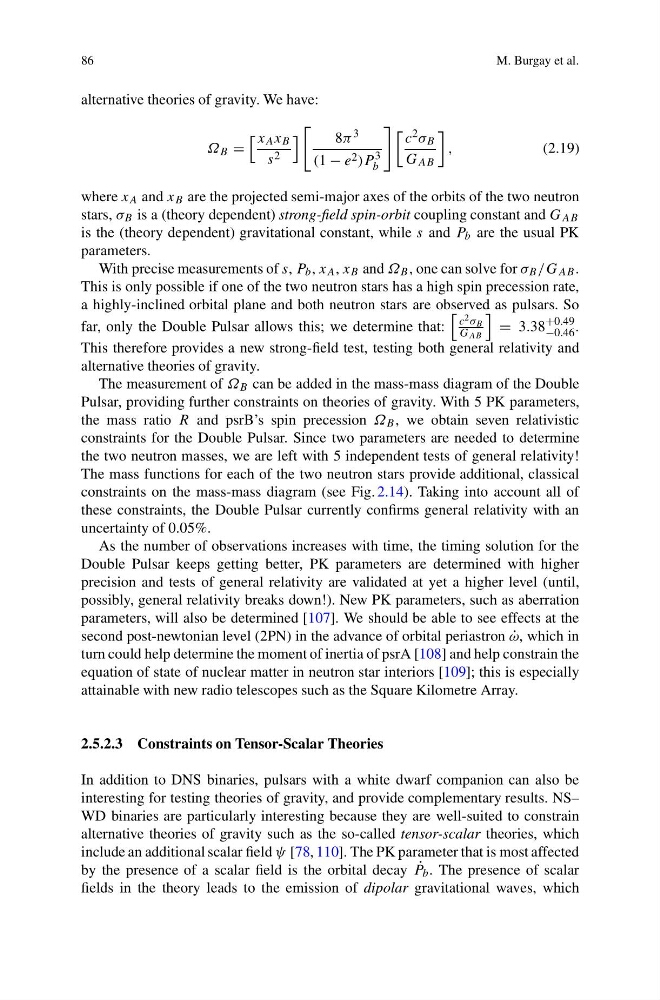
alternative theories of gravity. We have:
Ω B =
x A x B
s 2
8π 3
(1 − e 2 )P
3
b
c 2 σ B
G AB
,
(2.19)
where x A and x B are the projected semi-major axes of the orbits of the two neutron
stars, σ B is a (theory dependent) strong-field spin-orbit coupling constant and G AB
is the (theory dependent) gravitational constant, while s and P b are the usual PK
parameters.
With precise measurements of s, P b , x A , x B and Ω B , one can solve for σ B /G AB .
This is only possible if one of the two neutron stars has a high spin precession rate,
a highly-inclined orbital plane and both neutron stars are observed as pulsars. So
far, only the Double Pulsar allows this; we determine that:
c 2 σ B
G AB
= 3.38
+0.49
−0.46 .
This therefore provides a new strong-field test, testing both general relativity and
alternative theories of gravity.
The measurement of Ω B can be added in the mass-mass diagram of the Double
Pulsar, providing further constraints on theories of gravity. With 5 PK parameters,
the mass ratio R and psrB’s spin precession Ω B , we obtain seven relativistic
constraints for the Double Pulsar. Since two parameters are needed to determine
the two neutron masses, we are left with 5 independent tests of general relativity!
The mass functions for each of the two neutron stars provide additional, classical
constraints on the mass-mass diagram (see Fig. 2.14). Taking into account all of
these constraints, the Double Pulsar currently confirms general relativity with an
uncertainty of 0.05%.
As the number of observations increases with time, the timing solution for the
Double Pulsar keeps getting better, PK parameters are determined with higher
precision and tests of general relativity are validated at yet a higher level (until,
possibly, general relativity breaks down!). New PK parameters, such as aberration
parameters, will also be determined [107]. We should be able to see effects at the
second post-newtonian level (2PN) in the advance of orbital periastron ˙
ω, which in
turn could help determine the moment of inertia of psrA [108] and help constrain the
equation of state of nuclear matter in neutron star interiors [109]; this is especially
attainable with new radio telescopes such as the Square Kilometre Array.
2.5.2.3 Constraints on Tensor-Scalar Theories
In addition to DNS binaries, pulsars with a white dwarf companion can also be
interesting for testing theories of gravity, and provide complementary results. NS–
WD binaries are particularly interesting because they are well-suited to constrain
alternative theories of gravity such as the so-called tensor-scalar theories, which
include an additional scalar field ψ [78, 110]. The PK parameter that is most affected
by the presence of a scalar field is the orbital decay ˙
P b . The presence of scalar
fields in the theory leads to the emission of dipolar gravitational waves, which
M. Burgay et al.
alternative theories of gravity. We have:
Ω B =
x A x B
s 2
8π 3
(1 − e 2 )P
3
b
c 2 σ B
G AB
,
(2.19)
where x A and x B are the projected semi-major axes of the orbits of the two neutron
stars, σ B is a (theory dependent) strong-field spin-orbit coupling constant and G AB
is the (theory dependent) gravitational constant, while s and P b are the usual PK
parameters.
With precise measurements of s, P b , x A , x B and Ω B , one can solve for σ B /G AB .
This is only possible if one of the two neutron stars has a high spin precession rate,
a highly-inclined orbital plane and both neutron stars are observed as pulsars. So
far, only the Double Pulsar allows this; we determine that:
c 2 σ B
G AB
= 3.38
+0.49
−0.46 .
This therefore provides a new strong-field test, testing both general relativity and
alternative theories of gravity.
The measurement of Ω B can be added in the mass-mass diagram of the Double
Pulsar, providing further constraints on theories of gravity. With 5 PK parameters,
the mass ratio R and psrB’s spin precession Ω B , we obtain seven relativistic
constraints for the Double Pulsar. Since two parameters are needed to determine
the two neutron masses, we are left with 5 independent tests of general relativity!
The mass functions for each of the two neutron stars provide additional, classical
constraints on the mass-mass diagram (see Fig. 2.14). Taking into account all of
these constraints, the Double Pulsar currently confirms general relativity with an
uncertainty of 0.05%.
As the number of observations increases with time, the timing solution for the
Double Pulsar keeps getting better, PK parameters are determined with higher
precision and tests of general relativity are validated at yet a higher level (until,
possibly, general relativity breaks down!). New PK parameters, such as aberration
parameters, will also be determined [107]. We should be able to see effects at the
second post-newtonian level (2PN) in the advance of orbital periastron ˙
ω, which in
turn could help determine the moment of inertia of psrA [108] and help constrain the
equation of state of nuclear matter in neutron star interiors [109]; this is especially
attainable with new radio telescopes such as the Square Kilometre Array.
2.5.2.3 Constraints on Tensor-Scalar Theories
In addition to DNS binaries, pulsars with a white dwarf companion can also be
interesting for testing theories of gravity, and provide complementary results. NS–
WD binaries are particularly interesting because they are well-suited to constrain
alternative theories of gravity such as the so-called tensor-scalar theories, which
include an additional scalar field ψ [78, 110]. The PK parameter that is most affected
by the presence of a scalar field is the orbital decay ˙
P b . The presence of scalar
fields in the theory leads to the emission of dipolar gravitational waves, which