

2 General Relativity Measurements from Pulsars
85
• Both neutron stars have been observed as pulsars: radio pulses have been
monitored. This provides two clocks with which to determine PK parameters.
This particular set of circumstances enabled a quick determination (within 1
week) of the relativistic advance of periastron ˙
ω of psrA [41]. Within 6 months
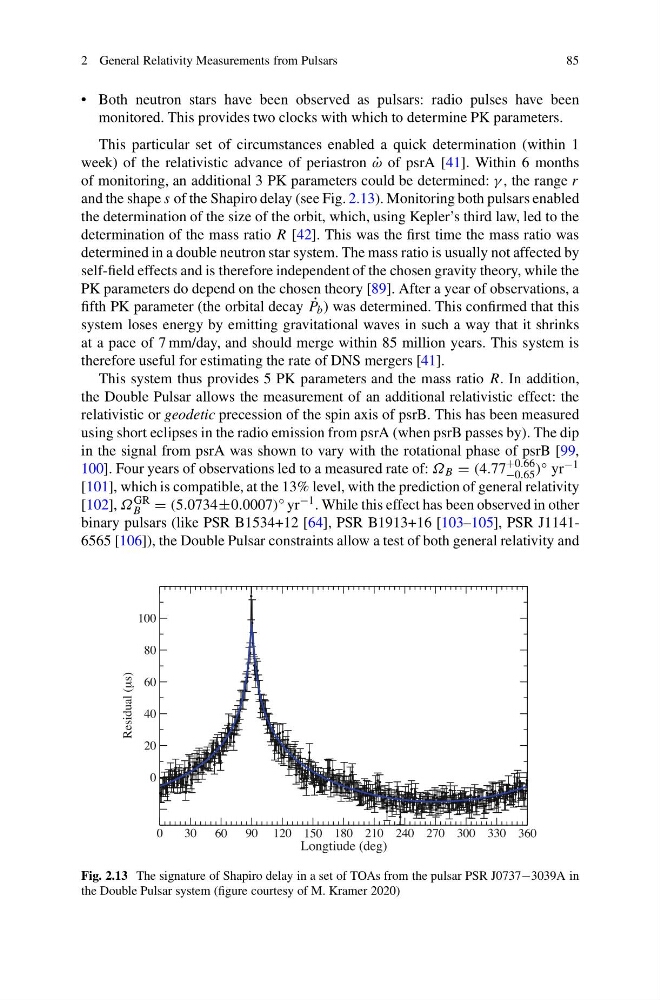
of monitoring, an additional 3 PK parameters could be determined: γ , the range r
and the shape s of the Shapiro delay (see Fig. 2.13). Monitoring both pulsars enabled
the determination of the size of the orbit, which, using Kepler’s third law, led to the
determination of the mass ratio R [42]. This was the first time the mass ratio was
determined in a double neutron star system. The mass ratio is usually not affected by
self-field effects and is therefore independent of the chosen gravity theory, while the
PK parameters do depend on the chosen theory [89]. After a year of observations, a
fifth PK parameter (the orbital decay ˙
P b ) was determined. This confirmed that this
system loses energy by emitting gravitational waves in such a way that it shrinks
at a pace of 7 mm/day, and should merge within 85 million years. This system is
therefore useful for estimating the rate of DNS mergers [41].
This system thus provides 5 PK parameters and the mass ratio R. In addition,
the Double Pulsar allows the measurement of an additional relativistic effect: the
relativistic or geodetic precession of the spin axis of psrB. This has been measured
using short eclipses in the radio emission from psrA (when psrB passes by). The dip
in the signal from psrA was shown to vary with the rotational phase of psrB [99,
100]. Four years of observations led to a measured rate of: Ω B = (4.77
+0.66
−0.65 ) ◦ yr −1
[101], which is compatible, at the 13% level, with the prediction of general relativity
[102], Ω GR
B = (5.0734±0.0007) ◦ yr −1 . While this effect has been observed in other
binary pulsars (like PSR B1534+12 [64], PSR B1913+16 [103–105], PSR J11416565 [106]), the Double Pulsar constraints allow a test of both general relativity and
Fig. 2.13 The signature of Shapiro delay in a set of TOAs from the pulsar PSR J0737−3039A in
the Double Pulsar system (figure courtesy of M. Kramer 2020)
85
• Both neutron stars have been observed as pulsars: radio pulses have been
monitored. This provides two clocks with which to determine PK parameters.
This particular set of circumstances enabled a quick determination (within 1
week) of the relativistic advance of periastron ˙
ω of psrA [41]. Within 6 months
of monitoring, an additional 3 PK parameters could be determined: γ , the range r
and the shape s of the Shapiro delay (see Fig. 2.13). Monitoring both pulsars enabled
the determination of the size of the orbit, which, using Kepler’s third law, led to the
determination of the mass ratio R [42]. This was the first time the mass ratio was
determined in a double neutron star system. The mass ratio is usually not affected by
self-field effects and is therefore independent of the chosen gravity theory, while the
PK parameters do depend on the chosen theory [89]. After a year of observations, a
fifth PK parameter (the orbital decay ˙
P b ) was determined. This confirmed that this
system loses energy by emitting gravitational waves in such a way that it shrinks
at a pace of 7 mm/day, and should merge within 85 million years. This system is
therefore useful for estimating the rate of DNS mergers [41].
This system thus provides 5 PK parameters and the mass ratio R. In addition,
the Double Pulsar allows the measurement of an additional relativistic effect: the
relativistic or geodetic precession of the spin axis of psrB. This has been measured
using short eclipses in the radio emission from psrA (when psrB passes by). The dip
in the signal from psrA was shown to vary with the rotational phase of psrB [99,
100]. Four years of observations led to a measured rate of: Ω B = (4.77
+0.66
−0.65 ) ◦ yr −1
[101], which is compatible, at the 13% level, with the prediction of general relativity
[102], Ω GR
B = (5.0734±0.0007) ◦ yr −1 . While this effect has been observed in other
binary pulsars (like PSR B1534+12 [64], PSR B1913+16 [103–105], PSR J11416565 [106]), the Double Pulsar constraints allow a test of both general relativity and
Fig. 2.13 The signature of Shapiro delay in a set of TOAs from the pulsar PSR J0737−3039A in
the Double Pulsar system (figure courtesy of M. Kramer 2020)