

84
M. Burgay et al.
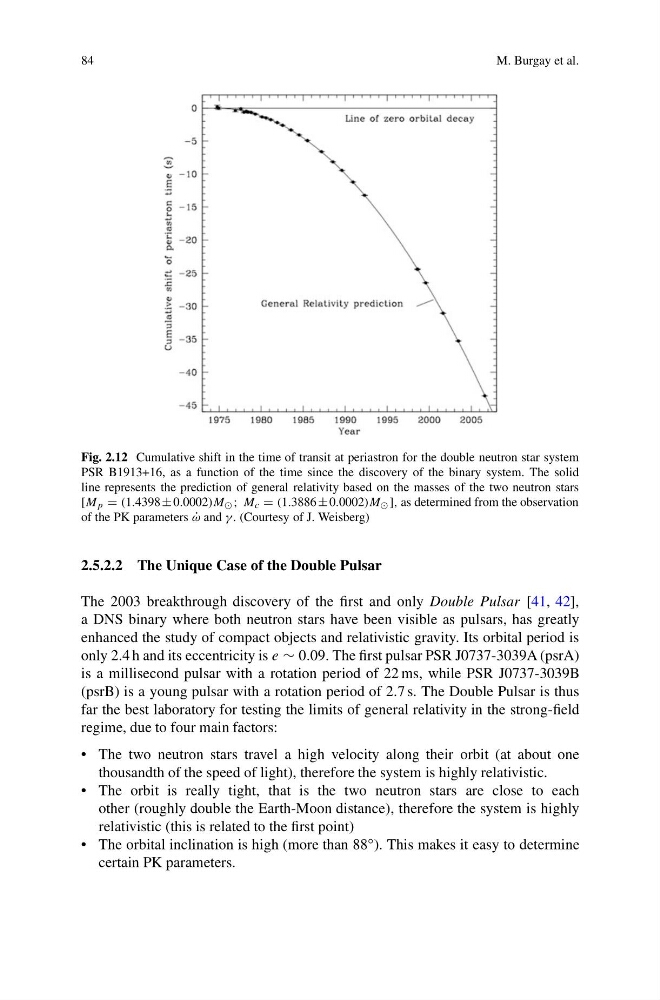
Fig. 2.12 Cumulative shift in the time of transit at periastron for the double neutron star system
PSR B1913+16, as a function of the time since the discovery of the binary system. The solid
line represents the prediction of general relativity based on the masses of the two neutron stars
[M p = (1.4398 ± 0.0002)M ; M c = (1.3886 ± 0.0002)M ], as determined from the observation
of the PK parameters ˙
ω and γ. (Courtesy of J. Weisberg)
2.5.2.2 The Unique Case of the Double Pulsar
The 2003 breakthrough discovery of the first and only Double Pulsar [41, 42],
a DNS binary where both neutron stars have been visible as pulsars, has greatly
enhanced the study of compact objects and relativistic gravity. Its orbital period is
only 2.4 h and its eccentricity is e ∼ 0.09. The first pulsar PSR J0737-3039A (psrA)
is a millisecond pulsar with a rotation period of 22 ms, while PSR J0737-3039B
(psrB) is a young pulsar with a rotation period of 2.7 s. The Double Pulsar is thus
far the best laboratory for testing the limits of general relativity in the strong-field
regime, due to four main factors:
• The two neutron stars travel a high velocity along their orbit (at about one
thousandth of the speed of light), therefore the system is highly relativistic.
• The orbit is really tight, that is the two neutron stars are close to each
other (roughly double the Earth-Moon distance), therefore the system is highly
relativistic (this is related to the first point)
• The orbital inclination is high (more than 88 ◦ ). This makes it easy to determine
certain PK parameters.
M. Burgay et al.
Fig. 2.12 Cumulative shift in the time of transit at periastron for the double neutron star system
PSR B1913+16, as a function of the time since the discovery of the binary system. The solid
line represents the prediction of general relativity based on the masses of the two neutron stars
[M p = (1.4398 ± 0.0002)M ; M c = (1.3886 ± 0.0002)M ], as determined from the observation
of the PK parameters ˙
ω and γ. (Courtesy of J. Weisberg)
2.5.2.2 The Unique Case of the Double Pulsar
The 2003 breakthrough discovery of the first and only Double Pulsar [41, 42],
a DNS binary where both neutron stars have been visible as pulsars, has greatly
enhanced the study of compact objects and relativistic gravity. Its orbital period is
only 2.4 h and its eccentricity is e ∼ 0.09. The first pulsar PSR J0737-3039A (psrA)
is a millisecond pulsar with a rotation period of 22 ms, while PSR J0737-3039B
(psrB) is a young pulsar with a rotation period of 2.7 s. The Double Pulsar is thus
far the best laboratory for testing the limits of general relativity in the strong-field
regime, due to four main factors:
• The two neutron stars travel a high velocity along their orbit (at about one
thousandth of the speed of light), therefore the system is highly relativistic.
• The orbit is really tight, that is the two neutron stars are close to each
other (roughly double the Earth-Moon distance), therefore the system is highly
relativistic (this is related to the first point)
• The orbital inclination is high (more than 88 ◦ ). This makes it easy to determine
certain PK parameters.