

2 General Relativity Measurements from Pulsars
87
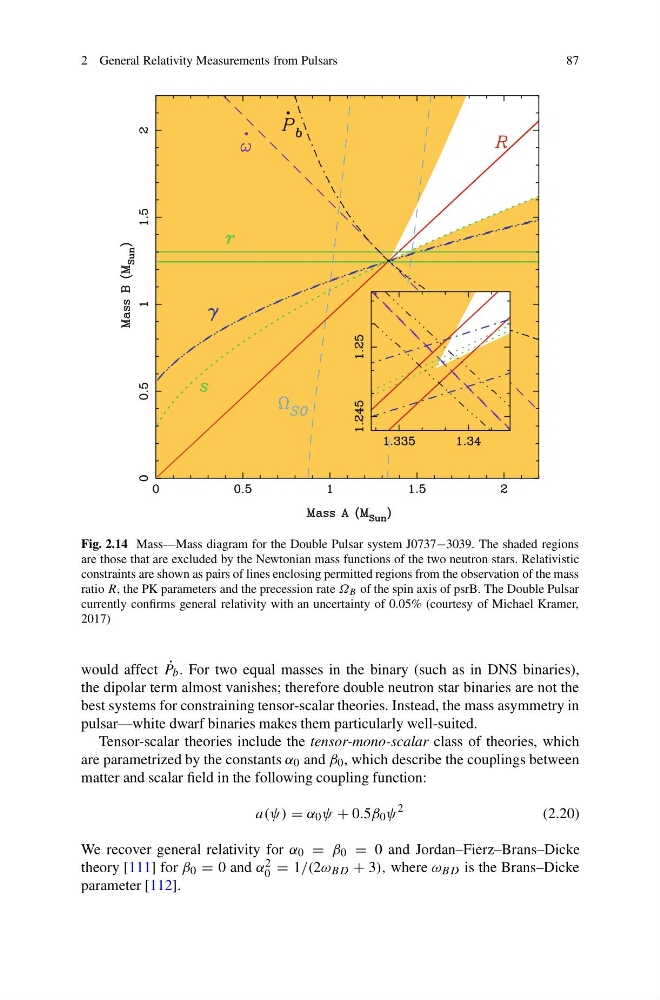
Fig. 2.14 Mass—Mass diagram for the Double Pulsar system J0737−3039. The shaded regions
are those that are excluded by the Newtonian mass functions of the two neutron stars. Relativistic
constraints are shown as pairs of lines enclosing permitted regions from the observation of the mass
ratio R, the PK parameters and the precession rate Ω B of the spin axis of psrB. The Double Pulsar
currently confirms general relativity with an uncertainty of 0.05% (courtesy of Michael Kramer,
2017)
would affect ˙
P b . For two equal masses in the binary (such as in DNS binaries),
the dipolar term almost vanishes; therefore double neutron star binaries are not the
best systems for constraining tensor-scalar theories. Instead, the mass asymmetry in
pulsar—white dwarf binaries makes them particularly well-suited.
Tensor-scalar theories include the tensor-mono-scalar class of theories, which
are parametrized by the constants α 0 and β 0 , which describe the couplings between
matter and scalar field in the following coupling function:
a(ψ) = α 0 ψ + 0.5β 0 ψ
2
(2.20)
We recover general relativity for α 0 = β 0 = 0 and Jordan–Fierz–Brans–Dicke
theory [111] for β 0 = 0 and α 2
0 = 1/(2ω BD + 3), where ω BD is the Brans–Dicke
parameter [112].
87
Fig. 2.14 Mass—Mass diagram for the Double Pulsar system J0737−3039. The shaded regions
are those that are excluded by the Newtonian mass functions of the two neutron stars. Relativistic
constraints are shown as pairs of lines enclosing permitted regions from the observation of the mass
ratio R, the PK parameters and the precession rate Ω B of the spin axis of psrB. The Double Pulsar
currently confirms general relativity with an uncertainty of 0.05% (courtesy of Michael Kramer,
2017)
would affect ˙
P b . For two equal masses in the binary (such as in DNS binaries),
the dipolar term almost vanishes; therefore double neutron star binaries are not the
best systems for constraining tensor-scalar theories. Instead, the mass asymmetry in
pulsar—white dwarf binaries makes them particularly well-suited.
Tensor-scalar theories include the tensor-mono-scalar class of theories, which
are parametrized by the constants α 0 and β 0 , which describe the couplings between
matter and scalar field in the following coupling function:
a(ψ) = α 0 ψ + 0.5β 0 ψ
2
(2.20)
We recover general relativity for α 0 = β 0 = 0 and Jordan–Fierz–Brans–Dicke
theory [111] for β 0 = 0 and α 2
0 = 1/(2ω BD + 3), where ω BD is the Brans–Dicke
parameter [112].