

2 General Relativity Measurements from Pulsars
55
effects on the orbital motions, leading to the best tests of relativistic gravity in the
strong-field regime.
In this chapter, after briefly summarising the ‘zoology’ of radio pulsars
(Sect. 2.2), we will concentrate on the description of the so-called relativistic binary
pulsars (Sect. 2.3), which are neutron stars orbiting compact objects at relativistic
speed, and whose radio signals, studied through pulsar timing techniques (Sect. 2.4),
are the best probes of the deformation of the space-time in the vicinity of a compact
star, hence making these pulsars unique laboratories for testing gravitational theories
with steadily increasing precision.
2.2 The Many Faces of the Radio Pulsar Zoo
Non-accreting neutron stars (NSs) are, for the vast majority, found in the form of
radio pulsars, which are sources of steady pulsations in the radio band. In recent
years, however, more and more different manifestations of slowing-down NSs have
been discovered, either emitting solely in other energy bands (such as the Central
Compact Objects, CCOs [9], or the X-ray Dim Isolated Neutron Stars, XDINSs
[10]) or as more or less extreme and irregular transients in the radio band, like
the sporadically emitting Rotational RAdio Transients, RRATs [11], or the puzzling
intermittent pulsars [12]. For most of the aforementioned families of NSs, the energy
budget is coming from their rotational energy (i.e. they are rotational-powered NSs),
but this does not hold true for the so-called ‘magnetars’ [13] and it is still under
debate for CCOs.
The diagram of Fig. 2.2 collects all of the non-accreting NSs for which the spin
period P and its derivative ˙
P are known (but for a subsample of the RRATs, which
do not have yet a measured ˙
P ). In the following sections, we will describe radioemitting pulsars.
2.2.1 Radio Pulsars
When a radio pulsar is discovered, the first parameters measured are its approximate
position in the sky, its period and its dispersion measure (DM). The latter is
computed by measuring the delay in the arrival times of a pulse at different
frequencies. Radio pulsar observations are in fact usually done over a wide band
(ideally up to about 30% of the central observing frequency) and, because of the
free electrons in the interstellar medium (ISM), waves emitted at higher frequencies
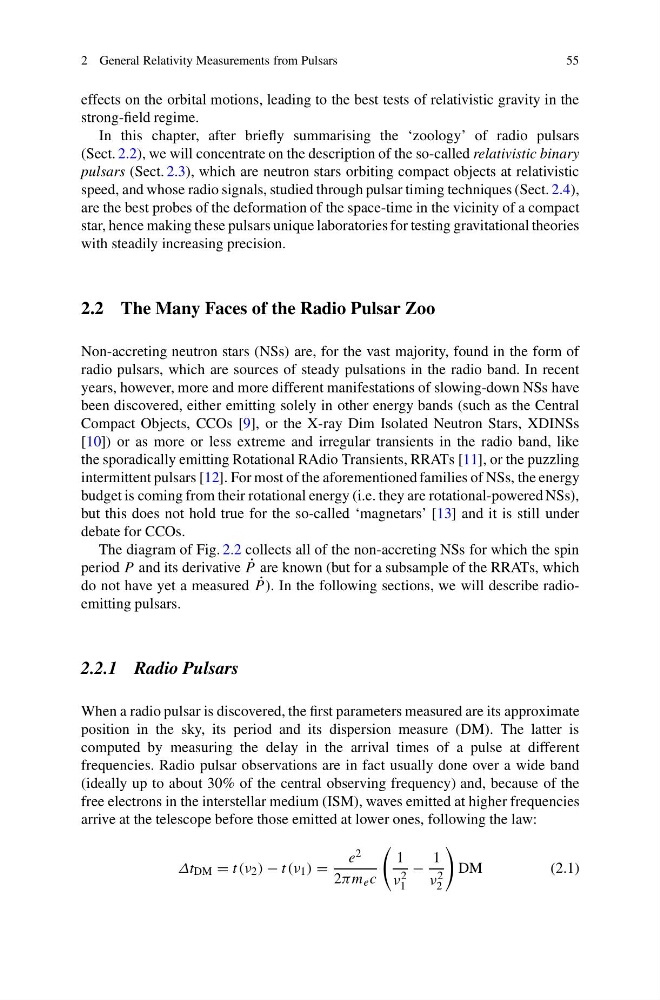
arrive at the telescope before those emitted at lower ones, following the law:
Δt DM = t (ν 2 ) − t (ν 1 ) =
e 2
2πm e c
1
ν 2
1
−
1
ν 2
2
DM
(2.1)
55
effects on the orbital motions, leading to the best tests of relativistic gravity in the
strong-field regime.
In this chapter, after briefly summarising the ‘zoology’ of radio pulsars
(Sect. 2.2), we will concentrate on the description of the so-called relativistic binary
pulsars (Sect. 2.3), which are neutron stars orbiting compact objects at relativistic
speed, and whose radio signals, studied through pulsar timing techniques (Sect. 2.4),
are the best probes of the deformation of the space-time in the vicinity of a compact
star, hence making these pulsars unique laboratories for testing gravitational theories
with steadily increasing precision.
2.2 The Many Faces of the Radio Pulsar Zoo
Non-accreting neutron stars (NSs) are, for the vast majority, found in the form of
radio pulsars, which are sources of steady pulsations in the radio band. In recent
years, however, more and more different manifestations of slowing-down NSs have
been discovered, either emitting solely in other energy bands (such as the Central
Compact Objects, CCOs [9], or the X-ray Dim Isolated Neutron Stars, XDINSs
[10]) or as more or less extreme and irregular transients in the radio band, like
the sporadically emitting Rotational RAdio Transients, RRATs [11], or the puzzling
intermittent pulsars [12]. For most of the aforementioned families of NSs, the energy
budget is coming from their rotational energy (i.e. they are rotational-powered NSs),
but this does not hold true for the so-called ‘magnetars’ [13] and it is still under
debate for CCOs.
The diagram of Fig. 2.2 collects all of the non-accreting NSs for which the spin
period P and its derivative ˙
P are known (but for a subsample of the RRATs, which
do not have yet a measured ˙
P ). In the following sections, we will describe radioemitting pulsars.
2.2.1 Radio Pulsars
When a radio pulsar is discovered, the first parameters measured are its approximate
position in the sky, its period and its dispersion measure (DM). The latter is
computed by measuring the delay in the arrival times of a pulse at different
frequencies. Radio pulsar observations are in fact usually done over a wide band
(ideally up to about 30% of the central observing frequency) and, because of the
free electrons in the interstellar medium (ISM), waves emitted at higher frequencies
arrive at the telescope before those emitted at lower ones, following the law:
Δt DM = t (ν 2 ) − t (ν 1 ) =
e 2
2πm e c
1
ν 2
1
−
1
ν 2
2
DM
(2.1)