

54
M. Burgay et al.
2.1 Why Radio Pulsars
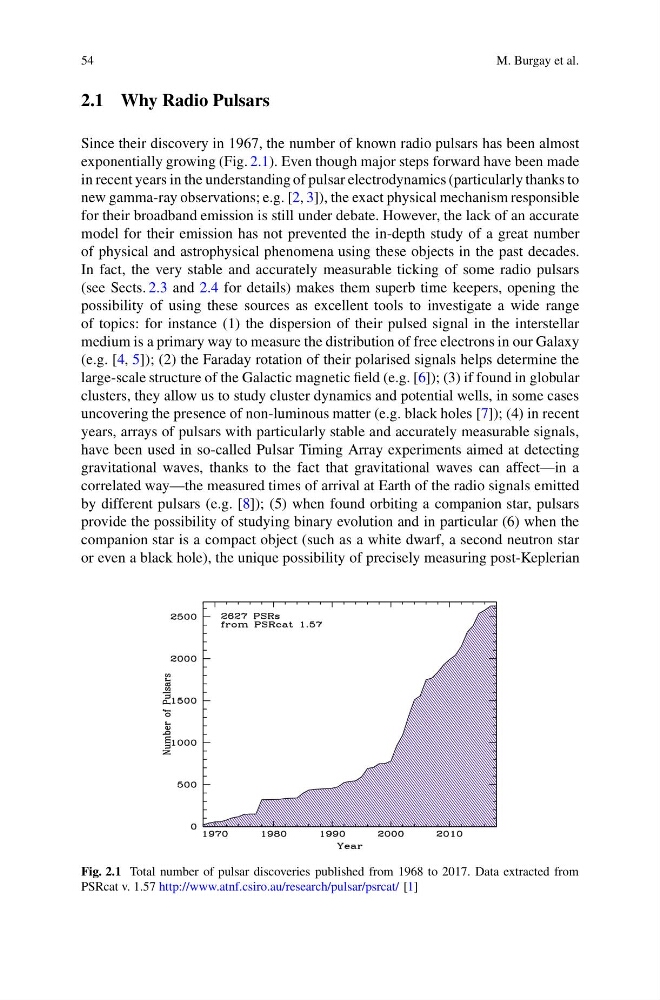
Since their discovery in 1967, the number of known radio pulsars has been almost
exponentially growing (Fig. 2.1). Even though major steps forward have been made
in recent years in the understanding of pulsar electrodynamics (particularly thanks to
new gamma-ray observations; e.g. [2, 3]), the exact physical mechanism responsible
for their broadband emission is still under debate. However, the lack of an accurate
model for their emission has not prevented the in-depth study of a great number
of physical and astrophysical phenomena using these objects in the past decades.
In fact, the very stable and accurately measurable ticking of some radio pulsars
(see Sects. 2.3 and 2.4 for details) makes them superb time keepers, opening the
possibility of using these sources as excellent tools to investigate a wide range
of topics: for instance (1) the dispersion of their pulsed signal in the interstellar
medium is a primary way to measure the distribution of free electrons in our Galaxy
(e.g. [4, 5]); (2) the Faraday rotation of their polarised signals helps determine the
large-scale structure of the Galactic magnetic field (e.g. [6]); (3) if found in globular
clusters, they allow us to study cluster dynamics and potential wells, in some cases
uncovering the presence of non-luminous matter (e.g. black holes [7]); (4) in recent
years, arrays of pulsars with particularly stable and accurately measurable signals,
have been used in so-called Pulsar Timing Array experiments aimed at detecting
gravitational waves, thanks to the fact that gravitational waves can affect—in a
correlated way—the measured times of arrival at Earth of the radio signals emitted
by different pulsars (e.g. [8]); (5) when found orbiting a companion star, pulsars
provide the possibility of studying binary evolution and in particular (6) when the
companion star is a compact object (such as a white dwarf, a second neutron star
or even a black hole), the unique possibility of precisely measuring post-Keplerian
Fig. 2.1 Total number of pulsar discoveries published from 1968 to 2017. Data extracted from
PSRcat v. 1.57 http://www.atnf.csiro.au/research/pulsar/psrcat/ [1]
M. Burgay et al.
2.1 Why Radio Pulsars
Since their discovery in 1967, the number of known radio pulsars has been almost
exponentially growing (Fig. 2.1). Even though major steps forward have been made
in recent years in the understanding of pulsar electrodynamics (particularly thanks to
new gamma-ray observations; e.g. [2, 3]), the exact physical mechanism responsible
for their broadband emission is still under debate. However, the lack of an accurate
model for their emission has not prevented the in-depth study of a great number
of physical and astrophysical phenomena using these objects in the past decades.
In fact, the very stable and accurately measurable ticking of some radio pulsars
(see Sects. 2.3 and 2.4 for details) makes them superb time keepers, opening the
possibility of using these sources as excellent tools to investigate a wide range
of topics: for instance (1) the dispersion of their pulsed signal in the interstellar
medium is a primary way to measure the distribution of free electrons in our Galaxy
(e.g. [4, 5]); (2) the Faraday rotation of their polarised signals helps determine the
large-scale structure of the Galactic magnetic field (e.g. [6]); (3) if found in globular
clusters, they allow us to study cluster dynamics and potential wells, in some cases
uncovering the presence of non-luminous matter (e.g. black holes [7]); (4) in recent
years, arrays of pulsars with particularly stable and accurately measurable signals,
have been used in so-called Pulsar Timing Array experiments aimed at detecting
gravitational waves, thanks to the fact that gravitational waves can affect—in a
correlated way—the measured times of arrival at Earth of the radio signals emitted
by different pulsars (e.g. [8]); (5) when found orbiting a companion star, pulsars
provide the possibility of studying binary evolution and in particular (6) when the
companion star is a compact object (such as a white dwarf, a second neutron star
or even a black hole), the unique possibility of precisely measuring post-Keplerian
Fig. 2.1 Total number of pulsar discoveries published from 1968 to 2017. Data extracted from
PSRcat v. 1.57 http://www.atnf.csiro.au/research/pulsar/psrcat/ [1]