

300
M. Méndez and T. M. Belloni
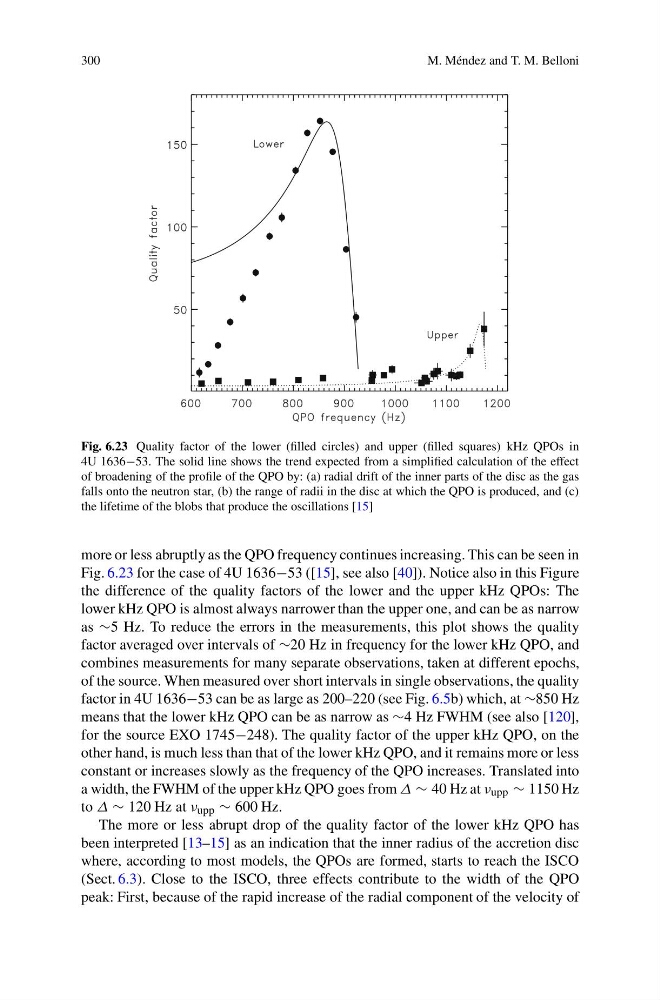
Fig. 6.23 Quality factor of the lower (filled circles) and upper (filled squares) kHz QPOs in
4U 1636−53. The solid line shows the trend expected from a simplified calculation of the effect
of broadening of the profile of the QPO by: (a) radial drift of the inner parts of the disc as the gas
falls onto the neutron star, (b) the range of radii in the disc at which the QPO is produced, and (c)
the lifetime of the blobs that produce the oscillations [15]
more or less abruptly as the QPO frequency continues increasing. This can be seen in
Fig. 6.23 for the case of 4U 1636−53 ([15], see also [40]). Notice also in this Figure
the difference of the quality factors of the lower and the upper kHz QPOs: The
lower kHz QPO is almost always narrower than the upper one, and can be as narrow
as ∼5 Hz. To reduce the errors in the measurements, this plot shows the quality
factor averaged over intervals of ∼20 Hz in frequency for the lower kHz QPO, and
combines measurements for many separate observations, taken at different epochs,
of the source. When measured over short intervals in single observations, the quality
factor in 4U 1636−53 can be as large as 200–220 (see Fig. 6.5b) which, at ∼850 Hz
means that the lower kHz QPO can be as narrow as ∼4 Hz FWHM (see also [120],
for the source EXO 1745−248). The quality factor of the upper kHz QPO, on the
other hand, is much less than that of the lower kHz QPO, and it remains more or less
constant or increases slowly as the frequency of the QPO increases. Translated into
a width, the FWHM of the upper kHz QPO goes from Δ ∼ 40 Hz at ν upp ∼ 1150 Hz
to Δ ∼ 120 Hz at ν upp ∼ 600 Hz.
The more or less abrupt drop of the quality factor of the lower kHz QPO has
been interpreted [13–15] as an indication that the inner radius of the accretion disc
where, according to most models, the QPOs are formed, starts to reach the ISCO
(Sect. 6.3). Close to the ISCO, three effects contribute to the width of the QPO
peak: First, because of the rapid increase of the radial component of the velocity of
M. Méndez and T. M. Belloni
Fig. 6.23 Quality factor of the lower (filled circles) and upper (filled squares) kHz QPOs in
4U 1636−53. The solid line shows the trend expected from a simplified calculation of the effect
of broadening of the profile of the QPO by: (a) radial drift of the inner parts of the disc as the gas
falls onto the neutron star, (b) the range of radii in the disc at which the QPO is produced, and (c)
the lifetime of the blobs that produce the oscillations [15]
more or less abruptly as the QPO frequency continues increasing. This can be seen in
Fig. 6.23 for the case of 4U 1636−53 ([15], see also [40]). Notice also in this Figure
the difference of the quality factors of the lower and the upper kHz QPOs: The
lower kHz QPO is almost always narrower than the upper one, and can be as narrow
as ∼5 Hz. To reduce the errors in the measurements, this plot shows the quality
factor averaged over intervals of ∼20 Hz in frequency for the lower kHz QPO, and
combines measurements for many separate observations, taken at different epochs,
of the source. When measured over short intervals in single observations, the quality
factor in 4U 1636−53 can be as large as 200–220 (see Fig. 6.5b) which, at ∼850 Hz
means that the lower kHz QPO can be as narrow as ∼4 Hz FWHM (see also [120],
for the source EXO 1745−248). The quality factor of the upper kHz QPO, on the
other hand, is much less than that of the lower kHz QPO, and it remains more or less
constant or increases slowly as the frequency of the QPO increases. Translated into
a width, the FWHM of the upper kHz QPO goes from Δ ∼ 40 Hz at ν upp ∼ 1150 Hz
to Δ ∼ 120 Hz at ν upp ∼ 600 Hz.
The more or less abrupt drop of the quality factor of the lower kHz QPO has
been interpreted [13–15] as an indication that the inner radius of the accretion disc
where, according to most models, the QPOs are formed, starts to reach the ISCO
(Sect. 6.3). Close to the ISCO, three effects contribute to the width of the QPO
peak: First, because of the rapid increase of the radial component of the velocity of