

172
A. Patruno and A. L. Watts
and the NS. At these accretion rates accreting plasma and magnetic field lines
may couple and modify the amount of enhanced angular momentum [7, 263], thus
invalidating the use of Eqs. (4.7)–(4.8).
Noting these caveats, theoretical expectations for the average spin frequency
derivative of an AMXP can be calculated with the simplest accretion model
(Eq. (4.7)) once one has a reasonable estimate of the mean mass accretion rate ˙
M
during an outburst. As discussed, such a measure is difficult to obtain, but several
estimates of ˙
M are present in the literature which can be taken as a first step to
compare the measured ˙
ν s with the expected values (see for example [130] and
[263]). The explicit expression for the expected ˙
ν
exp
s
can be obtained by substituting
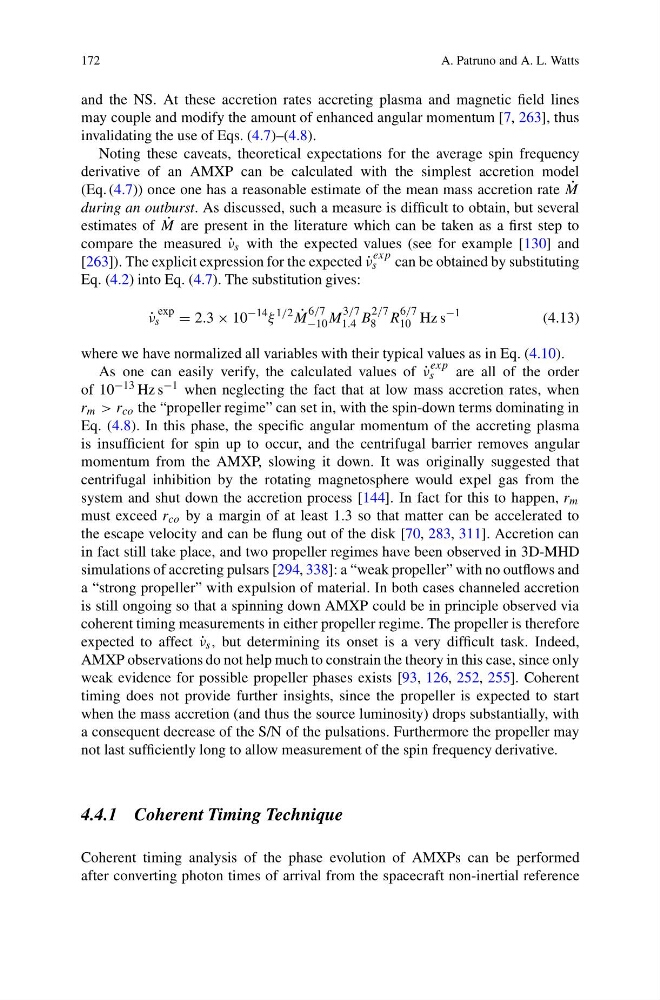
Eq. (4.2) into Eq. (4.7). The substitution gives:
˙
ν
exp
s
= 2.3 × 10
−14 ξ
1/2 ˙
M
6/7
−10 M
3/7
1.4 B
2/7
8 R
6/7
10 Hz s
−1
(4.13)
where we have normalized all variables with their typical values as in Eq. (4.10).
As one can easily verify, the calculated values of ˙
ν
exp
s
are all of the order
of 10 −13 Hz s −1 when neglecting the fact that at low mass accretion rates, when
r m > r co the “propeller regime” can set in, with the spin-down terms dominating in
Eq. (4.8). In this phase, the specific angular momentum of the accreting plasma
is insufficient for spin up to occur, and the centrifugal barrier removes angular
momentum from the AMXP, slowing it down. It was originally suggested that
centrifugal inhibition by the rotating magnetosphere would expel gas from the
system and shut down the accretion process [144]. In fact for this to happen, r m
must exceed r co by a margin of at least 1.3 so that matter can be accelerated to
the escape velocity and can be flung out of the disk [70, 283, 311]. Accretion can
in fact still take place, and two propeller regimes have been observed in 3D-MHD
simulations of accreting pulsars [294, 338]: a “weak propeller” with no outflows and
a “strong propeller” with expulsion of material. In both cases channeled accretion
is still ongoing so that a spinning down AMXP could be in principle observed via
coherent timing measurements in either propeller regime. The propeller is therefore
expected to affect ˙
ν s , but determining its onset is a very difficult task. Indeed,
AMXP observations do not help much to constrain the theory in this case, since only
weak evidence for possible propeller phases exists [93, 126, 252, 255]. Coherent
timing does not provide further insights, since the propeller is expected to start
when the mass accretion (and thus the source luminosity) drops substantially, with
a consequent decrease of the S/N of the pulsations. Furthermore the propeller may
not last sufficiently long to allow measurement of the spin frequency derivative.
4.4.1 Coherent Timing Technique
Coherent timing analysis of the phase evolution of AMXPs can be performed
after converting photon times of arrival from the spacecraft non-inertial reference
A. Patruno and A. L. Watts
and the NS. At these accretion rates accreting plasma and magnetic field lines
may couple and modify the amount of enhanced angular momentum [7, 263], thus
invalidating the use of Eqs. (4.7)–(4.8).
Noting these caveats, theoretical expectations for the average spin frequency
derivative of an AMXP can be calculated with the simplest accretion model
(Eq. (4.7)) once one has a reasonable estimate of the mean mass accretion rate ˙
M
during an outburst. As discussed, such a measure is difficult to obtain, but several
estimates of ˙
M are present in the literature which can be taken as a first step to
compare the measured ˙
ν s with the expected values (see for example [130] and
[263]). The explicit expression for the expected ˙
ν
exp
s
can be obtained by substituting
Eq. (4.2) into Eq. (4.7). The substitution gives:
˙
ν
exp
s
= 2.3 × 10
−14 ξ
1/2 ˙
M
6/7
−10 M
3/7
1.4 B
2/7
8 R
6/7
10 Hz s
−1
(4.13)
where we have normalized all variables with their typical values as in Eq. (4.10).
As one can easily verify, the calculated values of ˙
ν
exp
s
are all of the order
of 10 −13 Hz s −1 when neglecting the fact that at low mass accretion rates, when
r m > r co the “propeller regime” can set in, with the spin-down terms dominating in
Eq. (4.8). In this phase, the specific angular momentum of the accreting plasma
is insufficient for spin up to occur, and the centrifugal barrier removes angular
momentum from the AMXP, slowing it down. It was originally suggested that
centrifugal inhibition by the rotating magnetosphere would expel gas from the
system and shut down the accretion process [144]. In fact for this to happen, r m
must exceed r co by a margin of at least 1.3 so that matter can be accelerated to
the escape velocity and can be flung out of the disk [70, 283, 311]. Accretion can
in fact still take place, and two propeller regimes have been observed in 3D-MHD
simulations of accreting pulsars [294, 338]: a “weak propeller” with no outflows and
a “strong propeller” with expulsion of material. In both cases channeled accretion
is still ongoing so that a spinning down AMXP could be in principle observed via
coherent timing measurements in either propeller regime. The propeller is therefore
expected to affect ˙
ν s , but determining its onset is a very difficult task. Indeed,
AMXP observations do not help much to constrain the theory in this case, since only
weak evidence for possible propeller phases exists [93, 126, 252, 255]. Coherent
timing does not provide further insights, since the propeller is expected to start
when the mass accretion (and thus the source luminosity) drops substantially, with
a consequent decrease of the S/N of the pulsations. Furthermore the propeller may
not last sufficiently long to allow measurement of the spin frequency derivative.
4.4.1 Coherent Timing Technique
Coherent timing analysis of the phase evolution of AMXPs can be performed
after converting photon times of arrival from the spacecraft non-inertial reference