

4 Accreting Millisecond X-ray Pulsars
171
-22
-20
-18
-16
-14
-12
-10
-8
0.001
0.01
0.1
1
10
Log[dP/dt]
Period [s]
10 ^8 G
Sp in −U p Li ne
10 ^1 4 G
10 ^1 2 G
10 ^1 0 G
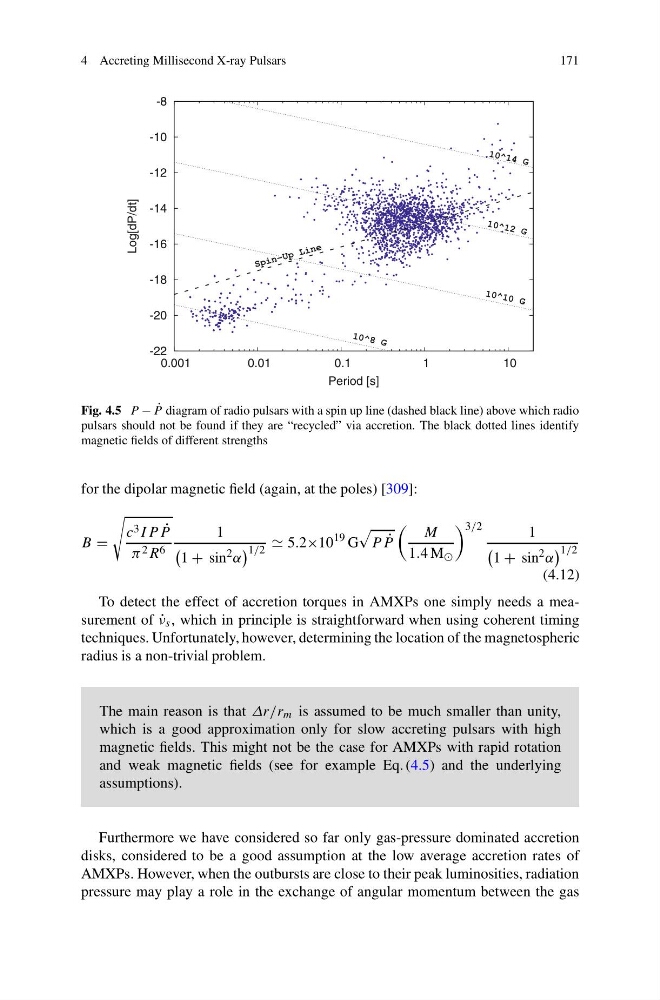
Fig. 4.5 P − ˙
P diagram of radio pulsars with a spin up line (dashed black line) above which radio
pulsars should not be found if they are “recycled” via accretion. The black dotted lines identify
magnetic fields of different strengths
for the dipolar magnetic field (again, at the poles) [309]:
B =
c 3 I P ˙
P
π 2 R 6
1
1 + sin 2 α
1/2 5.2×10
19 G
P ˙
P
M
1.4 M
3/2
1
1 + sin 2 α
1/2
(4.12)
To detect the effect of accretion torques in AMXPs one simply needs a measurement of ˙
ν s , which in principle is straightforward when using coherent timing
techniques. Unfortunately, however, determining the location of the magnetospheric
radius is a non-trivial problem.
The main reason is that Δr/r m is assumed to be much smaller than unity,
which is a good approximation only for slow accreting pulsars with high
magnetic fields. This might not be the case for AMXPs with rapid rotation
and weak magnetic fields (see for example Eq. (4.5) and the underlying
assumptions).
Furthermore we have considered so far only gas-pressure dominated accretion
disks, considered to be a good assumption at the low average accretion rates of
AMXPs. However, when the outbursts are close to their peak luminosities, radiation
pressure may play a role in the exchange of angular momentum between the gas
171
-22
-20
-18
-16
-14
-12
-10
-8
0.001
0.01
0.1
1
10
Log[dP/dt]
Period [s]
10 ^8 G
Sp in −U p Li ne
10 ^1 4 G
10 ^1 2 G
10 ^1 0 G
Fig. 4.5 P − ˙
P diagram of radio pulsars with a spin up line (dashed black line) above which radio
pulsars should not be found if they are “recycled” via accretion. The black dotted lines identify
magnetic fields of different strengths
for the dipolar magnetic field (again, at the poles) [309]:
B =
c 3 I P ˙
P
π 2 R 6
1
1 + sin 2 α
1/2 5.2×10
19 G
P ˙
P
M
1.4 M
3/2
1
1 + sin 2 α
1/2
(4.12)
To detect the effect of accretion torques in AMXPs one simply needs a measurement of ˙
ν s , which in principle is straightforward when using coherent timing
techniques. Unfortunately, however, determining the location of the magnetospheric
radius is a non-trivial problem.
The main reason is that Δr/r m is assumed to be much smaller than unity,
which is a good approximation only for slow accreting pulsars with high
magnetic fields. This might not be the case for AMXPs with rapid rotation
and weak magnetic fields (see for example Eq. (4.5) and the underlying
assumptions).
Furthermore we have considered so far only gas-pressure dominated accretion
disks, considered to be a good assumption at the low average accretion rates of
AMXPs. However, when the outbursts are close to their peak luminosities, radiation
pressure may play a role in the exchange of angular momentum between the gas