

170
A. Patruno and A. L. Watts
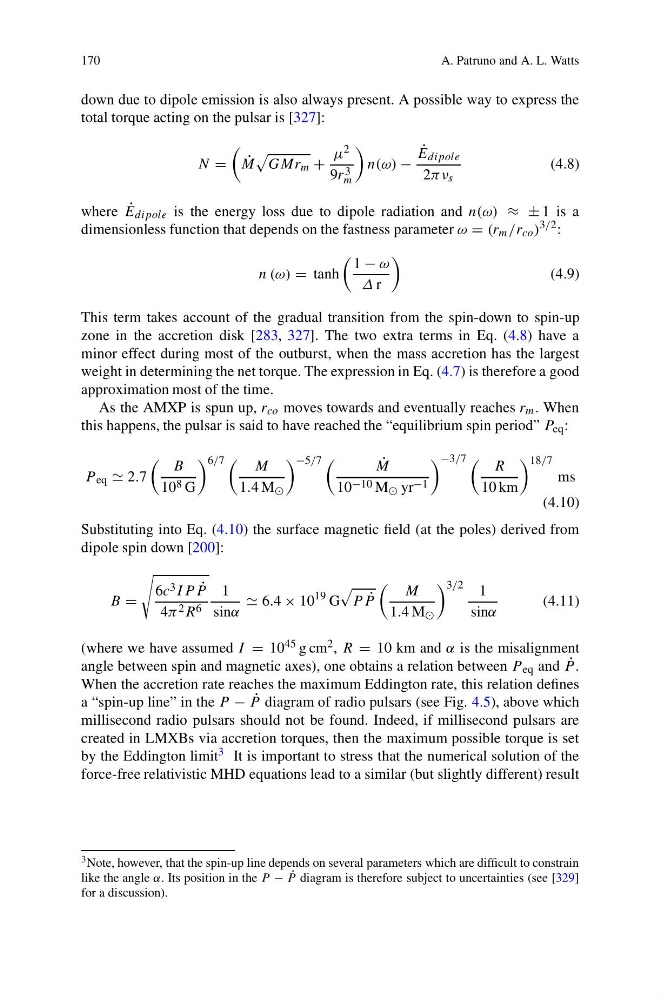
down due to dipole emission is also always present. A possible way to express the
total torque acting on the pulsar is [327]:
N =
˙
M
GMr m +
μ 2
9r 3
m
n(ω) −
˙
E dipole
2πν s
(4.8)
where ˙
E dipole is the energy loss due to dipole radiation and n(ω) ≈ ± 1 is a
dimensionless function that depends on the fastness parameter ω = (r m /r co )
3/2 :
n (ω) = tanh
1 − ω
Δ r
(4.9)
This term takes account of the gradual transition from the spin-down to spin-up
zone in the accretion disk [283, 327]. The two extra terms in Eq. (4.8) have a
minor effect during most of the outburst, when the mass accretion has the largest
weight in determining the net torque. The expression in Eq. (4.7) is therefore a good
approximation most of the time.
As the AMXP is spun up, r co moves towards and eventually reaches r m . When
this happens, the pulsar is said to have reached the “equilibrium spin period” P eq :
P eq 2.7
B
10 8 G
6/7
M
1.4 M
−5/7
˙
M
10 −10 M yr −1
−3/7
R
10 km
18/7
ms
(4.10)
Substituting into Eq. (4.10) the surface magnetic field (at the poles) derived from
dipole spin down [200]:
B =
6c 3 I P ˙
P
4π 2 R 6
1
sinα
6.4 × 10
19 G
P ˙
P
M
1.4 M
3/2 1
sinα
(4.11)
(where we have assumed I = 10 45 g cm 2 , R = 10 km and α is the misalignment
angle between spin and magnetic axes), one obtains a relation between P eq and ˙
P .
When the accretion rate reaches the maximum Eddington rate, this relation defines
a “spin-up line” in the P − ˙
P diagram of radio pulsars (see Fig. 4.5), above which
millisecond radio pulsars should not be found. Indeed, if millisecond pulsars are
created in LMXBs via accretion torques, then the maximum possible torque is set
by the Eddington limit 3 It is important to stress that the numerical solution of the
force-free relativistic MHD equations lead to a similar (but slightly different) result
3 Note, however, that the spin-up line depends on several parameters which are difficult to constrain
like the angle α. Its position in the P − ˙
P diagram is therefore subject to uncertainties (see [329]
for a discussion).
A. Patruno and A. L. Watts
down due to dipole emission is also always present. A possible way to express the
total torque acting on the pulsar is [327]:
N =
˙
M
GMr m +
μ 2
9r 3
m
n(ω) −
˙
E dipole
2πν s
(4.8)
where ˙
E dipole is the energy loss due to dipole radiation and n(ω) ≈ ± 1 is a
dimensionless function that depends on the fastness parameter ω = (r m /r co )
3/2 :
n (ω) = tanh
1 − ω
Δ r
(4.9)
This term takes account of the gradual transition from the spin-down to spin-up
zone in the accretion disk [283, 327]. The two extra terms in Eq. (4.8) have a
minor effect during most of the outburst, when the mass accretion has the largest
weight in determining the net torque. The expression in Eq. (4.7) is therefore a good
approximation most of the time.
As the AMXP is spun up, r co moves towards and eventually reaches r m . When
this happens, the pulsar is said to have reached the “equilibrium spin period” P eq :
P eq 2.7
B
10 8 G
6/7
M
1.4 M
−5/7
˙
M
10 −10 M yr −1
−3/7
R
10 km
18/7
ms
(4.10)
Substituting into Eq. (4.10) the surface magnetic field (at the poles) derived from
dipole spin down [200]:
B =
6c 3 I P ˙
P
4π 2 R 6
1
sinα
6.4 × 10
19 G
P ˙
P
M
1.4 M
3/2 1
sinα
(4.11)
(where we have assumed I = 10 45 g cm 2 , R = 10 km and α is the misalignment
angle between spin and magnetic axes), one obtains a relation between P eq and ˙
P .
When the accretion rate reaches the maximum Eddington rate, this relation defines
a “spin-up line” in the P − ˙
P diagram of radio pulsars (see Fig. 4.5), above which
millisecond radio pulsars should not be found. Indeed, if millisecond pulsars are
created in LMXBs via accretion torques, then the maximum possible torque is set
by the Eddington limit 3 It is important to stress that the numerical solution of the
force-free relativistic MHD equations lead to a similar (but slightly different) result
3 Note, however, that the spin-up line depends on several parameters which are difficult to constrain
like the angle α. Its position in the P − ˙
P diagram is therefore subject to uncertainties (see [329]
for a discussion).