

4 Accreting Millisecond X-ray Pulsars
169
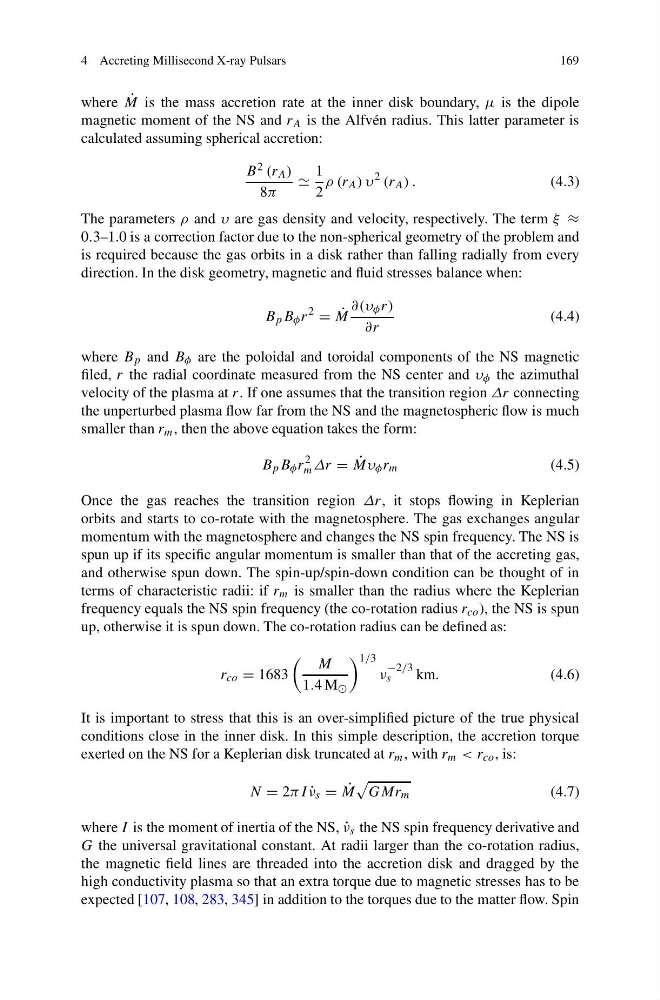
where ˙
M is the mass accretion rate at the inner disk boundary, μ is the dipole
magnetic moment of the NS and r A is the Alfvén radius. This latter parameter is
calculated assuming spherical accretion:
B 2 (r A )
8π
1
2
ρ (r A ) υ
2 (r A ) .
(4.3)
The parameters ρ and υ are gas density and velocity, respectively. The term ξ ≈
0.3–1.0 is a correction factor due to the non-spherical geometry of the problem and
is required because the gas orbits in a disk rather than falling radially from every
direction. In the disk geometry, magnetic and fluid stresses balance when:
B p B φ r
2
= ˙
M
∂(υ φ r)
∂r
(4.4)
where B p and B φ are the poloidal and toroidal components of the NS magnetic
filed, r the radial coordinate measured from the NS center and υ φ the azimuthal
velocity of the plasma at r. If one assumes that the transition region Δr connecting
the unperturbed plasma flow far from the NS and the magnetospheric flow is much
smaller than r m , then the above equation takes the form:
B p B φ r
2
m Δr = ˙
Mυ φ r m
(4.5)
Once the gas reaches the transition region Δr, it stops flowing in Keplerian
orbits and starts to co-rotate with the magnetosphere. The gas exchanges angular
momentum with the magnetosphere and changes the NS spin frequency. The NS is
spun up if its specific angular momentum is smaller than that of the accreting gas,
and otherwise spun down. The spin-up/spin-down condition can be thought of in
terms of characteristic radii: if r m is smaller than the radius where the Keplerian
frequency equals the NS spin frequency (the co-rotation radius r co ), the NS is spun
up, otherwise it is spun down. The co-rotation radius can be defined as:
r co = 1683
M
1.4 M
1/3
ν
−2/3
s
km.
(4.6)
It is important to stress that this is an over-simplified picture of the true physical
conditions close in the inner disk. In this simple description, the accretion torque
exerted on the NS for a Keplerian disk truncated at r m , with r m < r co , is:
N = 2πI ˙
ν s = ˙
M
GMr m
(4.7)
where I is the moment of inertia of the NS, ˙
ν s the NS spin frequency derivative and
G the universal gravitational constant. At radii larger than the co-rotation radius,
the magnetic field lines are threaded into the accretion disk and dragged by the
high conductivity plasma so that an extra torque due to magnetic stresses has to be
expected [107, 108, 283, 345] in addition to the torques due to the matter flow. Spin
169
where ˙
M is the mass accretion rate at the inner disk boundary, μ is the dipole
magnetic moment of the NS and r A is the Alfvén radius. This latter parameter is
calculated assuming spherical accretion:
B 2 (r A )
8π
1
2
ρ (r A ) υ
2 (r A ) .
(4.3)
The parameters ρ and υ are gas density and velocity, respectively. The term ξ ≈
0.3–1.0 is a correction factor due to the non-spherical geometry of the problem and
is required because the gas orbits in a disk rather than falling radially from every
direction. In the disk geometry, magnetic and fluid stresses balance when:
B p B φ r
2
= ˙
M
∂(υ φ r)
∂r
(4.4)
where B p and B φ are the poloidal and toroidal components of the NS magnetic
filed, r the radial coordinate measured from the NS center and υ φ the azimuthal
velocity of the plasma at r. If one assumes that the transition region Δr connecting
the unperturbed plasma flow far from the NS and the magnetospheric flow is much
smaller than r m , then the above equation takes the form:
B p B φ r
2
m Δr = ˙
Mυ φ r m
(4.5)
Once the gas reaches the transition region Δr, it stops flowing in Keplerian
orbits and starts to co-rotate with the magnetosphere. The gas exchanges angular
momentum with the magnetosphere and changes the NS spin frequency. The NS is
spun up if its specific angular momentum is smaller than that of the accreting gas,
and otherwise spun down. The spin-up/spin-down condition can be thought of in
terms of characteristic radii: if r m is smaller than the radius where the Keplerian
frequency equals the NS spin frequency (the co-rotation radius r co ), the NS is spun
up, otherwise it is spun down. The co-rotation radius can be defined as:
r co = 1683
M
1.4 M
1/3
ν
−2/3
s
km.
(4.6)
It is important to stress that this is an over-simplified picture of the true physical
conditions close in the inner disk. In this simple description, the accretion torque
exerted on the NS for a Keplerian disk truncated at r m , with r m < r co , is:
N = 2πI ˙
ν s = ˙
M
GMr m
(4.7)
where I is the moment of inertia of the NS, ˙
ν s the NS spin frequency derivative and
G the universal gravitational constant. At radii larger than the co-rotation radius,
the magnetic field lines are threaded into the accretion disk and dragged by the
high conductivity plasma so that an extra torque due to magnetic stresses has to be
expected [107, 108, 283, 345] in addition to the torques due to the matter flow. Spin