

168
A. Patruno and A. L. Watts
variations of up to 2 orders of magnitude happening within a few seconds[93, 247].
The two flux states can be described by two very different spectral models with
power-law index Γ ∼ 1.7 (high flux) and Γ ∼ 0.7 (low flux) [93]. This has been
interpreted as evidence for the onset of a propeller phase during the outburst,
rapidly alternating with a normal accretion phase [93]. A similar flickering was also
observed in quiescence[197] when the source switches from a stable low luminosity
state of ∼10 32 erg s −1 to a flickering state with luminosity ∼10 33 − 10 34 erg s −1 .
An iron K α line was also observed in the XMM-Newton spectrum [247]. Thermonuclear X-ray bursts were observed by Swift/XRT and MAXI [190, 246, 306] and
burst oscillations were later identified [251]. Archival optical observations obtained
with HST revealed a faint counterpart on April 2009 and 2010. However, on August
2009 the HST detected a blue counterpart, brighter by ∼2 mag in several filters
(F390W = 20.37±0.06, F606W = 19.51±0.04, and F656N = 17.26±0.04)[63, 237],
with a strong H α emission indicative of the presence of an accretion disk four years
before the 2013 outburst. Radio observations performed with ATCA on 2013 April
5, show a bright radio continuum counterpart (0.62 and 0.75 mJy at 5.5 and 9 GHz,
respectively) [267]. The source was last detected in X-rays on 2013 May 1 and soon
after it turned back on in radio as a millisecond pulsar [248].
4.4 Accretion Torques
Once the donor star overflows its Roche lobe, gas flowing through the inner
Lagrangian point L 1 carries large specific angular momentum and hence forms
an accretion disk around the NS. The type of disk depends on the microphysical
conditions governing the gas dynamics [106–108, 280]. If gas pressure dominates,
the disk will be geometrically thin and optically thick [106, 231, 307] with material
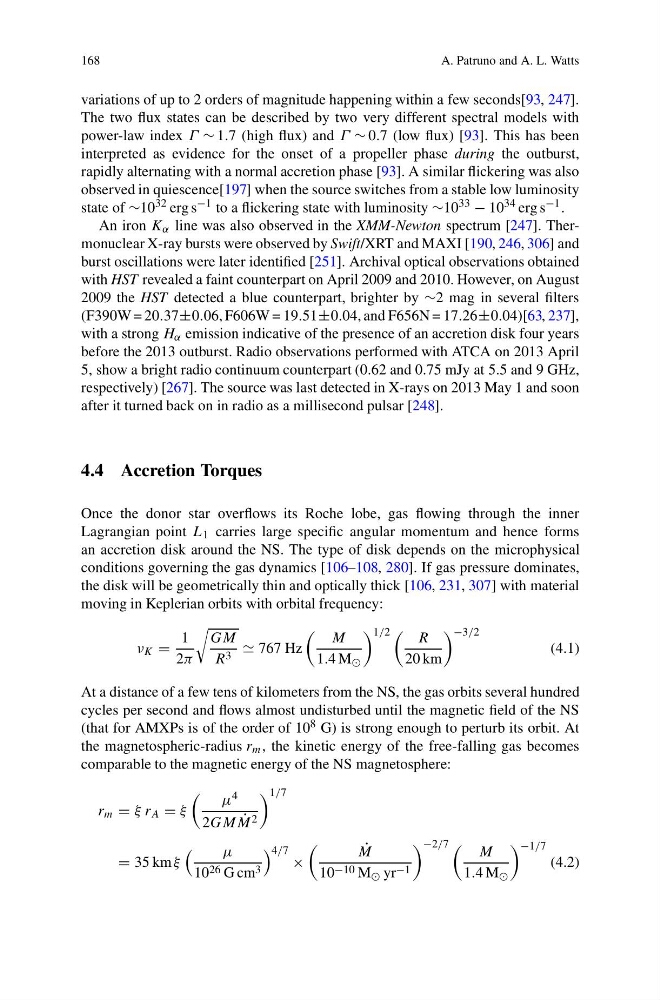
moving in Keplerian orbits with orbital frequency:
ν K =
1
2π
GM
R 3 767 Hz
M
1.4 M
1/2
R
20 km
−3/2
(4.1)
At a distance of a few tens of kilometers from the NS, the gas orbits several hundred
cycles per second and flows almost undisturbed until the magnetic field of the NS
(that for AMXPs is of the order of 10 8 G) is strong enough to perturb its orbit. At
the magnetospheric-radius r m , the kinetic energy of the free-falling gas becomes
comparable to the magnetic energy of the NS magnetosphere:
r m = ξ r A = ξ
μ 4
2GM ˙
M 2
1/7
= 35 km ξ
μ
10 26 G cm 3
4/7 ×
˙
M
10 −10 M yr −1
−2/7
M
1.4 M
−1/7
(4.2)
A. Patruno and A. L. Watts
variations of up to 2 orders of magnitude happening within a few seconds[93, 247].
The two flux states can be described by two very different spectral models with
power-law index Γ ∼ 1.7 (high flux) and Γ ∼ 0.7 (low flux) [93]. This has been
interpreted as evidence for the onset of a propeller phase during the outburst,
rapidly alternating with a normal accretion phase [93]. A similar flickering was also
observed in quiescence[197] when the source switches from a stable low luminosity
state of ∼10 32 erg s −1 to a flickering state with luminosity ∼10 33 − 10 34 erg s −1 .
An iron K α line was also observed in the XMM-Newton spectrum [247]. Thermonuclear X-ray bursts were observed by Swift/XRT and MAXI [190, 246, 306] and
burst oscillations were later identified [251]. Archival optical observations obtained
with HST revealed a faint counterpart on April 2009 and 2010. However, on August
2009 the HST detected a blue counterpart, brighter by ∼2 mag in several filters
(F390W = 20.37±0.06, F606W = 19.51±0.04, and F656N = 17.26±0.04)[63, 237],
with a strong H α emission indicative of the presence of an accretion disk four years
before the 2013 outburst. Radio observations performed with ATCA on 2013 April
5, show a bright radio continuum counterpart (0.62 and 0.75 mJy at 5.5 and 9 GHz,
respectively) [267]. The source was last detected in X-rays on 2013 May 1 and soon
after it turned back on in radio as a millisecond pulsar [248].
4.4 Accretion Torques
Once the donor star overflows its Roche lobe, gas flowing through the inner
Lagrangian point L 1 carries large specific angular momentum and hence forms
an accretion disk around the NS. The type of disk depends on the microphysical
conditions governing the gas dynamics [106–108, 280]. If gas pressure dominates,
the disk will be geometrically thin and optically thick [106, 231, 307] with material
moving in Keplerian orbits with orbital frequency:
ν K =
1
2π
GM
R 3 767 Hz
M
1.4 M
1/2
R
20 km
−3/2
(4.1)
At a distance of a few tens of kilometers from the NS, the gas orbits several hundred
cycles per second and flows almost undisturbed until the magnetic field of the NS
(that for AMXPs is of the order of 10 8 G) is strong enough to perturb its orbit. At
the magnetospheric-radius r m , the kinetic energy of the free-falling gas becomes
comparable to the magnetic energy of the NS magnetosphere:
r m = ξ r A = ξ
μ 4
2GM ˙
M 2
1/7
= 35 km ξ
μ
10 26 G cm 3
4/7 ×
˙
M
10 −10 M yr −1
−2/7
M
1.4 M
−1/7
(4.2)