

930
Appendix: All Solutions to the Problems
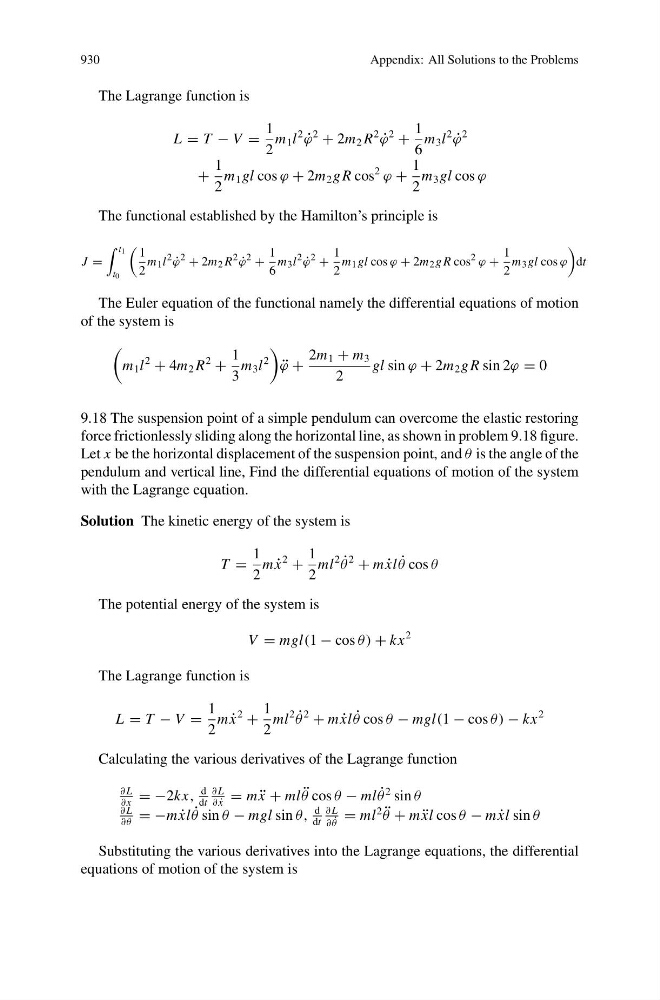
The Lagrange function is
L = T − V =
1
2
m 1 l
2
˙
ϕ
2
+ 2m 2 R
2
˙
ϕ
2
+
1
6
m 3 l
2
˙
ϕ
2
+
1
2
m 1 gl cos ϕ + 2m 2 g R cos
2
ϕ +
1
2
m 3 gl cos ϕ
The functional established by the Hamilton’s principle is
J =
t1
t0
1
2
m 1 l
2 ˙
ϕ
2 + 2m 2 R
2 ˙
ϕ
2 +
1
6
m 3 l
2 ˙
ϕ
2 +
1
2
m 1 gl cos ϕ + 2m 2 g R cos
2 ϕ +
1
2
m 3 gl cos ϕ
dt
The Euler equation of the functional namely the differential equations of motion
of the system is
m 1 l
2
+ 4m 2 R
2
+
1
3
m 3 l
2
¨
ϕ +
2m 1 + m 3
2
gl sin ϕ + 2m 2 g R sin 2ϕ = 0
9.18 The suspension point of a simple pendulum can overcome the elastic restoring
force frictionlessly sliding along the horizontal line, as shown in problem 9.18 figure.
Let x be the horizontal displacement of the suspension point, and θ is the angle of the
pendulum and vertical line, Find the differential equations of motion of the system
with the Lagrange equation.
Solution The kinetic energy of the system is
T =
1
2
m ˙
x
2
+
1
2
ml
2 ˙
θ
2
+ m ˙
xl ˙
θ cos θ
The potential energy of the system is
V = mgl(1 − cos θ) + kx
2
The Lagrange function is
L = T − V =
1
2
m ˙
x
2
+
1
2
ml
2 ˙
θ
2
+ m ˙
xl ˙
θ cos θ − mgl(1 − cos θ) − kx
2
Calculating the various derivatives of the Lagrange function
∂ L
∂ x
= −2kx,
d
dt
∂ L
∂ ˙
x
= m ¨
x + ml ¨
θ cos θ − ml ˙
θ
2 sin θ
∂ L
∂θ
= −m ˙
xl ˙
θ sin θ − mgl sin θ,
d
dt
∂ L
∂ ˙
θ
= ml
2 ¨
θ + m ¨
xl cos θ − m ˙
xl sin θ
Substituting the various derivatives into the Lagrange equations, the differential
equations of motion of the system is
Appendix: All Solutions to the Problems
The Lagrange function is
L = T − V =
1
2
m 1 l
2
˙
ϕ
2
+ 2m 2 R
2
˙
ϕ
2
+
1
6
m 3 l
2
˙
ϕ
2
+
1
2
m 1 gl cos ϕ + 2m 2 g R cos
2
ϕ +
1
2
m 3 gl cos ϕ
The functional established by the Hamilton’s principle is
J =
t1
t0
1
2
m 1 l
2 ˙
ϕ
2 + 2m 2 R
2 ˙
ϕ
2 +
1
6
m 3 l
2 ˙
ϕ
2 +
1
2
m 1 gl cos ϕ + 2m 2 g R cos
2 ϕ +
1
2
m 3 gl cos ϕ
dt
The Euler equation of the functional namely the differential equations of motion
of the system is
m 1 l
2
+ 4m 2 R
2
+
1
3
m 3 l
2
¨
ϕ +
2m 1 + m 3
2
gl sin ϕ + 2m 2 g R sin 2ϕ = 0
9.18 The suspension point of a simple pendulum can overcome the elastic restoring
force frictionlessly sliding along the horizontal line, as shown in problem 9.18 figure.
Let x be the horizontal displacement of the suspension point, and θ is the angle of the
pendulum and vertical line, Find the differential equations of motion of the system
with the Lagrange equation.
Solution The kinetic energy of the system is
T =
1
2
m ˙
x
2
+
1
2
ml
2 ˙
θ
2
+ m ˙
xl ˙
θ cos θ
The potential energy of the system is
V = mgl(1 − cos θ) + kx
2
The Lagrange function is
L = T − V =
1
2
m ˙
x
2
+
1
2
ml
2 ˙
θ
2
+ m ˙
xl ˙
θ cos θ − mgl(1 − cos θ) − kx
2
Calculating the various derivatives of the Lagrange function
∂ L
∂ x
= −2kx,
d
dt
∂ L
∂ ˙
x
= m ¨
x + ml ¨
θ cos θ − ml ˙
θ
2 sin θ
∂ L
∂θ
= −m ˙
xl ˙
θ sin θ − mgl sin θ,
d
dt
∂ L
∂ ˙
θ
= ml
2 ¨
θ + m ¨
xl cos θ − m ˙
xl sin θ
Substituting the various derivatives into the Lagrange equations, the differential
equations of motion of the system is