

Appendix: All Solutions to the Problems
929
L = T − V =
3
2
m ˙
x
2
+ ml ˙
x ˙
θ +
1
2
ml
2 ˙
θ
2
− mgl(1 − cos θ)
Calculating the various derivatives of the Lagrange function
∂ L
∂ x
= 0,
d
dt
∂ L
∂ ˙
x
= 3m ¨
x + ml ¨
θ
∂ L
∂θ
= −mgl sin θ,
d
dt
∂ L
∂ ˙
θ
= ml ¨
x + ml
2 ¨
θ
From which the differential equations of motion of the system can be obtained
3m ¨
x + ml ¨
θ = 0
ml ¨
x + ml
2 ¨
θ + mgl sin θ = 0
The above equations can be simplified as
3 ¨
x + l ¨
θ = 0
¨
x + l ¨
θ + g sin θ = 0
9.17 A plane pendulum is as shown in problem 9.17 figure, the mass of the pendulum
bob is m 1 , the swinging link mass of the homogeneous bar is m 3 , the length is of the
swing link l, hanging at the fulcrum O, it can swing in the vertical plane, another
small ball of mass m 2 smoothly fits over the swinging link, it can both slide freely
along the swing link, and can slide in the fixed cylindrical groove of radius R, the
friction is neglected. Write the differential equation of motion of the system with the
Hamilton’s principle.
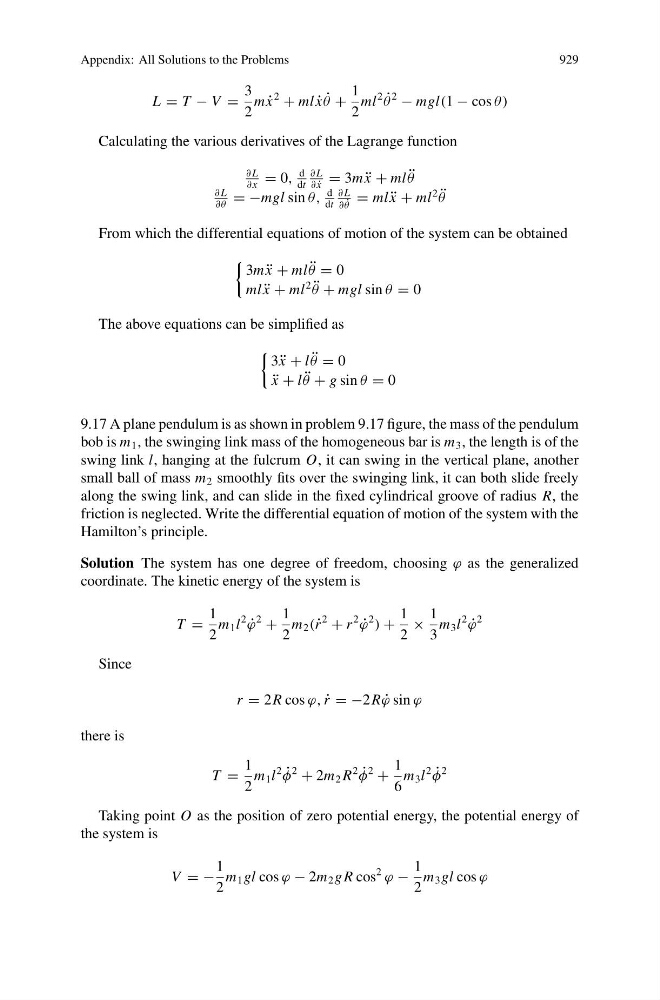
Solution The system has one degree of freedom, choosing ϕ as the generalized
coordinate. The kinetic energy of the system is
T =
1
2
m 1 l
2
˙
ϕ
2
+
1
2
m 2 (˙ r
2
+ r
2
˙
ϕ
2
) +
1
2
×
1
3
m 3 l
2
˙
ϕ
2
Since
r = 2R cos ϕ, ˙
r = −2R ˙
ϕ sin ϕ
there is
T =
1
2
m 1 l
2 ˙
φ
2
+ 2m 2 R
2 ˙
φ
2
+
1
6
m 3 l
2 ˙
φ
2
Taking point O as the position of zero potential energy, the potential energy of
the system is
V = −
1
2
m 1 gl cos ϕ − 2m 2 g R cos
2
ϕ −
1
2
m 3 gl cos ϕ
929
L = T − V =
3
2
m ˙
x
2
+ ml ˙
x ˙
θ +
1
2
ml
2 ˙
θ
2
− mgl(1 − cos θ)
Calculating the various derivatives of the Lagrange function
∂ L
∂ x
= 0,
d
dt
∂ L
∂ ˙
x
= 3m ¨
x + ml ¨
θ
∂ L
∂θ
= −mgl sin θ,
d
dt
∂ L
∂ ˙
θ
= ml ¨
x + ml
2 ¨
θ
From which the differential equations of motion of the system can be obtained
3m ¨
x + ml ¨
θ = 0
ml ¨
x + ml
2 ¨
θ + mgl sin θ = 0
The above equations can be simplified as
3 ¨
x + l ¨
θ = 0
¨
x + l ¨
θ + g sin θ = 0
9.17 A plane pendulum is as shown in problem 9.17 figure, the mass of the pendulum
bob is m 1 , the swinging link mass of the homogeneous bar is m 3 , the length is of the
swing link l, hanging at the fulcrum O, it can swing in the vertical plane, another
small ball of mass m 2 smoothly fits over the swinging link, it can both slide freely
along the swing link, and can slide in the fixed cylindrical groove of radius R, the
friction is neglected. Write the differential equation of motion of the system with the
Hamilton’s principle.
Solution The system has one degree of freedom, choosing ϕ as the generalized
coordinate. The kinetic energy of the system is
T =
1
2
m 1 l
2
˙
ϕ
2
+
1
2
m 2 (˙ r
2
+ r
2
˙
ϕ
2
) +
1
2
×
1
3
m 3 l
2
˙
ϕ
2
Since
r = 2R cos ϕ, ˙
r = −2R ˙
ϕ sin ϕ
there is
T =
1
2
m 1 l
2 ˙
φ
2
+ 2m 2 R
2 ˙
φ
2
+
1
6
m 3 l
2 ˙
φ
2
Taking point O as the position of zero potential energy, the potential energy of
the system is
V = −
1
2
m 1 gl cos ϕ − 2m 2 g R cos
2
ϕ −
1
2
m 3 gl cos ϕ