

Appendix: All Solutions to the Problems
931
m ¨
x + ml ¨
θ cos θ − ml ˙
θ
2 sin θ + 2kx = 0
ml
2 ¨
θ + m ¨
xl cos θ + mgl sin θ = 0
Eliminating ml in the second equation of the above equations, we get
m ¨
x + ml ¨
θ cos θ − ml ˙
θ
2 sin θ + 2kx = 0
¨
x cos θ + l ¨
θ + g sin θ = 0
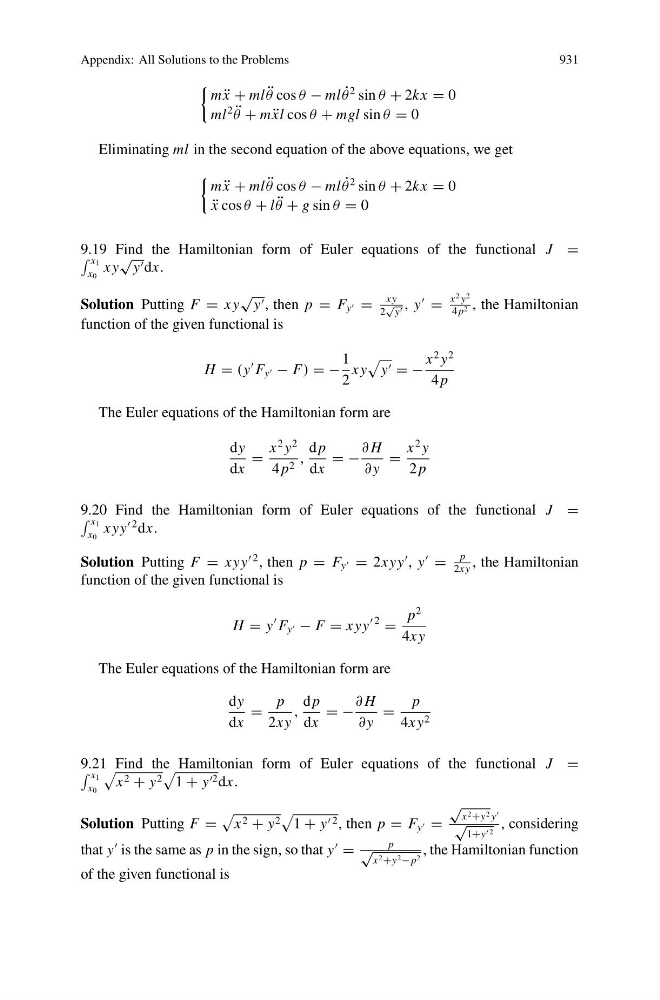
9.19 Find the Hamiltonian form of Euler equations of the functional J =
x 1
x 0
x y
√
y dx.
Solution Putting F = x y
√
y , then p = F y =
xy
2
√
y , y
=
x
2 y
2
4 p 2 , the Hamiltonian
function of the given functional is
H = (y
F y − F) = −
1
2
x y
y = −
x
2 y
2
4 p
The Euler equations of the Hamiltonian form are
dy
dx
=
x
2 y
2
4 p 2 ,
d p
dx
= −
∂ H
∂ y
=
x
2 y
2 p
9.20 Find the Hamiltonian form of Euler equations of the functional J =
x 1
x 0
x yy
2 dx.
Solution Putting F = x yy
2 , then p = F y = 2x yy
, y
=
p
2xy
, the Hamiltonian
function of the given functional is
H = y
F y − F = x yy
2
=
p
2
4x y
The Euler equations of the Hamiltonian form are
dy
dx
=
p
2x y
,
d p
dx
= −
∂ H
∂ y
=
p
4x y 2
9.21 Find the Hamiltonian form of Euler equations of the functional J =
x 1
x 0
x 2 + y 2
1 + y 2 dx.
Solution Putting F =
x 2 + y 2
1 + y 2 , then p = F y =
√
x 2 +y 2 y
√
1+y 2
, considering
that y
is the same as p in the sign, so that y
=
p
√
x 2 +y 2 − p 2
, the Hamiltonian function
of the given functional is