

Appendix: All Solutions to the Problems
923
y = Y + y
∗
= c 1 sin
k
m
t + c 2 cos
k
m
t +
a
1 − mω 2 /k
sin ωt
From the initial condition t = 0, y = 0, we get c 2 = 0, so that
y = c 1 sin
k
m
t +
a
1 − mω 2 /k
sin ωt
Deriving the above expression
y
= c 1
k
m
cos
k
m
t +
aω
1 − mω 2 /k
cos ωt
At the initial time, the velocity is zero, solving for c 1
c 1 = −
aω
1 − mω 2 /k
m
k
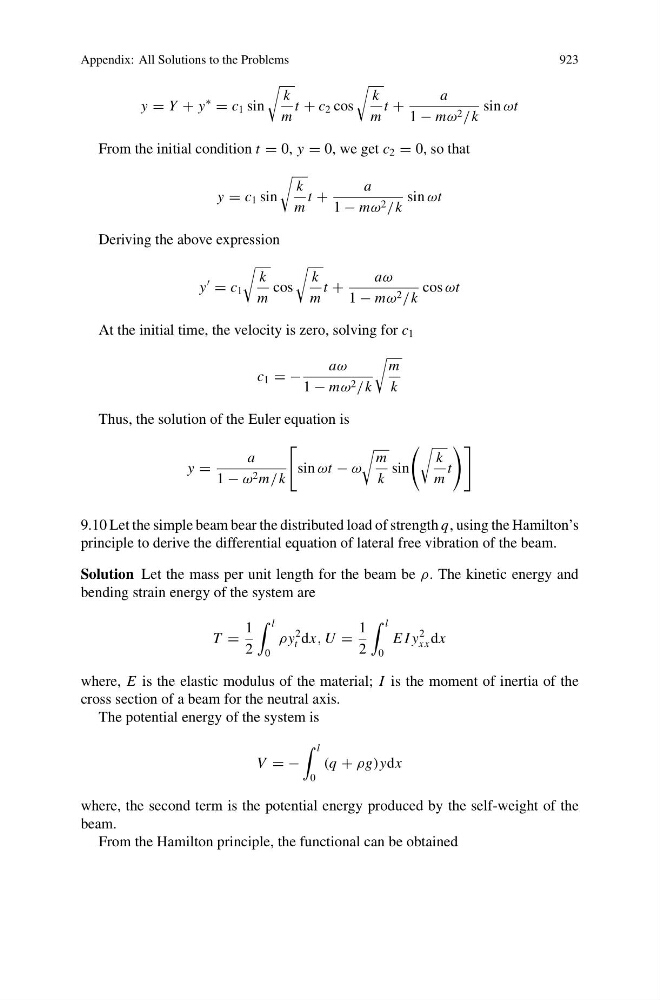
Thus, the solution of the Euler equation is
y =
a
1 − ω 2 m/k
sin ωt − ω
m
k
sin
k
m
t
9.10 Let the simple beam bear the distributed load of strength q, using the Hamilton’s
principle to derive the differential equation of lateral free vibration of the beam.
Solution Let the mass per unit length for the beam be ρ. The kinetic energy and
bending strain energy of the system are
T =
1
2
l
0
ρy
2
t dx, U =
1
2
l
0
E I y
2
xx dx
where, E is the elastic modulus of the material; I is the moment of inertia of the
cross section of a beam for the neutral axis.
The potential energy of the system is
V = −
l
0
(q + ρg)ydx
where, the second term is the potential energy produced by the self-weight of the
beam.
From the Hamilton principle, the functional can be obtained