

924
Appendix: All Solutions to the Problems
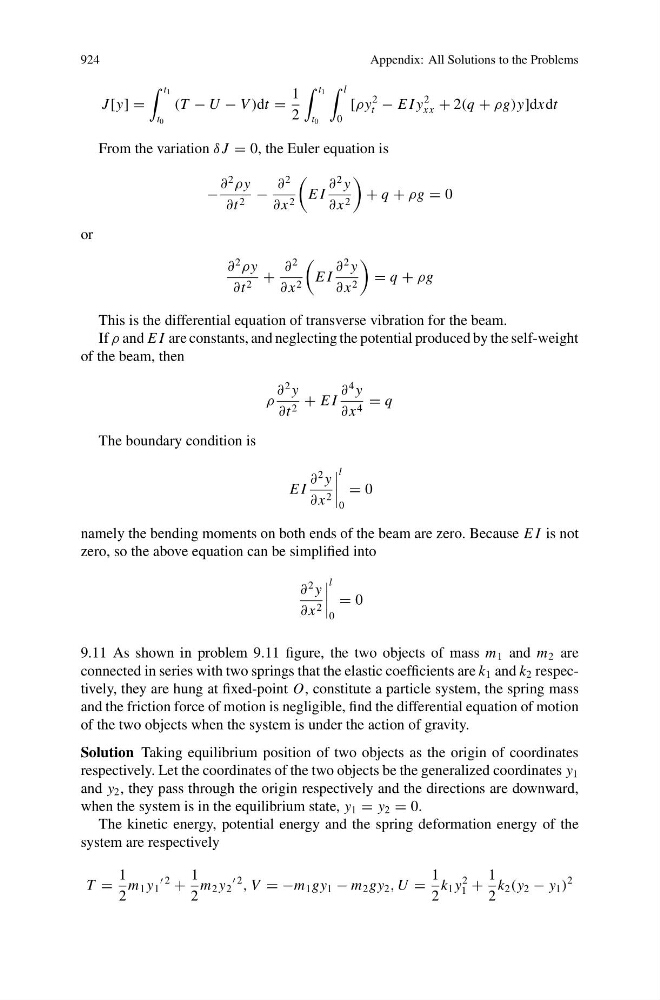
J [y] =
t 1
t 0
(T − U − V )dt =
1
2
t 1
t 0
l
0
[ρy
2
t − E I y
2
xx + 2(q + ρg)y]dxdt
From the variation δ J = 0, the Euler equation is
−
∂
2
ρy
∂t 2 −
∂
2
∂ x 2
E I
∂
2 y
∂ x 2
+ q + ρg = 0
or
∂
2
ρy
∂t 2 +
∂
2
∂ x 2
E I
∂
2 y
∂ x 2
= q + ρg
This is the differential equation of transverse vibration for the beam.
If ρ and E I are constants, and neglecting the potential produced by the self-weight
of the beam, then
ρ
∂
2 y
∂t 2 + E I
∂
4 y
∂ x 4 = q
The boundary condition is
E I
∂
2 y
∂ x 2
l
0
= 0
namely the bending moments on both ends of the beam are zero. Because E I is not
zero, so the above equation can be simplified into
∂
2 y
∂ x 2
l
0
= 0
9.11 As shown in problem 9.11 figure, the two objects of mass m 1 and m 2 are
connected in series with two springs that the elastic coefficients are k 1 and k 2 respectively, they are hung at fixed-point O, constitute a particle system, the spring mass
and the friction force of motion is negligible, find the differential equation of motion
of the two objects when the system is under the action of gravity.
Solution Taking equilibrium position of two objects as the origin of coordinates
respectively. Let the coordinates of the two objects be the generalized coordinates y 1
and y 2 , they pass through the origin respectively and the directions are downward,
when the system is in the equilibrium state, y 1 = y 2 = 0.
The kinetic energy, potential energy and the spring deformation energy of the
system are respectively
T =
1
2
m 1 y 1
2
+
1
2
m 2 y 2
2
, V = −m 1 gy 1 − m 2 gy 2 , U =
1
2
k 1 y
2
1 +
1
2
k 2 (y 2 − y 1 )
2