

922
Appendix: All Solutions to the Problems
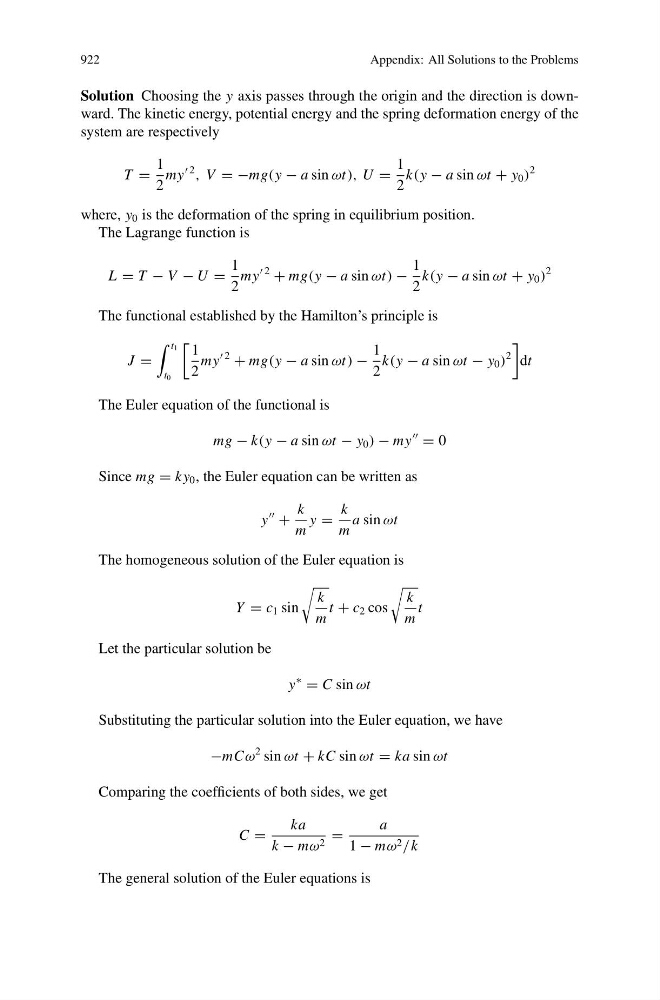
Solution Choosing the y axis passes through the origin and the direction is downward. The kinetic energy, potential energy and the spring deformation energy of the
system are respectively
T =
1
2
my
2
, V = −mg(y − a sin ωt), U =
1
2
k(y − a sin ωt + y 0 )
2
where, y 0 is the deformation of the spring in equilibrium position.
The Lagrange function is
L = T − V − U =
1
2
my
2
+ mg(y − a sin ωt) −
1
2
k(y − a sin ωt + y 0 )
2
The functional established by the Hamilton’s principle is
J =
t 1
t 0
1
2
my
2
+ mg(y − a sin ωt) −
1
2
k(y − a sin ωt − y 0 )
2
dt
The Euler equation of the functional is
mg − k(y − a sin ωt − y 0 ) − my
= 0
Since mg = ky 0 , the Euler equation can be written as
y
+
k
m
y =
k
m
a sin ωt
The homogeneous solution of the Euler equation is
Y = c 1 sin
k
m
t + c 2 cos
k
m
t
Let the particular solution be
y
∗
= C sin ωt
Substituting the particular solution into the Euler equation, we have
−mCω
2 sin ωt + kC sin ωt = ka sin ωt
Comparing the coefficients of both sides, we get
C =
ka
k − mω 2 =
a
1 − mω 2 /k
The general solution of the Euler equations is
Appendix: All Solutions to the Problems
Solution Choosing the y axis passes through the origin and the direction is downward. The kinetic energy, potential energy and the spring deformation energy of the
system are respectively
T =
1
2
my
2
, V = −mg(y − a sin ωt), U =
1
2
k(y − a sin ωt + y 0 )
2
where, y 0 is the deformation of the spring in equilibrium position.
The Lagrange function is
L = T − V − U =
1
2
my
2
+ mg(y − a sin ωt) −
1
2
k(y − a sin ωt + y 0 )
2
The functional established by the Hamilton’s principle is
J =
t 1
t 0
1
2
my
2
+ mg(y − a sin ωt) −
1
2
k(y − a sin ωt − y 0 )
2
dt
The Euler equation of the functional is
mg − k(y − a sin ωt − y 0 ) − my
= 0
Since mg = ky 0 , the Euler equation can be written as
y
+
k
m
y =
k
m
a sin ωt
The homogeneous solution of the Euler equation is
Y = c 1 sin
k
m
t + c 2 cos
k
m
t
Let the particular solution be
y
∗
= C sin ωt
Substituting the particular solution into the Euler equation, we have
−mCω
2 sin ωt + kC sin ωt = ka sin ωt
Comparing the coefficients of both sides, we get
C =
ka
k − mω 2 =
a
1 − mω 2 /k
The general solution of the Euler equations is