

Appendix: All Solutions to the Problems
921
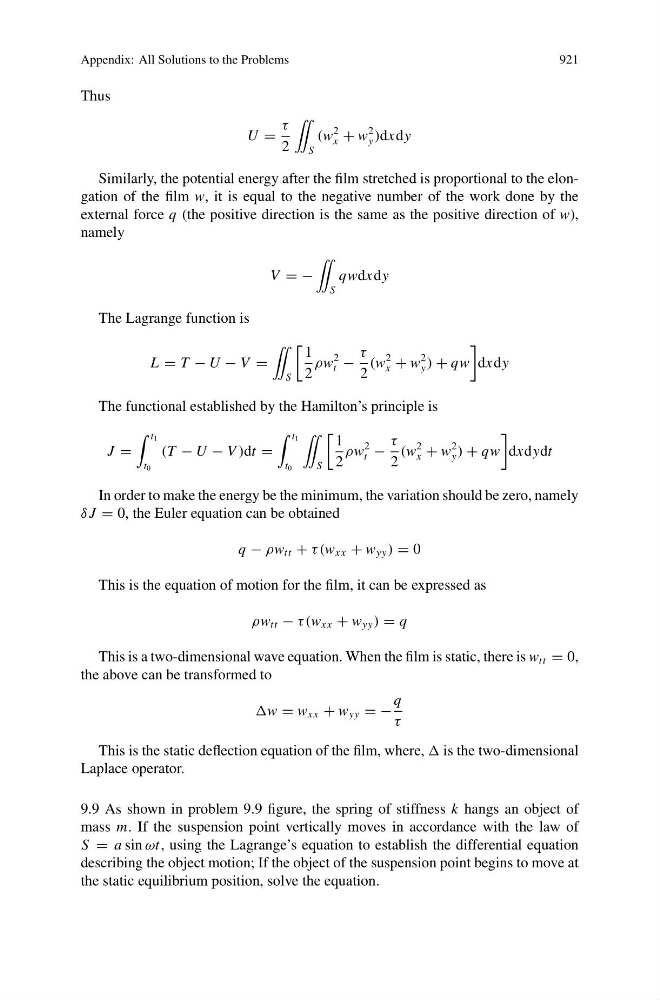
Thus
U =
τ
2
¨
S
(w
2
x + w
2
y )dxdy
Similarly, the potential energy after the film stretched is proportional to the elongation of the film w, it is equal to the negative number of the work done by the
external force q (the positive direction is the same as the positive direction of w),
namely
V = −
¨
S
qwdxdy
The Lagrange function is
L = T − U − V =
¨
S
1
2
ρw
2
t −
τ
2
(w
2
x + w
2
y ) + qw
dxdy
The functional established by the Hamilton’s principle is
J =
t 1
t 0
(T − U − V )dt =
t 1
t 0
¨
S
1
2
ρw
2
t −
τ
2
(w
2
x + w
2
y ) + qw
dxdydt
In order to make the energy be the minimum, the variation should be zero, namely
δ J = 0, the Euler equation can be obtained
q − ρw tt + τ (w xx + w yy ) = 0
This is the equation of motion for the film, it can be expressed as
ρw tt − τ (w xx + w yy ) = q
This is a two-dimensional wave equation. When the film is static, there is w tt = 0,
the above can be transformed to
w = w xx + w yy = −
q
τ
This is the static deflection equation of the film, where, is the two-dimensional
Laplace operator.
9.9 As shown in problem 9.9 figure, the spring of stiffness k hangs an object of
mass m. If the suspension point vertically moves in accordance with the law of
S = a sin ωt, using the Lagrange’s equation to establish the differential equation
describing the object motion; If the object of the suspension point begins to move at
the static equilibrium position, solve the equation.