

Appendix: All Solutions to the Problems
913
V =
∞
r
F(r )dr
The Lagrange function is
L = T − V
According to the Hamilton principle, there is
δ
t 1
t 0
Ldt = δ
t 1
t 0
(T − V )dt = 0
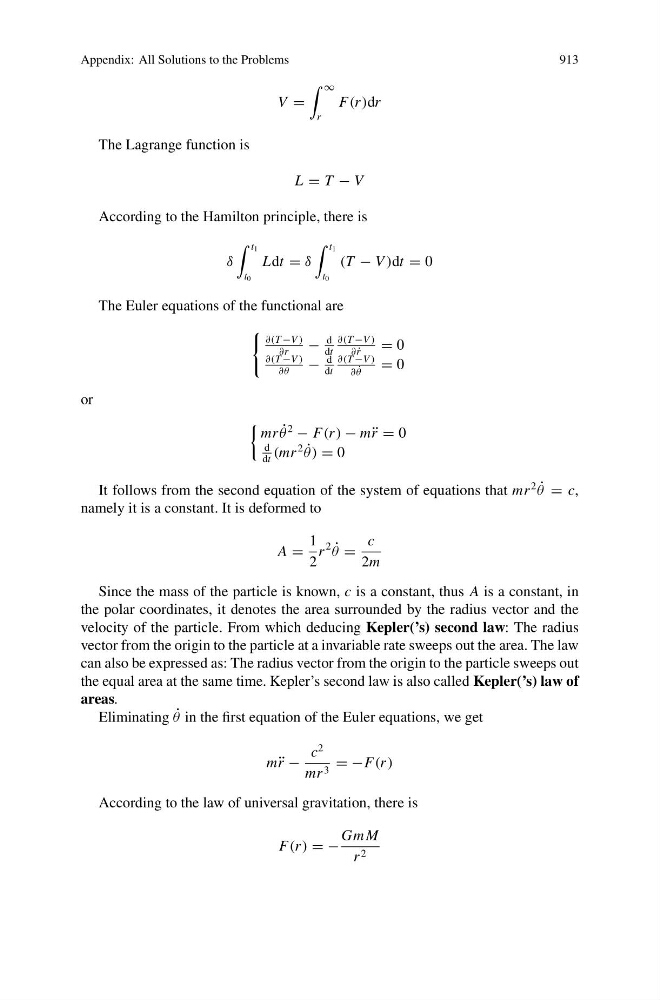
The Euler equations of the functional are
∂(T −V )
∂r
−
d
dt
∂(T −V )
∂ ˙
r
= 0
∂(T −V )
∂θ
−
d
dt
∂(T −V )
∂ ˙
θ
= 0
or
mr ˙
θ
2
− F(r ) − m ¨
r = 0
d
dt
(mr
2 ˙
θ) = 0
It follows from the second equation of the system of equations that mr
2 ˙
θ = c,
namely it is a constant. It is deformed to
A =
1
2
r
2 ˙
θ =
c
2m
Since the mass of the particle is known, c is a constant, thus A is a constant, in
the polar coordinates, it denotes the area surrounded by the radius vector and the
velocity of the particle. From which deducing Kepler(’s) second law: The radius
vector from the origin to the particle at a invariable rate sweeps out the area. The law
can also be expressed as: The radius vector from the origin to the particle sweeps out
the equal area at the same time. Kepler’s second law is also called Kepler(’s) law of
areas.
Eliminating ˙
θ in the first equation of the Euler equations, we get
m ¨
r −
c
2
mr 3 = −F(r )
According to the law of universal gravitation, there is
F(r ) = −
Gm M
r 2