

912
Appendix: All Solutions to the Problems
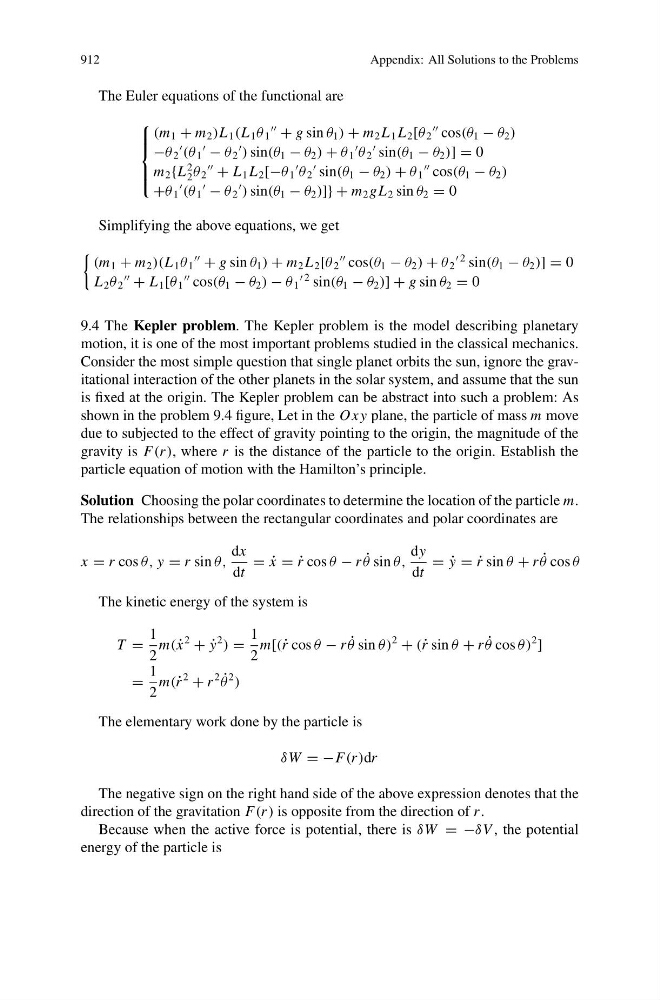
The Euler equations of the functional are
⎧
⎪ ⎪ ⎨
⎪ ⎪ ⎩
(m 1 + m 2 )L 1 (L 1 θ 1
+ g sin θ 1 ) + m 2 L 1 L 2 [θ 2
cos(θ 1 − θ 2 )
−θ 2
(θ 1
− θ 2
) sin(θ 1 − θ 2 ) + θ 1
θ 2
sin(θ 1 − θ 2 )] = 0
m 2 {L
2
2 θ 2
+ L 1 L 2 [−θ 1
θ 2
sin(θ 1 − θ 2 ) + θ 1
cos(θ 1 − θ 2 )
+θ 1
(θ 1
− θ 2
) sin(θ 1 − θ 2 )]} + m 2 gL 2 sin θ 2 = 0
Simplifying the above equations, we get
(m 1 + m 2 )(L 1 θ 1
+ g sin θ 1 ) + m 2 L 2 [θ 2
cos(θ 1 − θ 2 ) + θ 2
2 sin(θ 1 − θ 2 )] = 0
L 2 θ 2
+ L 1 [θ 1
cos(θ 1 − θ 2 ) − θ 1
2 sin(θ 1 − θ 2 )] + g sin θ 2 = 0
9.4 The Kepler problem. The Kepler problem is the model describing planetary
motion, it is one of the most important problems studied in the classical mechanics.
Consider the most simple question that single planet orbits the sun, ignore the gravitational interaction of the other planets in the solar system, and assume that the sun
is fixed at the origin. The Kepler problem can be abstract into such a problem: As
shown in the problem 9.4 figure, Let in the Ox y plane, the particle of mass m move
due to subjected to the effect of gravity pointing to the origin, the magnitude of the
gravity is F(r ), where r is the distance of the particle to the origin. Establish the
particle equation of motion with the Hamilton’s principle.
Solution Choosing the polar coordinates to determine the location of the particle m.
The relationships between the rectangular coordinates and polar coordinates are
x = r cos θ, y = r sin θ,
dx
dt
= ˙
x = ˙
r cos θ − r ˙
θ sin θ,
dy
dt
= ˙
y = ˙
r sin θ + r ˙
θ cos θ
The kinetic energy of the system is
T =
1
2
m( ˙
x
2
+ ˙
y
2
) =
1
2
m[(˙ r cos θ − r ˙
θ sin θ)
2
+ (˙ r sin θ + r ˙
θ cos θ)
2
]
=
1
2
m(˙ r
2
+ r
2 ˙
θ
2
)
The elementary work done by the particle is
δW = −F(r )dr
The negative sign on the right hand side of the above expression denotes that the
direction of the gravitation F(r ) is opposite from the direction of r .
Because when the active force is potential, there is δW = −δV , the potential
energy of the particle is