

Appendix: All Solutions to the Problems
911
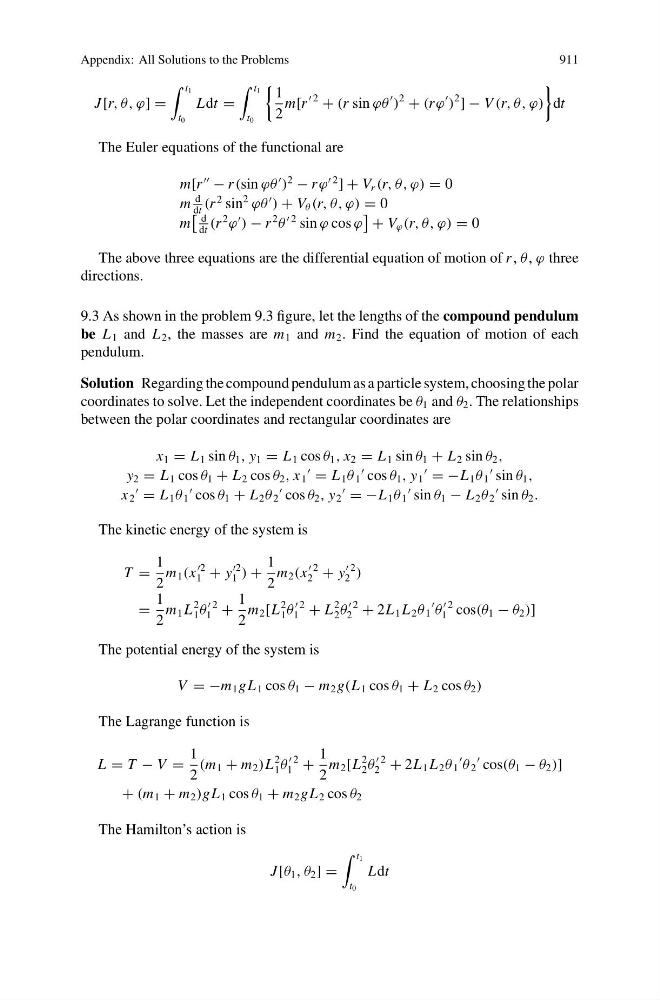
J [r, θ, ϕ] =
t 1
t 0
Ldt =
t 1
t 0
1
2
m[r
2
+ (r sin ϕθ
)
2
+ (r ϕ
)
2
] − V (r, θ, ϕ)
dt
The Euler equations of the functional are
m[r
− r (sin ϕθ
)
2
− r ϕ
2
] + V r (r, θ, ϕ) = 0
m
d
dt
(r
2 sin
2
ϕθ
) + V θ (r, θ, ϕ) = 0
m
d
dt
(r
2
ϕ
) − r
2
θ
2 sin ϕ cos ϕ
+ V ϕ (r, θ, ϕ) = 0
The above three equations are the differential equation of motion of r , θ , ϕ three
directions.
9.3 As shown in the problem 9.3 figure, let the lengths of the compound pendulum
be L 1 and L 2 , the masses are m 1 and m 2 . Find the equation of motion of each
pendulum.
Solution Regarding the compound pendulum as a particle system, choosing the polar
coordinates to solve. Let the independent coordinates be θ 1 and θ 2 . The relationships
between the polar coordinates and rectangular coordinates are
x 1 = L 1 sin θ 1 , y 1 = L 1 cos θ 1 , x 2 = L 1 sin θ 1 + L 2 sin θ 2 ,
y 2 = L 1 cos θ 1 + L 2 cos θ 2 , x 1
= L 1 θ 1
cos θ 1 , y 1
= −L 1 θ 1
sin θ 1 ,
x 2
= L 1 θ 1
cos θ 1 + L 2 θ 2
cos θ 2 , y 2
= −L 1 θ 1
sin θ 1 − L 2 θ 2
sin θ 2 .
The kinetic energy of the system is
T =
1
2
m 1 (x
2
1 + y
2
1 ) +
1
2
m 2 (x
2
2 + y
2
2 )
=
1
2
m 1 L
2
1 θ
2
1 +
1
2
m 2 [L
2
1 θ
2
1 + L
2
2 θ
2
2 + 2L 1 L 2 θ 1
θ
2
1 cos(θ 1 − θ 2 )]
The potential energy of the system is
V = −m 1 gL 1 cos θ 1 − m 2 g(L 1 cos θ 1 + L 2 cos θ 2 )
The Lagrange function is
L = T − V =
1
2
(m 1 + m 2 )L
2
1 θ
2
1 +
1
2
m 2 [L
2
2 θ
2
2 + 2L 1 L 2 θ 1
θ 2
cos(θ 1 − θ 2 )]
+ (m 1 + m 2 )gL 1 cos θ 1 + m 2 gL 2 cos θ 2
The Hamilton’s action is
J [θ 1 , θ 2 ] =
t 1
t 0
Ldt