

914
Appendix: All Solutions to the Problems
where, G is the gravitational constant; m is the mass of the planet; M is the mass
of the sun.
9.5 The longitudinal vibration equation of an elastic rod. Let the uniform rod of
length l be laid on the Ox axis, the linear density is ρ, because the rod has elasticity,
the axial force is removed, it will move along the Ox axis direction, Establish the
differential equation of motion of the rod.
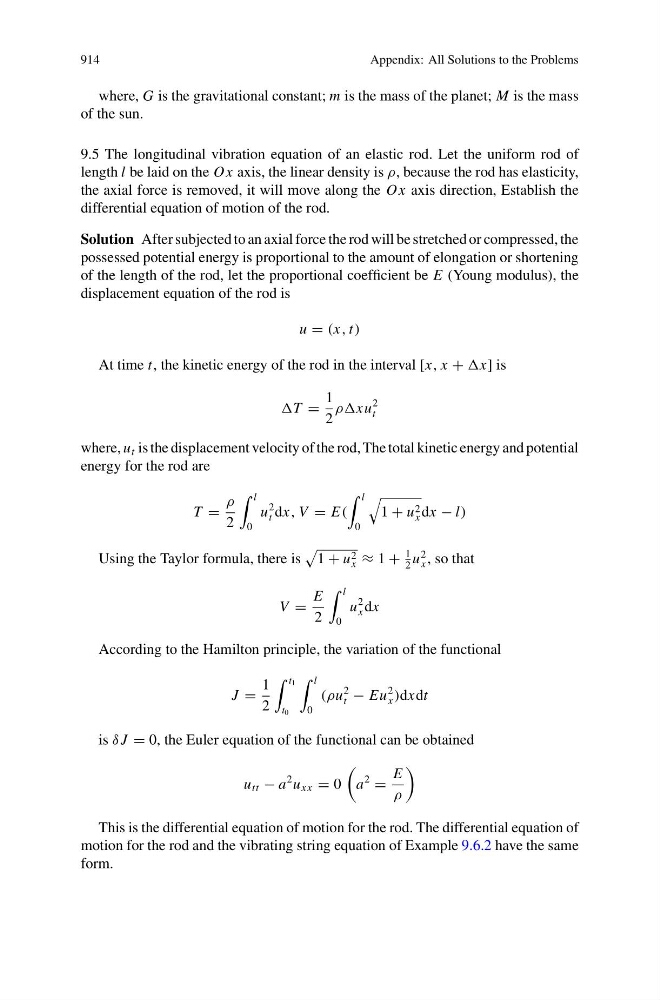
Solution After subjected to an axial force the rod will be stretched or compressed, the
possessed potential energy is proportional to the amount of elongation or shortening
of the length of the rod, let the proportional coefficient be E (Young modulus), the
displacement equation of the rod is
u = (x, t)
At time t, the kinetic energy of the rod in the interval [x, x + x] is
T =
1
2
ρρxu
2
t
where, u t is the displacement velocity of the rod, The total kinetic energy and potential
energy for the rod are
T =
ρ
2
l
0
u
2
t dx, V = E(
l
0
1 + u 2
x dx − l)
Using the Taylor formula, there is
1 + u 2
x ≈ 1 +
1
2
u
2
x , so that
V =
E
2
l
0
u
2
x dx
According to the Hamilton principle, the variation of the functional
J =
1
2
t 1
t 0
l
0
(ρu
2
t − Eu
2
x )dxdt
is δ J = 0, the Euler equation of the functional can be obtained
u tt − a
2 u xx = 0
a
2
=
E
ρ
This is the differential equation of motion for the rod. The differential equation of
motion for the rod and the vibrating string equation of Example 9.6.2 have the same
form.