

Appendix: All Solutions to the Problems
885
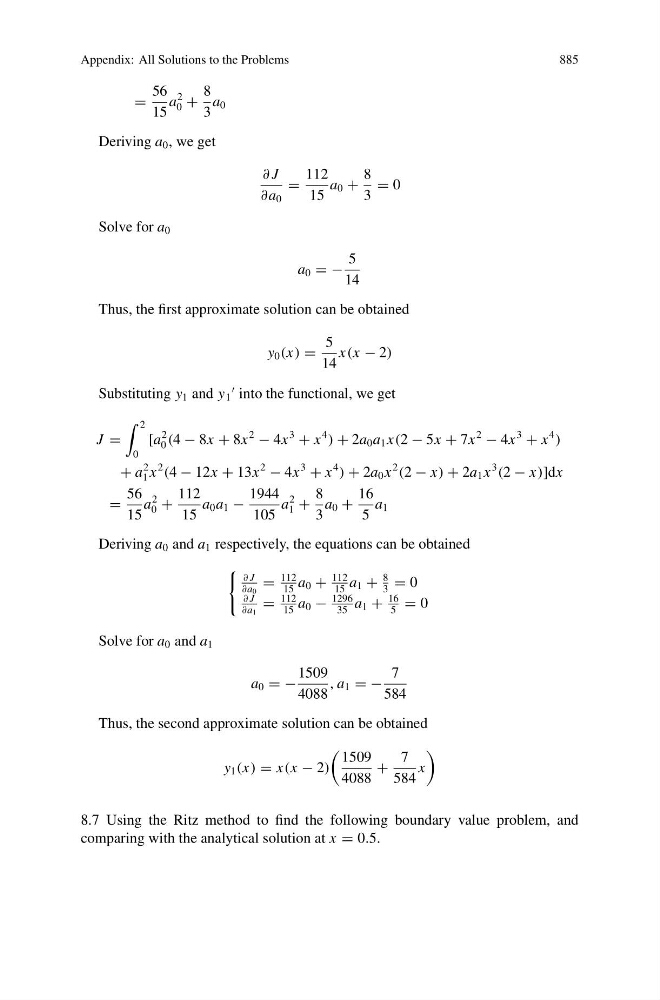
=
56
15
a
2
0 +
8
3
a 0
Deriving a 0 , we get
∂ J
∂a 0
=
112
15
a 0 +
8
3
= 0
Solve for a 0
a 0 = −
5
14
Thus, the first approximate solution can be obtained
y 0 (x) =
5
14
x(x − 2)
Substituting y 1 and y 1
into the functional, we get
J =
2
0
[a
2
0 (4 − 8x + 8x
2
− 4x
3
+ x
4
) + 2a 0 a 1 x(2 − 5x + 7x
2
− 4x
3
+ x
4
)
+ a
2
1 x
2
(4 − 12x + 13x
2
− 4x
3
+ x
4
) + 2a 0 x
2
(2 − x) + 2a 1 x
3
(2 − x)]dx
=
56
15
a
2
0 +
112
15
a 0 a 1 −
1944
105
a
2
1 +
8
3
a 0 +
16
5
a 1
Deriving a 0 and a 1 respectively, the equations can be obtained
∂ J
∂a 0
=
112
15
a 0 +
112
15
a 1 +
8
3
= 0
∂ J
∂a 1
=
112
15
a 0 −
1296
35
a 1 +
16
5
= 0
Solve for a 0 and a 1
a 0 = −
1509
4088
, a 1 = −
7
584
Thus, the second approximate solution can be obtained
y 1 (x) = x(x − 2)
1509
4088
+
7
584
x
8.7 Using the Ritz method to find the following boundary value problem, and
comparing with the analytical solution at x = 0.5.