

884
Appendix: All Solutions to the Problems
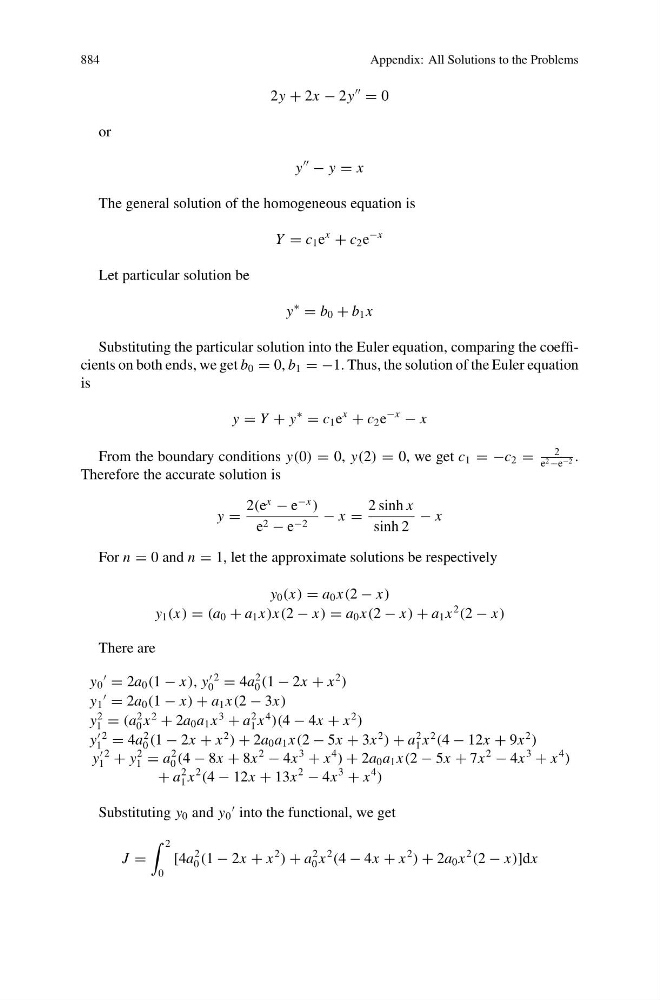
2y + 2x − 2y
= 0
or
y
− y = x
The general solution of the homogeneous equation is
Y = c 1 e
x
+ c 2 e
−x
Let particular solution be
y
∗
= b 0 + b 1 x
Substituting the particular solution into the Euler equation, comparing the coefficients on both ends, we get b 0 = 0, b 1 = −1. Thus, the solution of the Euler equation
is
y = Y + y
∗
= c 1 e
x
+ c 2 e
−x
− x
From the boundary conditions y(0) = 0, y(2) = 0, we get c 1 = −c 2 =
2
e 2 −e −2 .
Therefore the accurate solution is
y =
2(e
x
− e
−x
)
e 2 − e −2 − x =
2 sinh x
sinh 2
− x
For n = 0 and n = 1, let the approximate solutions be respectively
y 0 (x) = a 0 x(2 − x)
y 1 (x) = (a 0 + a 1 x)x(2 − x) = a 0 x(2 − x) + a 1 x
2
(2 − x)
There are
y 0
= 2a 0 (1 − x), y
2
0 = 4a
2
0 (1 − 2x + x
2
)
y 1
= 2a 0 (1 − x) + a 1 x(2 − 3x)
y
2
1 = (a
2
0 x
2
+ 2a 0 a 1 x
3
+ a
2
1 x
4
)(4 − 4x + x
2
)
y
2
1 = 4a
2
0 (1 − 2x + x
2
) + 2a 0 a 1 x(2 − 5x + 3x
2
) + a
2
1 x
2
(4 − 12x + 9x
2
)
y
2
1 + y
2
1 = a
2
0 (4 − 8x + 8x
2
− 4x
3
+ x
4
) + 2a 0 a 1 x(2 − 5x + 7x
2
− 4x
3
+ x
4
)
+ a
2
1 x
2
(4 − 12x + 13x
2
− 4x
3
+ x
4
)
Substituting y 0 and y 0
into the functional, we get
J =
2
0
[4a
2
0 (1 − 2x + x
2
) + a
2
0 x
2
(4 − 4x + x
2
) + 2a 0 x
2
(2 − x)]dx