

Appendix: All Solutions to the Problems
871
Because the minimum of p(x) in the interval x 0 ≤ x ≤ x 1 is p m (≥ 0), the
minimum of q(x) in the interval x 0 ≤ x ≤ x 1 is q m (≥ 0), there is
x 1
x 0
p(x)y
2 dx ≥ p m
x 1
x 0
y
2 dx
(2)
x 1
x 0
q(x)y
2 dx ≥ q m
x 1
x 0
y
2 dx
(3)
According to the Schwarz inequality, there is
x 1
x 0
p(x)y
2 dx ≥
2 p m
(x 1 − x 0 ) 2
x 1
x 0
y
2 dx
(4)
Substituting Eqs. (3) and (4) into Eq. (1), we have
(T y, y) ≥
2 p m
(x 1 − x 0 ) 2 + q m
x 1
x 0
y
2 dx
(5)
Putting
r
2
=
2 p m
(x 1 − x 0 ) 2 + q m ≥ 0
( 6 )
then
(T y, y) ≥ r
2
x 1
x 0
y
2 dx = r
2
(y, y)
(7)
Quod erat demonstrandum.
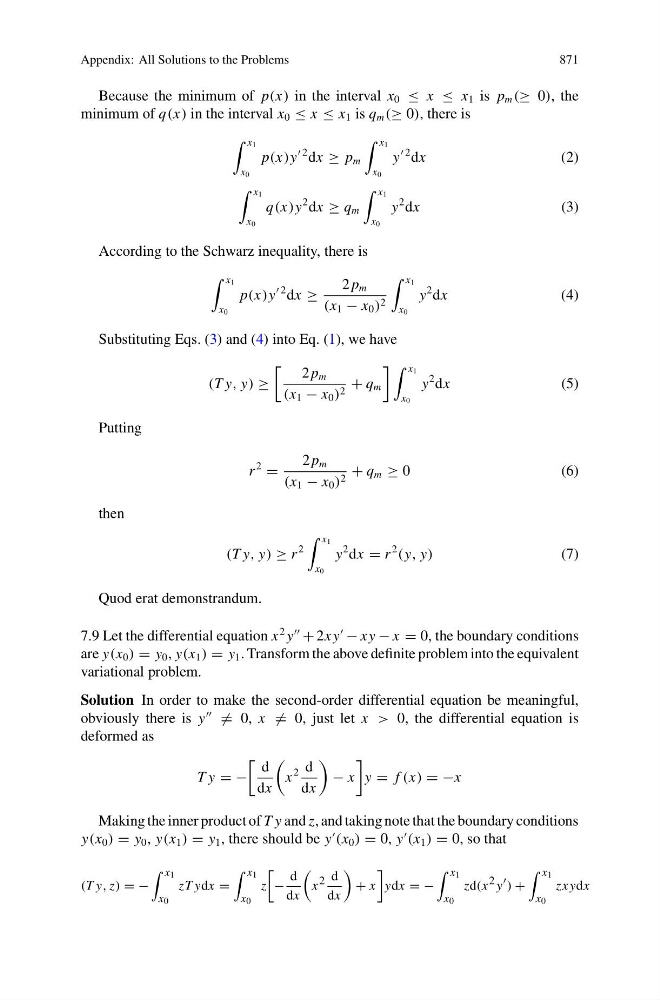
7.9 Let the differential equation x
2 y
+ 2x y
− x y − x = 0, the boundary conditions
are y(x 0 ) = y 0 , y(x 1 ) = y 1 . Transform the above definite problem into the equivalent
variational problem.
Solution In order to make the second-order differential equation be meaningful,
obviously there is y
= 0, x = 0, just let x > 0, the differential equation is
deformed as
T y = −
d
dx
x
2 d
dx
− x
y = f (x) = −x
Making the inner product of T y and z, and taking note that the boundary conditions
y(x 0 ) = y 0 , y(x 1 ) = y 1 , there should be y
(x 0 ) = 0, y
(x 1 ) = 0, so that
(T y, z) = −
x 1
x 0
zT ydx =
x 1
x 0
z
−
d
dx
x 2 d
dx
+ x
ydx = −
x 1
x 0
zd(x 2 y ) +
x 1
x 0
zx ydx