

870
Appendix: All Solutions to the Problems
Γ
v
∂
∂n
( p∇
2 u) − u
∂
∂n
( p∇
2 v) + p∇
2 v
∂u
∂n
− p∇
2 u
∂v
∂n
dΓ = 0
where, v ∈ D T ,
∂
∂n
(·) is the outward normal directional derivative of the boundary
Γ of D.
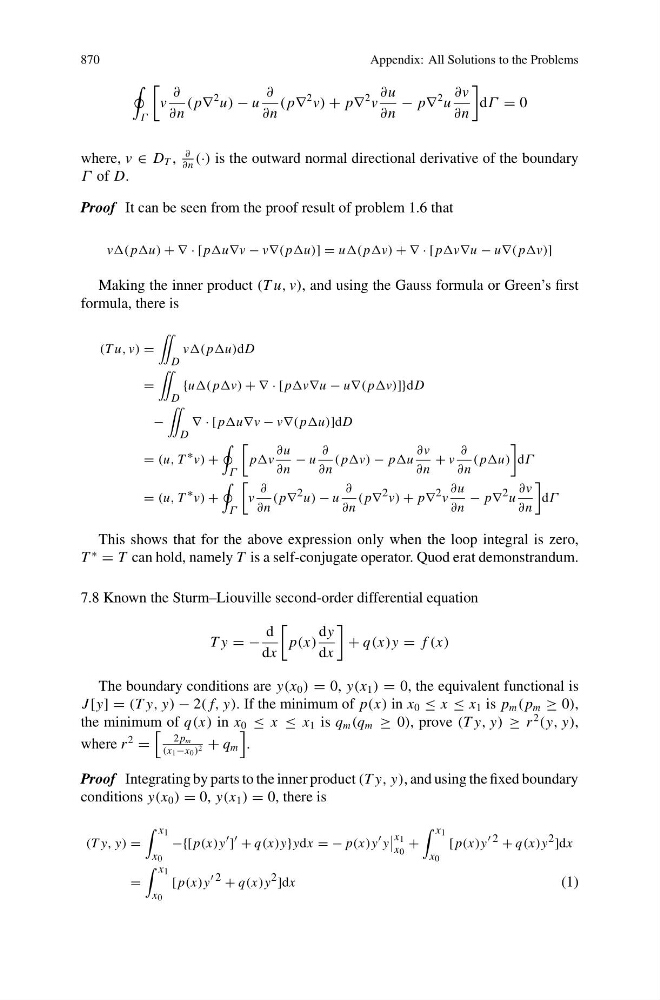
Proof It can be seen from the proof result of problem 1.6 that
v( pu) + ∇ · [pu∇v − v∇( pu)] = u( pv) + ∇ · [pv∇u − u∇( pv)]
Making the inner product (T u, v), and using the Gauss formula or Green’s first
formula, there is
(T u, v) =
¨
D
v( pu)dD
=
¨
D
{u( pv) + ∇ · [pv∇u − u∇( pv)]}dD
−
¨
D
∇ · [pu∇v − v∇( pu)]dD
= (u, T ∗ v) +
Γ
pv
∂u
∂n
− u
∂
∂n
( pv) − pu
∂v
∂n
+ v
∂
∂n
( pu)
dΓ
= (u, T ∗ v) +
Γ
v
∂
∂n
( p∇ 2 u) − u
∂
∂n
( p∇ 2 v) + p∇ 2 v
∂u
∂n
− p∇ 2 u
∂v
∂n
dΓ
This shows that for the above expression only when the loop integral is zero,
T
∗
= T can hold, namely T is a self-conjugate operator. Quod erat demonstrandum.
7.8 Known the Sturm–Liouville second-order differential equation
T y = −
d
dx
p(x)
dy
dx
+ q(x)y = f (x)
The boundary conditions are y(x 0 ) = 0, y(x 1 ) = 0, the equivalent functional is
J [y] = (T y, y) − 2( f, y). If the minimum of p(x) in x 0 ≤ x ≤ x 1 is p m ( p m ≥ 0),
the minimum of q(x) in x 0 ≤ x ≤ x 1 is q m (q m ≥ 0), prove (T y, y) ≥ r
2
(y, y),
where r
2
=
2 p m
(x 1 −x 0 ) 2 + q m
.
Proof Integrating by parts to the inner product (T y, y), and using the fixed boundary
conditions y(x 0 ) = 0, y(x 1 ) = 0, there is
(T y, y) =
x 1
x 0
−{[ p(x)y ] + q(x)y}ydx = − p(x)y y
x 1
x 0
+
x 1
x 0
[ p(x)y 2 + q(x)y 2 ]dx
=
x 1
x 0
[ p(x)y 2 + q(x)y 2 ]dx
(1)