

Appendix: All Solutions to the Problems
869
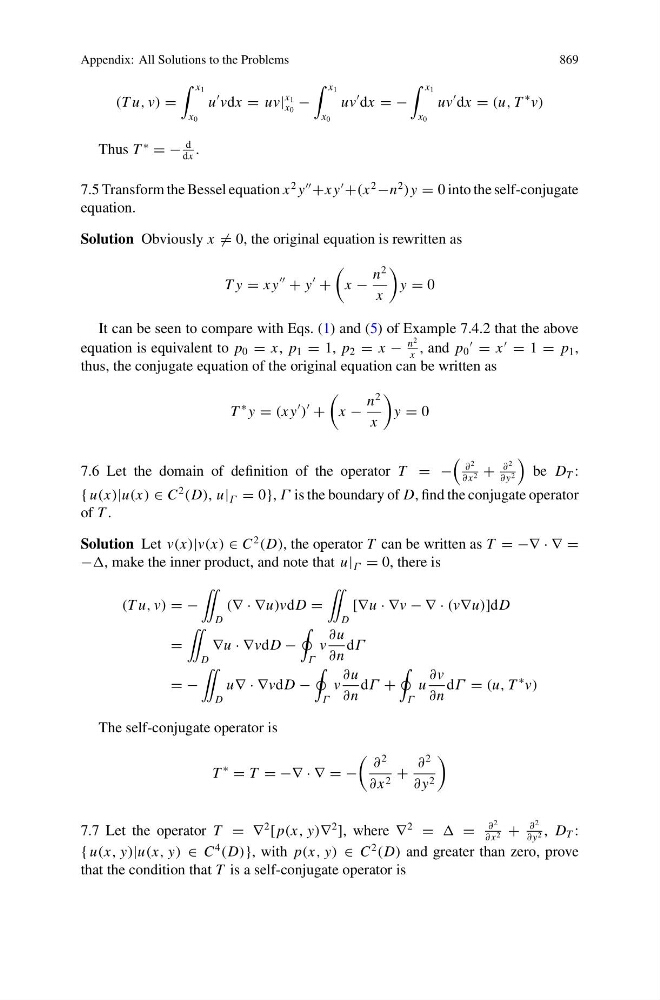
(T u, v) =
x 1
x 0
u
vdx = uv|
x 1
x 0
−
x 1
x 0
uv
dx = −
x 1
x 0
uv
dx = (u, T
∗ v)
Thus T
∗
= −
d
dx
.
7.5 Transform the Bessel equation x
2 y
+x y
+(x
2
−n
2
)y = 0 into the self-conjugate
equation.
Solution Obviously x = 0, the original equation is rewritten as
T y = x y
+ y
+
x −
n
2
x
y = 0
It can be seen to compare with Eqs. (1) and (5) of Example 7.4.2 that the above
equation is equivalent to p 0 = x, p 1 = 1, p 2 = x −
n
2
x
, and p 0
= x
= 1 = p 1 ,
thus, the conjugate equation of the original equation can be written as
T
∗ y = (x y
)
+
x −
n
2
x
y = 0
7.6 Let the domain of definition of the operator T = −
∂
2
∂ x 2 +
∂
2
∂ y 2
be D T :
{ u(x)|u(x) ∈ C
2
(D), u| Γ = 0}, Γ is the boundary of D, find the conjugate operator
of T .
Solution Let v(x)|v(x) ∈ C
2
(D), the operator T can be written as T = −∇ · ∇ =
−, make the inner product, and note that u| Γ = 0, there is
(T u, v) = −
¨
D
(∇ · ∇u)vdD =
¨
D
[∇u · ∇v − ∇ · (v∇u)]dD
=
¨
D
∇u · ∇vdD −
Γ
v
∂u
∂n
dΓ
= −
¨
D
u∇ · ∇vdD −
Γ
v
∂u
∂n
dΓ +
Γ
u
∂v
∂n
dΓ = (u, T
∗ v)
The self-conjugate operator is
T
∗
= T = −∇ · ∇ = −
∂
2
∂ x 2 +
∂
2
∂ y 2
7.7 Let the operator T = ∇
2
[ p(x, y)∇
2
], where ∇
2
= =
∂
2
∂ x 2 +
∂
2
∂ y 2 , D T :
{ u(x, y)|u(x, y) ∈ C
4
(D)}, with p(x, y) ∈ C
2
(D) and greater than zero, prove
that the condition that T is a self-conjugate operator is