

872
Appendix: All Solutions to the Problems
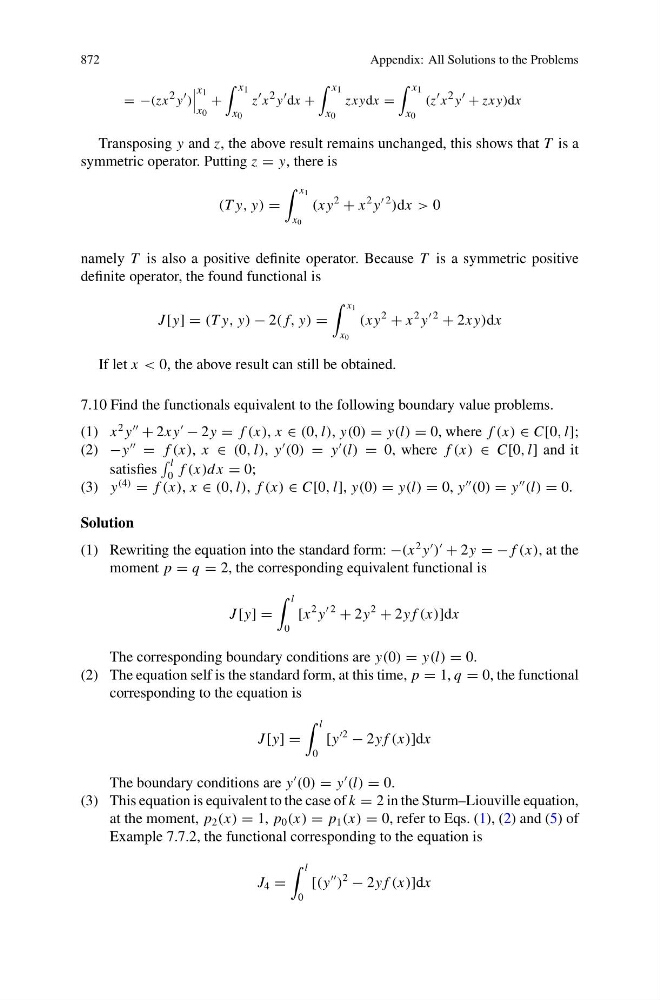
= −(zx 2 y )
x 1
x 0
+
x 1
x 0
z x 2 y dx +
x 1
x 0
zx ydx =
x 1
x 0
(z x 2 y + zx y)dx
Transposing y and z, the above result remains unchanged, this shows that T is a
symmetric operator. Putting z = y, there is
(T y, y) =
x 1
x 0
(x y
2
+ x
2 y
2
)dx > 0
namely T is also a positive definite operator. Because T is a symmetric positive
definite operator, the found functional is
J [y] = (T y, y) − 2( f, y) =
x 1
x 0
(x y
2
+ x
2 y
2
+ 2x y)dx
If let x < 0, the above result can still be obtained.
7.10 Find the functionals equivalent to the following boundary value problems.
(1) x
2 y
+ 2x y
− 2y = f (x), x ∈ (0, l), y(0) = y(l) = 0, where f (x) ∈ C[0, l];
(2) −y
= f (x), x ∈ (0, l), y
(0) = y
(l) = 0, where f (x) ∈ C[0, l] and it
satisfies
l
0 f (x)dx = 0;
(3) y
(4)
= f (x), x ∈ (0, l), f (x) ∈ C[0, l], y(0) = y(l) = 0, y
(0) = y
(l) = 0.
Solution
(1) Rewriting the equation into the standard form: −(x
2 y
)
+ 2y = − f (x), at the
moment p = q = 2, the corresponding equivalent functional is
J [y] =
l
0
[x
2 y
2
+ 2y
2
+ 2y f (x)]dx
The corresponding boundary conditions are y(0) = y(l) = 0.
(2) The equation self is the standard form, at this time, p = 1, q = 0, the functional
corresponding to the equation is
J [y] =
l
0
[y
2
− 2y f (x)]dx
The boundary conditions are y
(0) = y
(l) = 0.
(3) This equation is equivalent to the case of k = 2 in the Sturm–Liouville equation,
at the moment, p 2 (x) = 1, p 0 (x) = p 1 (x) = 0, refer to Eqs. (1), (2) and (5) of
Example 7.7.2, the functional corresponding to the equation is
J 4 =
l
0
[(y
)
2
− 2y f (x)]dx