

Appendix: All Solutions to the Problems
837
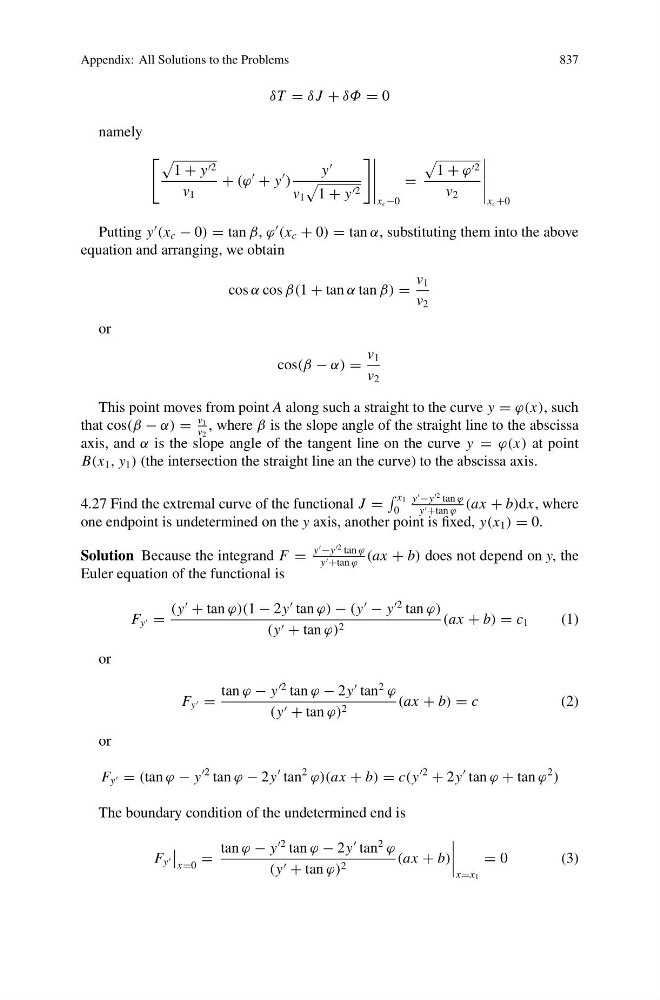
δT = δ J + δΦ = 0
namely
1 + y 2
v 1
+ (ϕ
+ y
)
y
v 1
1 + y 2
x c −0
=
1 + ϕ 2
v 2
x c +0
Putting y
(x c − 0) = tan β, ϕ
(x c + 0) = tan α, substituting them into the above
equation and arranging, we obtain
cos α cos β(1 + tan α tan β) =
v 1
v 2
or
cos(β − α) =
v 1
v 2
This point moves from point A along such a straight to the curve y = ϕ(x), such
that cos(β − α) =
v 1
v 2
, where β is the slope angle of the straight line to the abscissa
axis, and α is the slope angle of the tangent line on the curve y = ϕ(x) at point
B(x 1 , y 1 ) (the intersection the straight line an the curve) to the abscissa axis.
4.27 Find the extremal curve of the functional J =
x 1
0
y
−y
2 tan ϕ
y +tan ϕ
(ax + b)dx, where
one endpoint is undetermined on the y axis, another point is fixed, y(x 1 ) = 0.
Solution Because the integrand F =
y
−y
2 tan ϕ
y +tan ϕ
(ax + b) does not depend on y, the
Euler equation of the functional is
F y =
(y
+ tan ϕ)(1 − 2y
tan ϕ) − (y
− y
2 tan ϕ)
(y + tan ϕ) 2
(ax + b) = c 1
(1)
or
F y =
tan ϕ − y
2 tan ϕ − 2y
tan
2
ϕ
(y + tan ϕ) 2
(ax + b) = c
(2)
or
F y = (tan ϕ − y
2 tan ϕ − 2y
tan
2
ϕ)(ax + b) = c(y
2
+ 2y
tan ϕ + tan ϕ
2
)
The boundary condition of the undetermined end is
F y
x=0
=
tan ϕ − y
2 tan ϕ − 2y
tan
2
ϕ
(y + tan ϕ) 2
(ax + b)
x=x 1
= 0
( 3 )