

836
Appendix: All Solutions to the Problems
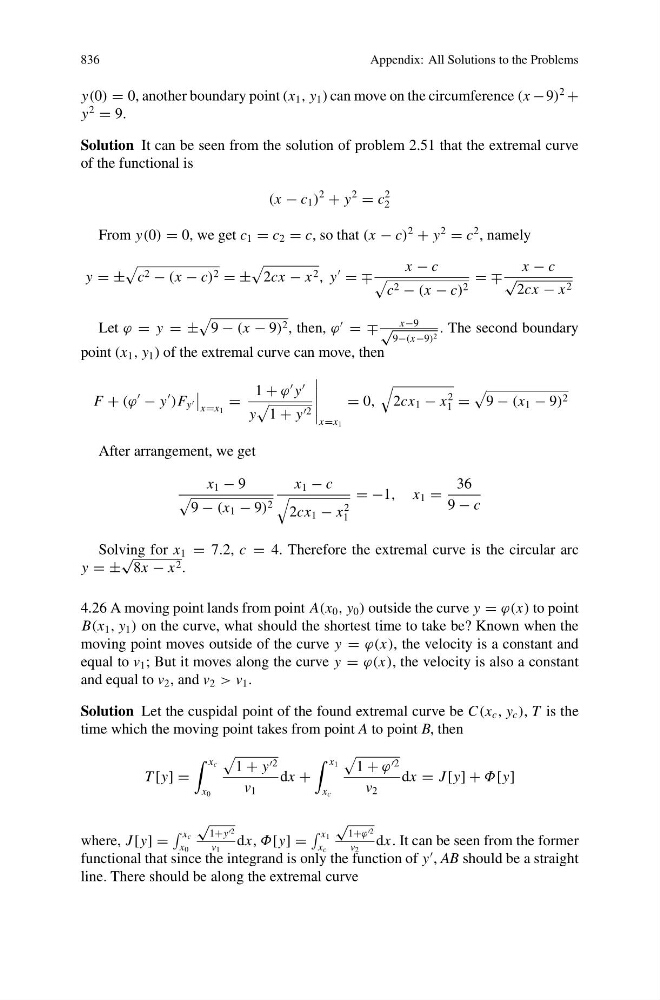
y(0) = 0, another boundary point (x 1 , y 1 ) can move on the circumference (x − 9)
2
+
y
2
= 9.
Solution It can be seen from the solution of problem 2.51 that the extremal curve
of the functional is
(x − c 1 )
2
+ y
2
= c
2
2
From y(0) = 0, we get c 1 = c 2 = c, so that (x − c)
2
+ y
2
= c
2 , namely
y = ±
c 2 − (x − c) 2 = ±
2cx − x 2 , y
= ∓
x − c
c 2 − (x − c) 2
= ∓
x − c
√
2cx − x 2
Let ϕ = y = ±
9 − (x − 9) 2 , then, ϕ
= ∓
x−9
√
9−(x−9) 2
. The second boundary
point (x 1 , y 1 ) of the extremal curve can move, then
F + (ϕ
− y
)F y
x=x 1
=
1 + ϕ
y
y
1 + y 2
x=x 1
= 0,
2cx 1 − x
2
1 =
9 − (x 1 − 9) 2
After arrangement, we get
x 1 − 9
9 − (x 1 − 9) 2
x 1 − c
2cx 1 − x
2
1
= −1, x 1 =
36
9 − c
Solving for x 1 = 7.2, c = 4. Therefore the extremal curve is the circular arc
y = ±
√
8x − x 2 .
4.26 A moving point lands from point A(x 0 , y 0 ) outside the curve y = ϕ(x) to point
B(x 1 , y 1 ) on the curve, what should the shortest time to take be? Known when the
moving point moves outside of the curve y = ϕ(x), the velocity is a constant and
equal to v 1 ; But it moves along the curve y = ϕ(x), the velocity is also a constant
and equal to v 2 , and v 2 > v 1 .
Solution Let the cuspidal point of the found extremal curve be C(x c , y c ), T is the
time which the moving point takes from point A to point B, then
T [y] =
x c
x 0
1 + y 2
v 1
dx +
x 1
x c
1 + ϕ 2
v 2
dx = J [y] + Φ[y]
where, J [y] =
x c
x 0
√
1+y 2
v 1
dx, Φ[y] =
x 1
x c
√
1+ϕ 2
v 2
dx. It can be seen from the former
functional that since the integrand is only the function of y
, AB should be a straight
line. There should be along the extremal curve