

68
1 Preliminaries
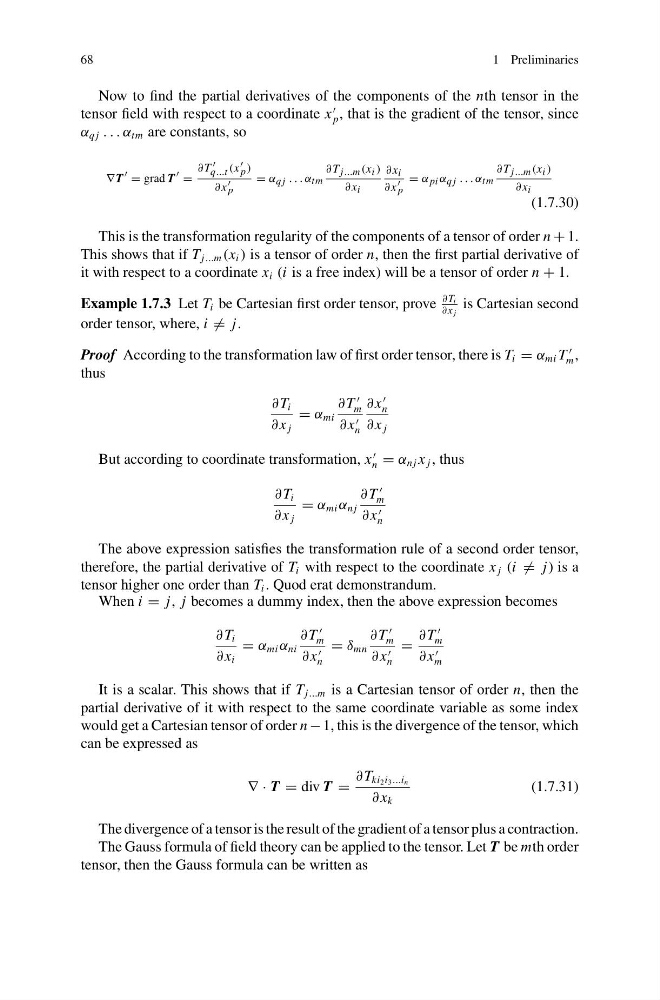
Now to find the partial derivatives of the components of the nth tensor in the
tensor field with respect to a coordinate x
p , that is the gradient of the tensor, since
α q j . . . α tm are constants, so
∇ T = grad T =
∂ T
q...t (x
p )
∂ x
p
= α q j . . . α tm
∂ T j...m (x i )
∂ x i
∂ x i
∂ x
p
= α pi α q j . . . α tm
∂ T j...m (x i )
∂ x i
(1.7.30)
This is the transformation regularity of the components of a tensor of order n + 1.
This shows that if T j...m (x i ) is a tensor of order n, then the first partial derivative of
it with respect to a coordinate x i (i is a free index) will be a tensor of order n + 1.
Example 1.7.3 Let T i be Cartesian first order tensor, prove
∂ T i
∂ x j
is Cartesian second
order tensor, where, i = j.
Proof According to the transformation law of first order tensor, there is T i = α mi T
m ,
thus
∂ T i
∂ x j
= α mi
∂ T
m
∂ x
n
∂ x
n
∂ x j
But according to coordinate transformation, x
n = α nj x j , thus
∂ T i
∂ x j
= α mi α nj
∂ T
m
∂ x
n
The above expression satisfies the transformation rule of a second order tensor,
therefore, the partial derivative of T i with respect to the coordinate x j (i = j) is a
tensor higher one order than T i . Quod erat demonstrandum.
When i = j, j becomes a dummy index, then the above expression becomes
∂ T i
∂ x i
= α mi α ni
∂ T
m
∂ x
n
= δ mn
∂ T
m
∂ x
n
=
∂ T
m
∂ x
m
It is a scalar. This shows that if T j...m is a Cartesian tensor of order n, then the
partial derivative of it with respect to the same coordinate variable as some index
would get a Cartesian tensor of order n − 1, this is the divergence of the tensor, which
can be expressed as
∇ · T = div T =
∂ T ki 2 i 3 ...i n
∂ x k
(1.7.31)
The divergence of a tensor is the result of the gradient of a tensor plus a contraction.
The Gauss formula of field theory can be applied to the tensor. Let T be mth order
tensor, then the Gauss formula can be written as
1 Preliminaries
Now to find the partial derivatives of the components of the nth tensor in the
tensor field with respect to a coordinate x
p , that is the gradient of the tensor, since
α q j . . . α tm are constants, so
∇ T = grad T =
∂ T
q...t (x
p )
∂ x
p
= α q j . . . α tm
∂ T j...m (x i )
∂ x i
∂ x i
∂ x
p
= α pi α q j . . . α tm
∂ T j...m (x i )
∂ x i
(1.7.30)
This is the transformation regularity of the components of a tensor of order n + 1.
This shows that if T j...m (x i ) is a tensor of order n, then the first partial derivative of
it with respect to a coordinate x i (i is a free index) will be a tensor of order n + 1.
Example 1.7.3 Let T i be Cartesian first order tensor, prove
∂ T i
∂ x j
is Cartesian second
order tensor, where, i = j.
Proof According to the transformation law of first order tensor, there is T i = α mi T
m ,
thus
∂ T i
∂ x j
= α mi
∂ T
m
∂ x
n
∂ x
n
∂ x j
But according to coordinate transformation, x
n = α nj x j , thus
∂ T i
∂ x j
= α mi α nj
∂ T
m
∂ x
n
The above expression satisfies the transformation rule of a second order tensor,
therefore, the partial derivative of T i with respect to the coordinate x j (i = j) is a
tensor higher one order than T i . Quod erat demonstrandum.
When i = j, j becomes a dummy index, then the above expression becomes
∂ T i
∂ x i
= α mi α ni
∂ T
m
∂ x
n
= δ mn
∂ T
m
∂ x
n
=
∂ T
m
∂ x
m
It is a scalar. This shows that if T j...m is a Cartesian tensor of order n, then the
partial derivative of it with respect to the same coordinate variable as some index
would get a Cartesian tensor of order n − 1, this is the divergence of the tensor, which
can be expressed as
∇ · T = div T =
∂ T ki 2 i 3 ...i n
∂ x k
(1.7.31)
The divergence of a tensor is the result of the gradient of a tensor plus a contraction.
The Gauss formula of field theory can be applied to the tensor. Let T be mth order
tensor, then the Gauss formula can be written as