

1.7 Basic Conceptions of Tensors
67
The real roots of cubic algebraic equation of the characteristic value λ may have
three kinds of cases, namely three not equal real roots, a real root plus two equal real
roots and three equal real roots. For a symmetric tensor, if the three real roots are not
equal, then one can prove that the three principal directions are orthogonal to each
other.
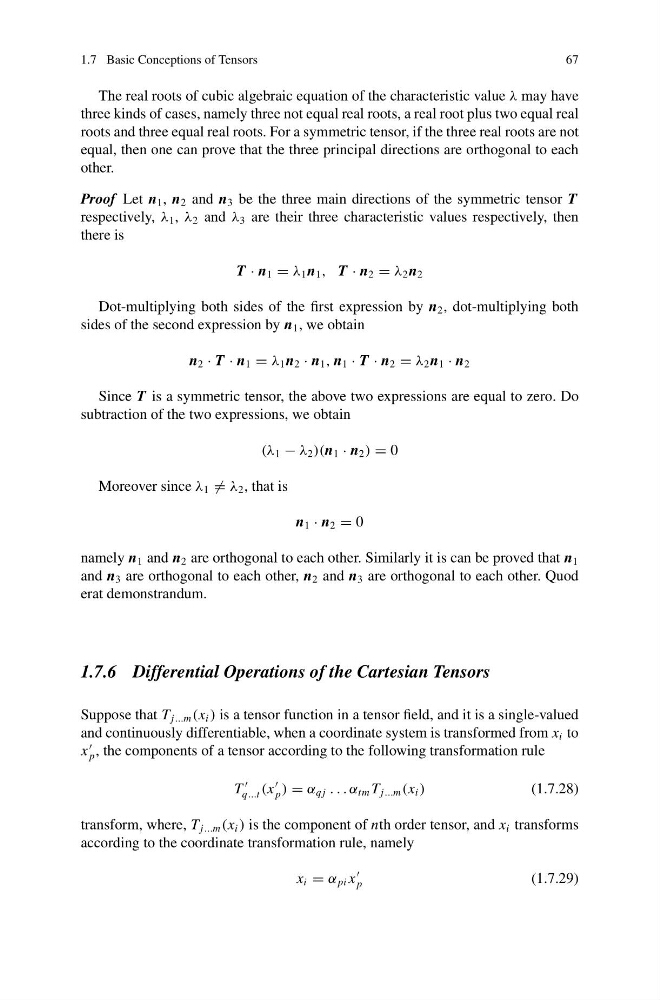
Proof Let n 1 , n 2 and n 3 be the three main directions of the symmetric tensor T
respectively, λ 1 , λ 2 and λ 3 are their three characteristic values respectively, then
there is
T · n 1 = λ 1 n 1 , T · n 2 = λ 2 n 2
Dot-multiplying both sides of the first expression by n 2 , dot-multiplying both
sides of the second expression by n 1 , we obtain
n 2 · T · n 1 = λ 1 n 2 · n 1 , n 1 · T · n 2 = λ 2 n 1 · n 2
Since T is a symmetric tensor, the above two expressions are equal to zero. Do
subtraction of the two expressions, we obtain
(λ 1 − λ 2 )(n 1 · n 2 ) = 0
Moreover since λ 1 = λ 2 , that is
n 1 · n 2 = 0
namely n 1 and n 2 are orthogonal to each other. Similarly it is can be proved that n 1
and n 3 are orthogonal to each other, n 2 and n 3 are orthogonal to each other. Quod
erat demonstrandum.
1.7.6 Differential Operations of the Cartesian Tensors
Suppose that T j...m (x i ) is a tensor function in a tensor field, and it is a single-valued
and continuously differentiable, when a coordinate system is transformed from x i to
x
p , the components of a tensor according to the following transformation rule
T
q...t (x
p ) = α q j . . . α tm T j...m (x i )
(1.7.28)
transform, where, T j...m (x i ) is the component of nth order tensor, and x i transforms
according to the coordinate transformation rule, namely
x i = α pi x
p
(1.7.29)
67
The real roots of cubic algebraic equation of the characteristic value λ may have
three kinds of cases, namely three not equal real roots, a real root plus two equal real
roots and three equal real roots. For a symmetric tensor, if the three real roots are not
equal, then one can prove that the three principal directions are orthogonal to each
other.
Proof Let n 1 , n 2 and n 3 be the three main directions of the symmetric tensor T
respectively, λ 1 , λ 2 and λ 3 are their three characteristic values respectively, then
there is
T · n 1 = λ 1 n 1 , T · n 2 = λ 2 n 2
Dot-multiplying both sides of the first expression by n 2 , dot-multiplying both
sides of the second expression by n 1 , we obtain
n 2 · T · n 1 = λ 1 n 2 · n 1 , n 1 · T · n 2 = λ 2 n 1 · n 2
Since T is a symmetric tensor, the above two expressions are equal to zero. Do
subtraction of the two expressions, we obtain
(λ 1 − λ 2 )(n 1 · n 2 ) = 0
Moreover since λ 1 = λ 2 , that is
n 1 · n 2 = 0
namely n 1 and n 2 are orthogonal to each other. Similarly it is can be proved that n 1
and n 3 are orthogonal to each other, n 2 and n 3 are orthogonal to each other. Quod
erat demonstrandum.
1.7.6 Differential Operations of the Cartesian Tensors
Suppose that T j...m (x i ) is a tensor function in a tensor field, and it is a single-valued
and continuously differentiable, when a coordinate system is transformed from x i to
x
p , the components of a tensor according to the following transformation rule
T
q...t (x
p ) = α q j . . . α tm T j...m (x i )
(1.7.28)
transform, where, T j...m (x i ) is the component of nth order tensor, and x i transforms
according to the coordinate transformation rule, namely
x i = α pi x
p
(1.7.29)