

66
1 Preliminaries
theorem that λ is a scalar. Substituting Eq. (1.7.22) into Eq. (1.7.21) and transpose
the term, we obtain
T · a − λa = 0
(1.7.23)
Expand Eq. (1.7.23), we obtain
⎧
⎨
⎩
(T 11 − λ)a 1 + T 12 a 2 + T 13 a 3 = 0
T 21 a 1 + (T 22 − λ)a 2 + T 23 a 3 = 0
T 31 a 1 + T 32 a 2 + (T 33 − λ)a 3 = 0
(1.7.24)
Equation (1.7.24) is homogeneous linear algebraic equations on a 1 , a 2 and a 3 . If
make this equations have non-zero solution, must make the following determinant
equal zero, namely
T 11 − λ T 12
T 13
T 21 T 22 − λ T 23
T 31
T 32 T 33 − λ
= 0
(1.7.25)
Expand the determinant (1.7.25), we obtain
λ 3 − (T 11 + T 22 + T 33 )λ 2 +
T 22 T 23
T 32 T 33
+
T 11 T 13
T 31 T 33
+
T 11 T 12
T 21 T 22
λ −
T 11 T 12 T 13
T 21 T 22 T 23
T 31 T 32 T 33
= 0
(1.7.26)
It is a cubic algebraic equation about the characteristic value λ. The equation has
three root, Or three real root, or a real root, two conjugate complex root. There are
the following relationships between the three roots λ 1 , λ 2 and λ 3 of the characteristic
values λ and the coefficient of λ
I 1 = T ii = T 11 + T 22 + T 33 = λ 1 + λ 2 + λ 3
I 2 =
T 22 T 23
T 32 T 33
+
T 11 T 13
T 31 T 33
+
T 11 T 12
T 21 T 22
=
1
2
(T ii T j j − T i j T ji ) = λ 1 λ 2 + λ 2 λ 3 + λ 3 λ 1
I 3 =
T 11 T 12 T 13
T 21 T 22 T 23
T 31 T 32 T 33
= ε i jk T 1i T 2 j T 3k = λ 1 λ 2 λ 3
(1.7.27)
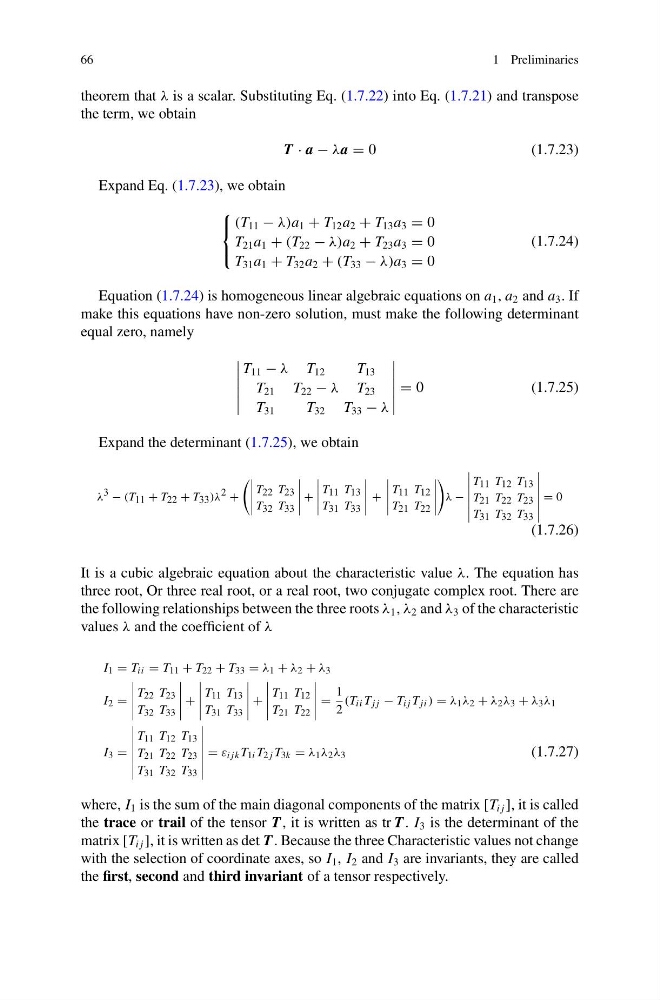
where, I 1 is the sum of the main diagonal components of the matrix [T i j ], it is called
the trace or trail of the tensor T , it is written as tr T . I 3 is the determinant of the
matrix [T i j ], it is written as det T . Because the three Characteristic values not change
with the selection of coordinate axes, so I 1 , I 2 and I 3 are invariants, they are called
the first, second and third invariant of a tensor respectively.
1 Preliminaries
theorem that λ is a scalar. Substituting Eq. (1.7.22) into Eq. (1.7.21) and transpose
the term, we obtain
T · a − λa = 0
(1.7.23)
Expand Eq. (1.7.23), we obtain
⎧
⎨
⎩
(T 11 − λ)a 1 + T 12 a 2 + T 13 a 3 = 0
T 21 a 1 + (T 22 − λ)a 2 + T 23 a 3 = 0
T 31 a 1 + T 32 a 2 + (T 33 − λ)a 3 = 0
(1.7.24)
Equation (1.7.24) is homogeneous linear algebraic equations on a 1 , a 2 and a 3 . If
make this equations have non-zero solution, must make the following determinant
equal zero, namely
T 11 − λ T 12
T 13
T 21 T 22 − λ T 23
T 31
T 32 T 33 − λ
= 0
(1.7.25)
Expand the determinant (1.7.25), we obtain
λ 3 − (T 11 + T 22 + T 33 )λ 2 +
T 22 T 23
T 32 T 33
+
T 11 T 13
T 31 T 33
+
T 11 T 12
T 21 T 22
λ −
T 11 T 12 T 13
T 21 T 22 T 23
T 31 T 32 T 33
= 0
(1.7.26)
It is a cubic algebraic equation about the characteristic value λ. The equation has
three root, Or three real root, or a real root, two conjugate complex root. There are
the following relationships between the three roots λ 1 , λ 2 and λ 3 of the characteristic
values λ and the coefficient of λ
I 1 = T ii = T 11 + T 22 + T 33 = λ 1 + λ 2 + λ 3
I 2 =
T 22 T 23
T 32 T 33
+
T 11 T 13
T 31 T 33
+
T 11 T 12
T 21 T 22
=
1
2
(T ii T j j − T i j T ji ) = λ 1 λ 2 + λ 2 λ 3 + λ 3 λ 1
I 3 =
T 11 T 12 T 13
T 21 T 22 T 23
T 31 T 32 T 33
= ε i jk T 1i T 2 j T 3k = λ 1 λ 2 λ 3
(1.7.27)
where, I 1 is the sum of the main diagonal components of the matrix [T i j ], it is called
the trace or trail of the tensor T , it is written as tr T . I 3 is the determinant of the
matrix [T i j ], it is written as det T . Because the three Characteristic values not change
with the selection of coordinate axes, so I 1 , I 2 and I 3 are invariants, they are called
the first, second and third invariant of a tensor respectively.