

Appendix: All Solutions to the Problems
829
y = c 1 x + c 2
z = c 3 x + c 4
(2)
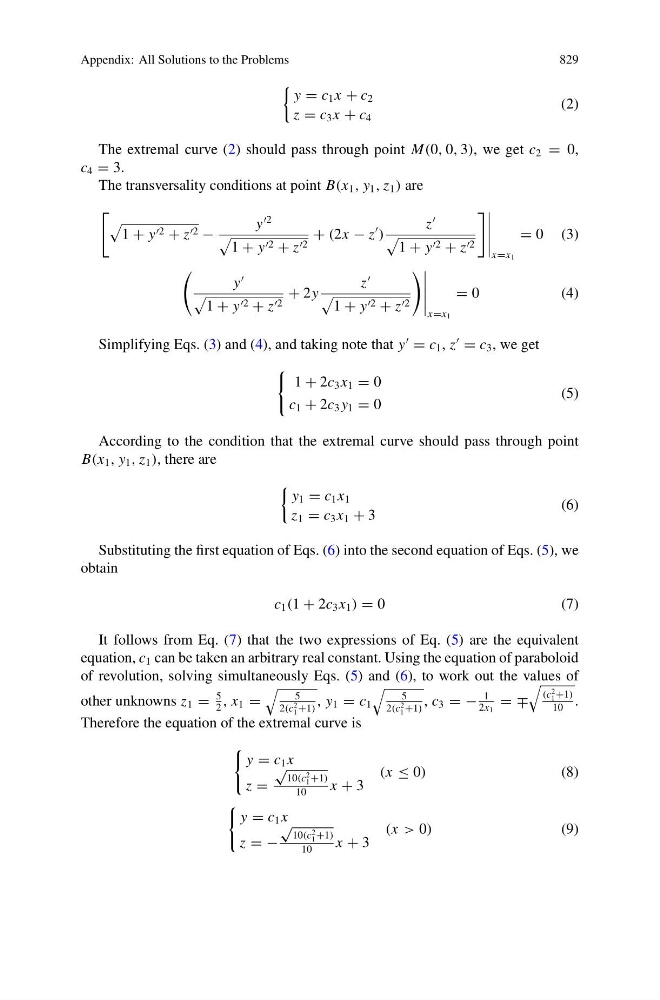
The extremal curve (2) should pass through point M(0, 0, 3), we get c 2 = 0,
c 4 = 3.
The transversality conditions at point B(x 1 , y 1 , z 1 ) are
1 + y 2 + z 2 −
y
2
1 + y 2 + z 2
+ (2x − z
)
z
1 + y 2 + z 2
x=x 1
= 0 (3)
y
1 + y 2 + z 2
+ 2y
z
1 + y 2 + z 2
x=x 1
= 0
( 4 )
Simplifying Eqs. (3) and (4), and taking note that y
= c 1 , z
= c 3 , we get
1 + 2c 3 x 1 = 0
c 1 + 2c 3 y 1 = 0
(5)
According to the condition that the extremal curve should pass through point
B(x 1 , y 1 , z 1 ), there are
y 1 = c 1 x 1
z 1 = c 3 x 1 + 3
(6)
Substituting the first equation of Eqs. (6) into the second equation of Eqs. (5), we
obtain
c 1 (1 + 2c 3 x 1 ) = 0
( 7 )
It follows from Eq. (7) that the two expressions of Eq. (5) are the equivalent
equation, c 1 can be taken an arbitrary real constant. Using the equation of paraboloid
of revolution, solving simultaneously Eqs. (5) and (6), to work out the values of
other unknowns z 1 =
5
2
, x 1 =
5
2(c
2
1 +1)
, y 1 = c 1
5
2(c
2
1 +1)
, c 3 = −
1
2x 1
= ∓
(c
2
1 +1)
10
.
Therefore the equation of the extremal curve is
y = c 1 x
z =
√
10(c
2
1 +1)
10
x + 3
(x ≤ 0)
(8)
y = c 1 x
z = −
√
10(c
2
1 +1)
10
x + 3
(x > 0)
(9)