

828
Appendix: All Solutions to the Problems
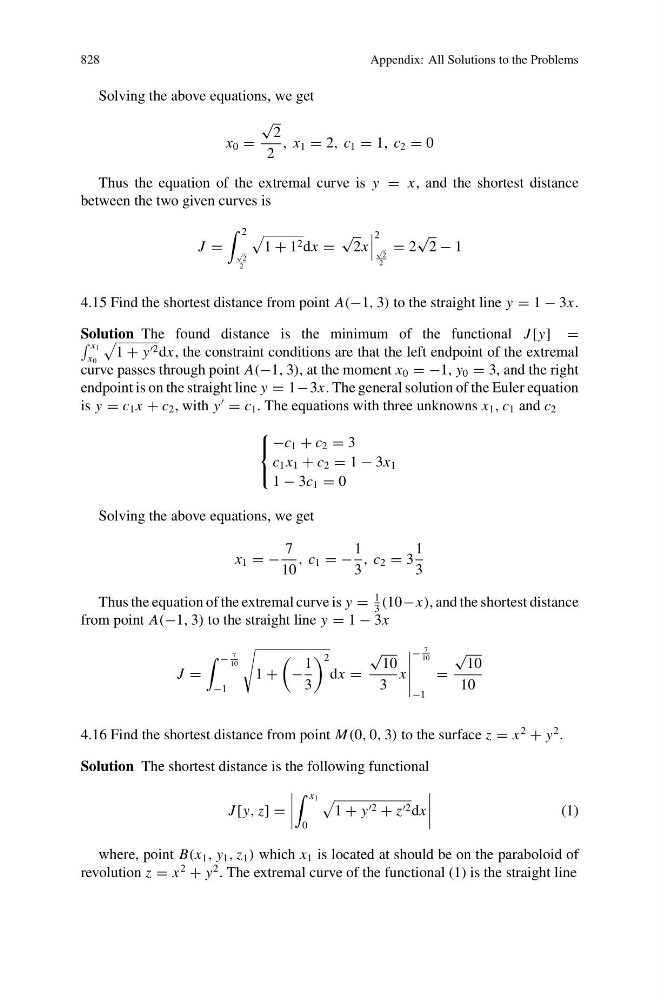
Solving the above equations, we get
x 0 =
√
2
2
, x 1 = 2, c 1 = 1, c 2 = 0
Thus the equation of the extremal curve is y = x, and the shortest distance
between the two given curves is
J =
2
√
2
2
1 + 1 2 dx =
√
2x
2
√
2
2
= 2
√
2 − 1
4.15 Find the shortest distance from point A(−1, 3) to the straight line y = 1 − 3x.
Solution The found distance is the minimum of the functional J [y] =
x 1
x 0
1 + y 2 dx, the constraint conditions are that the left endpoint of the extremal
curve passes through point A(−1, 3), at the moment x 0 = −1, y 0 = 3, and the right
endpoint is on the straight line y = 1−3x. The general solution of the Euler equation
is y = c 1 x + c 2 , with y
= c 1 . The equations with three unknowns x 1 , c 1 and c 2
⎧
⎨
⎩
−c 1 + c 2 = 3
c 1 x 1 + c 2 = 1 − 3x 1
1 − 3c 1 = 0
Solving the above equations, we get
x 1 = −
7
10
, c 1 = −
1
3
, c 2 = 3
1
3
Thus the equation of the extremal curve is y =
1
3
(10−x), and the shortest distance
from point A(−1, 3) to the straight line y = 1 − 3x
J =
−
7
10
−1
1 +
−
1
3
2
dx =
√
10
3
x
−
7
10
−1
=
√
10
10
4.16 Find the shortest distance from point M(0, 0, 3) to the surface z = x
2
+ y
2 .
Solution The shortest distance is the following functional
J [y, z] =
x 1
0
1 + y 2 + z 2 dx
(1)
where, point B(x 1 , y 1 , z 1 ) which x 1 is located at should be on the paraboloid of
revolution z = x
2
+ y
2 . The extremal curve of the functional (1) is the straight line