

830
Appendix: All Solutions to the Problems
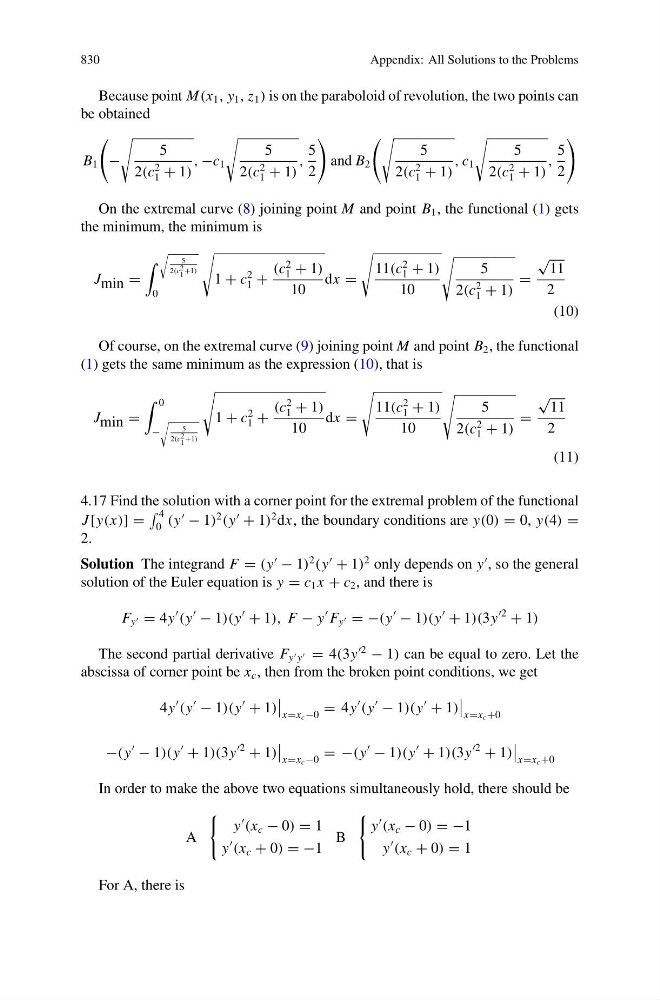
Because point M(x 1 , y 1 , z 1 ) is on the paraboloid of revolution, the two points can
be obtained
B 1
−
5
2(c
2
1 + 1)
, −c 1
5
2(c
2
1 + 1)
,
5
2
and B 2
5
2(c
2
1 + 1)
, c 1
5
2(c
2
1 + 1)
,
5
2
On the extremal curve (8) joining point M and point B 1 , the functional (1) gets
the minimum, the minimum is
J min =
5
2(c 2
1 +1)
0
1 + c
2
1 +
(c
2
1 + 1)
10
dx =
11(c
2
1 + 1)
10
5
2(c
2
1 + 1)
=
√
11
2
(10)
Of course, on the extremal curve (9) joining point M and point B 2 , the functional
(1) gets the same minimum as the expression (10), that is
J min =
0
−
5
2(c 2
1 +1)
1 + c
2
1 +
(c
2
1 + 1)
10
dx =
11(c
2
1 + 1)
10
5
2(c
2
1 + 1)
=
√
11
2
(11)
4.17 Find the solution with a corner point for the extremal problem of the functional
J [y(x)] =
4
0 (y
− 1)
2
(y
+ 1)
2 dx, the boundary conditions are y(0) = 0, y(4) =
2.
Solution The integrand F = (y
− 1)
2
(y
+ 1)
2 only depends on y
, so the general
solution of the Euler equation is y = c 1 x + c 2 , and there is
F y = 4y
(y
− 1)(y
+ 1), F − y
F y = −(y
− 1)(y
+ 1)(3y
2
+ 1)
The second partial derivative F y y = 4(3y
2
− 1) can be equal to zero. Let the
abscissa of corner point be x c , then from the broken point conditions, we get
4y
(y
− 1)(y
+ 1)
x=x c −0
= 4y
(y
− 1)(y
+ 1)
x=x c +0
−(y
− 1)(y
+ 1)(3y
2
+ 1)
x=x c −0
= −(y
− 1)(y
+ 1)(3y
2
+ 1)
x=x c +0
In order to make the above two equations simultaneously hold, there should be
A
y
(x c − 0) = 1
y
(x c + 0) = −1
B
y
(x c − 0) = −1
y
(x c + 0) = 1
For A, there is