

824
Appendix: All Solutions to the Problems
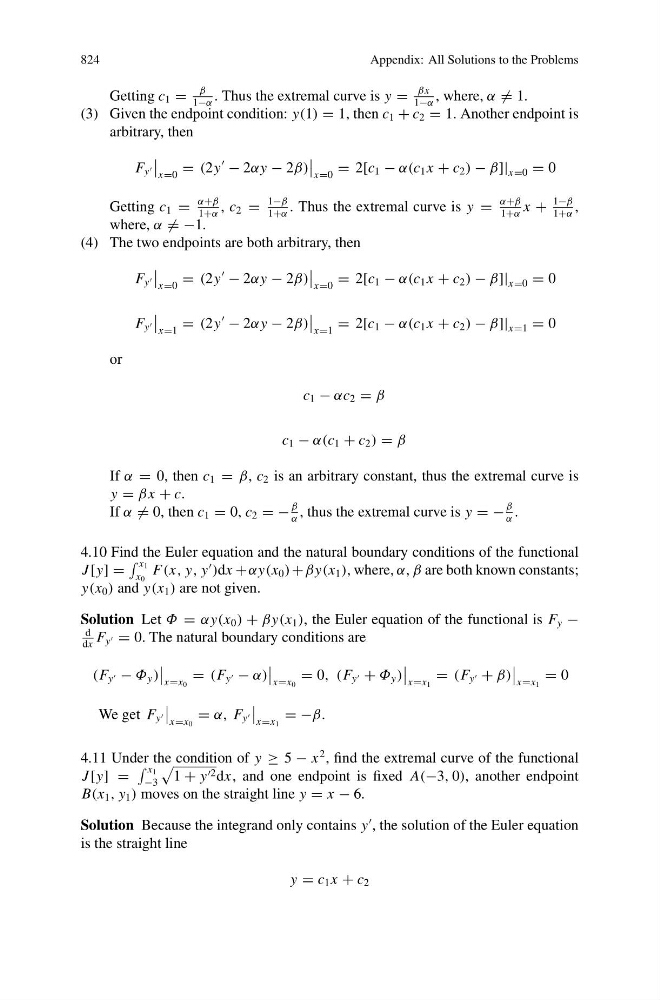
Getting c 1 =
β
1−α
. Thus the extremal curve is y =
βx
1−α
, where, α = 1.
(3) Given the endpoint condition: y(1) = 1, then c 1 + c 2 = 1. Another endpoint is
arbitrary, then
F y
x=0
= (2y
− 2αy − 2β)
x=0
= 2[c 1 − α(c 1 x + c 2 ) − β]| x=0 = 0
Getting c 1 =
α+β
1+α
, c 2 =
1−β
1+α
. Thus the extremal curve is y =
α+β
1+α
x +
1−β
1+α
,
where, α = −1.
(4) The two endpoints are both arbitrary, then
F y
x=0
= (2y
− 2αy − 2β)
x=0
= 2[c 1 − α(c 1 x + c 2 ) − β]| x=0 = 0
F y
x=1
= (2y
− 2αy − 2β)
x=1
= 2[c 1 − α(c 1 x + c 2 ) − β]| x=1 = 0
or
c 1 − αc 2 = β
c 1 − α(c 1 + c 2 ) = β
If α = 0, then c 1 = β, c 2 is an arbitrary constant, thus the extremal curve is
y = βx + c.
If α = 0, then c 1 = 0, c 2 = −
β
α
, thus the extremal curve is y = −
β
α
.
4.10 Find the Euler equation and the natural boundary conditions of the functional
J [y] =
x 1
x 0
F(x, y, y
)dx + αy(x 0 ) + βy(x 1 ), where, α, β are both known constants;
y(x 0 ) and y(x 1 ) are not given.
Solution Let Φ = αy(x 0 ) + βy(x 1 ), the Euler equation of the functional is F y −
d
dx
F y = 0. The natural boundary conditions are
(F y − Φ y )
x=x 0
= (F y − α)
x=x 0
= 0, (F y + Φ y )
x=x 1
= (F y + β)
x=x 1
= 0
We get F y
x=x 0
= α, F y
x=x 1
= −β.
4.11 Under the condition of y ≥ 5 − x
2 , find the extremal curve of the functional
J [y] =
x 1
−3
1 + y 2 dx, and one endpoint is fixed A(−3, 0), another endpoint
B(x 1 , y 1 ) moves on the straight line y = x − 6.
Solution Because the integrand only contains y
, the solution of the Euler equation
is the straight line
y = c 1 x + c 2