

Appendix: All Solutions to the Problems
825
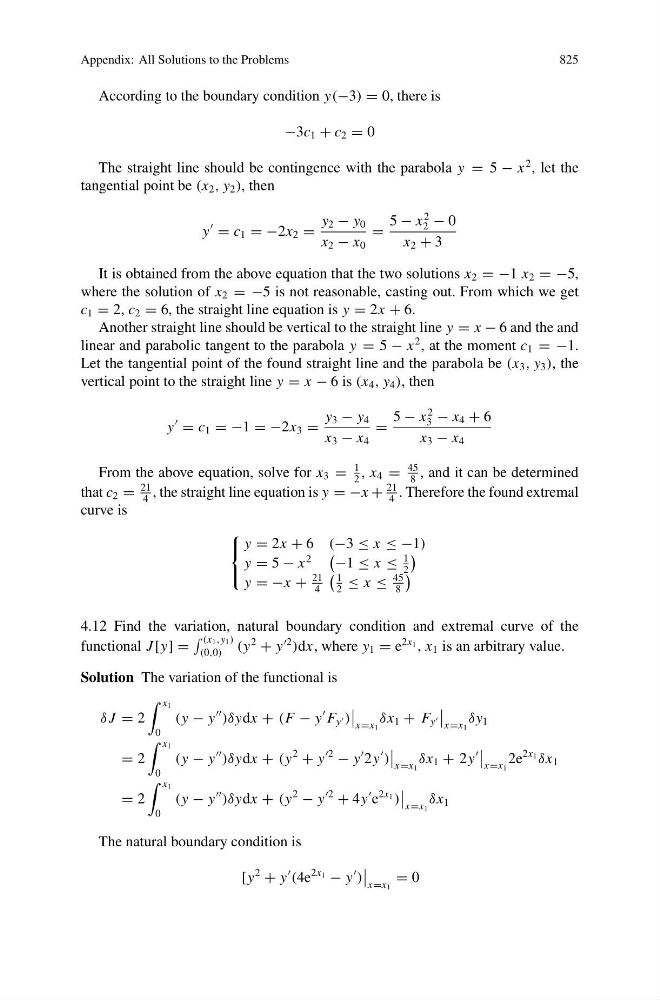
According to the boundary condition y(−3) = 0, there is
−3c 1 + c 2 = 0
The straight line should be contingence with the parabola y = 5 − x
2 , let the
tangential point be (x 2 , y 2 ), then
y
= c 1 = −2x 2 =
y 2 − y 0
x 2 − x 0
=
5 − x
2
2 − 0
x 2 + 3
It is obtained from the above equation that the two solutions x 2 = −1 x 2 = −5,
where the solution of x 2 = −5 is not reasonable, casting out. From which we get
c 1 = 2, c 2 = 6, the straight line equation is y = 2x + 6.
Another straight line should be vertical to the straight line y = x − 6 and the and
linear and parabolic tangent to the parabola y = 5 − x
2 , at the moment c 1 = −1.
Let the tangential point of the found straight line and the parabola be (x 3 , y 3 ), the
vertical point to the straight line y = x − 6 is (x 4 , y 4 ), then
y
= c 1 = −1 = −2x 3 =
y 3 − y 4
x 3 − x 4
=
5 − x
2
3 − x 4 + 6
x 3 − x 4
From the above equation, solve for x 3 =
1
2
, x 4 =
45
8
, and it can be determined
that c 2 =
21
4
, the straight line equation is y = −x +
21
4
. Therefore the found extremal
curve is
⎧
⎨
⎩
y = 2x + 6 (−3 ≤ x ≤ −1)
y = 5 − x
2
−1 ≤ x ≤
1
2
y = −x +
21
4
1
2
≤ x ≤
45
8
4.12 Find the variation, natural boundary condition and extremal curve of the
functional J [y] =
(x 1 ,y 1 )
(0,0) (y
2
+ y
2
)dx, where y 1 = e
2x 1 , x 1 is an arbitrary value.
Solution The variation of the functional is
δ J = 2
x 1
0
(y − y
)δydx + (F − y
F y )
x=x 1
δx 1 + F y
x=x 1
δy 1
= 2
x 1
0
(y − y
)δydx + (y
2
+ y
2
− y
2y
)
x=x 1
δx 1 + 2y
x=x 1
2e
2x 1 δx 1
= 2
x 1
0
(y − y
)δydx + (y
2
− y
2
+ 4y
e
2x 1 )
x=x 1
δx 1
The natural boundary condition is
[y
2
+ y
(4e
2x 1 − y
)
x=x 1
= 0