

Appendix: All Solutions to the Problems
823
=
x 1
x 0
F y −
d
dx
F y + P y + Q y y
−
d
dx
Q
δydx + (F y + Q)δy
x 1
x 0
=
x 1
x 0
F y −
d
dx
F y + P y + Q y y
− Q x − Q y y
δydx + (F y + Q)δy
x 1
x 0
=
x 1
x 0
F y −
d
dx
F y
δydx + (F y + Q)δy
x 1
x 0
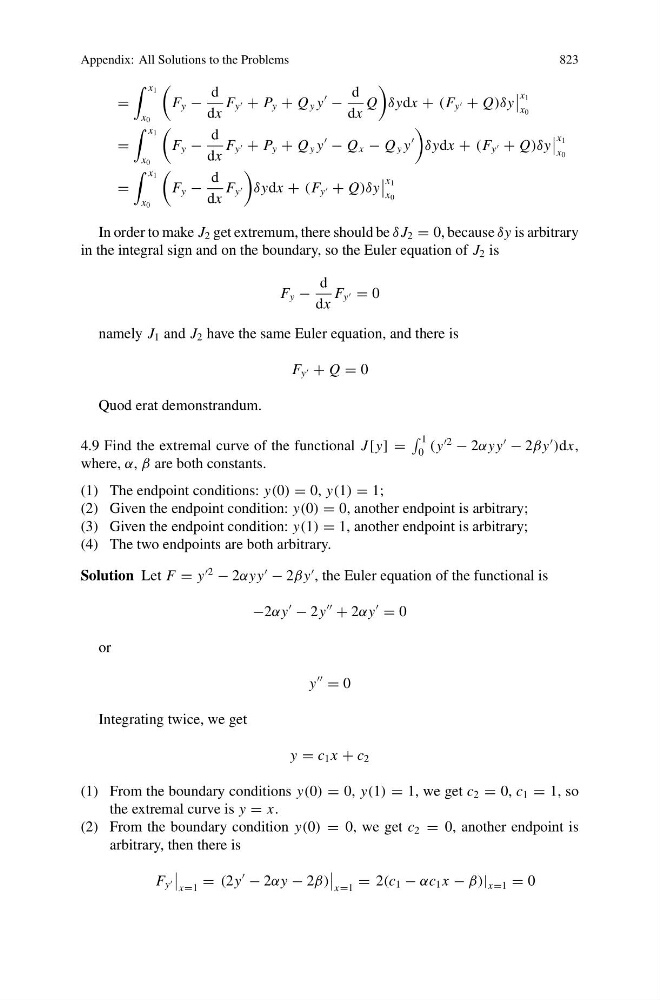
In order to make J 2 get extremum, there should be δ J 2 = 0, because δy is arbitrary
in the integral sign and on the boundary, so the Euler equation of J 2 is
F y −
d
dx
F y = 0
namely J 1 and J 2 have the same Euler equation, and there is
F y + Q = 0
Quod erat demonstrandum.
4.9 Find the extremal curve of the functional J [y] =
1
0 (y
2
− 2αyy
− 2βy
)dx,
where, α, β are both constants.
(1) The endpoint conditions: y(0) = 0, y(1) = 1;
(2) Given the endpoint condition: y(0) = 0, another endpoint is arbitrary;
(3) Given the endpoint condition: y(1) = 1, another endpoint is arbitrary;
(4) The two endpoints are both arbitrary.
Solution Let F = y
2
− 2αyy
− 2βy
, the Euler equation of the functional is
−2αy
− 2y
+ 2αy
= 0
or
y
= 0
Integrating twice, we get
y = c 1 x + c 2
(1) From the boundary conditions y(0) = 0, y(1) = 1, we get c 2 = 0, c 1 = 1, so
the extremal curve is y = x.
(2) From the boundary condition y(0) = 0, we get c 2 = 0, another endpoint is
arbitrary, then there is
F y
x=1
= (2y
− 2αy − 2β)
x=1
= 2(c 1 − αc 1 x − β)| x=1 = 0