

814
Appendix: All Solutions to the Problems
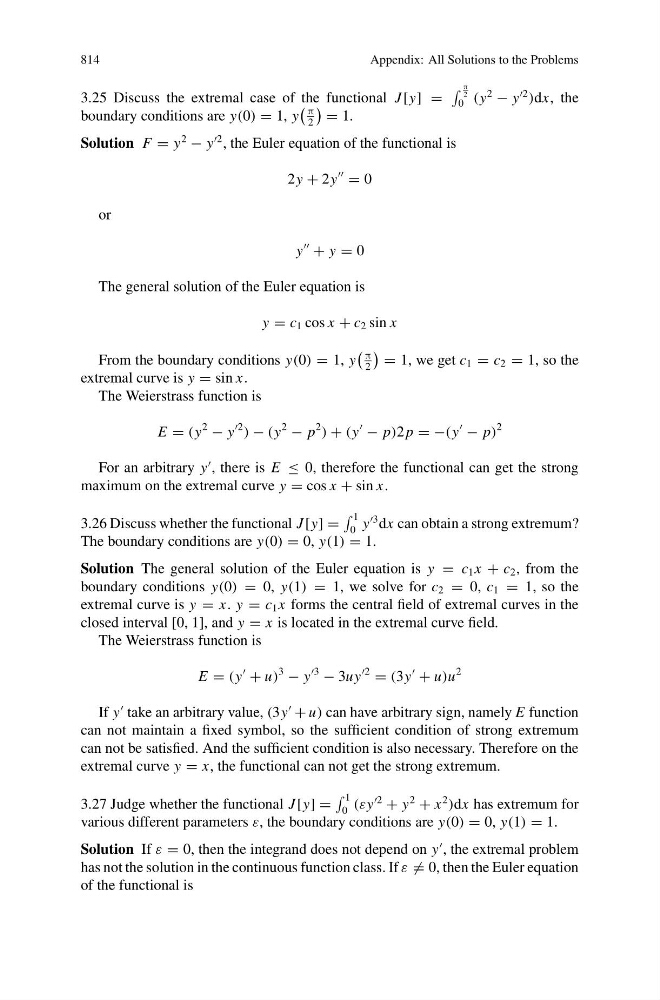
3.25 Discuss the extremal case of the functional J [y] =
π
2
0 (y
2
− y
2
)dx, the
boundary conditions are y(0) = 1, y
π
2
= 1.
Solution F = y
2
− y
2 , the Euler equation of the functional is
2y + 2y
= 0
or
y
+ y = 0
The general solution of the Euler equation is
y = c 1 cos x + c 2 sin x
From the boundary conditions y(0) = 1, y
π
2
= 1, we get c 1 = c 2 = 1, so the
extremal curve is y = sin x.
The Weierstrass function is
E = (y
2
− y
2
) − (y
2
− p
2
) + (y
− p)2 p = −(y
− p)
2
For an arbitrary y
, there is E ≤ 0, therefore the functional can get the strong
maximum on the extremal curve y = cos x + sin x.
3.26 Discuss whether the functional J [y] =
1
0 y
3 dx can obtain a strong extremum?
The boundary conditions are y(0) = 0, y(1) = 1.
Solution The general solution of the Euler equation is y = c 1 x + c 2 , from the
boundary conditions y(0) = 0, y(1) = 1, we solve for c 2 = 0, c 1 = 1, so the
extremal curve is y = x. y = c 1 x forms the central field of extremal curves in the
closed interval [0, 1], and y = x is located in the extremal curve field.
The Weierstrass function is
E = (y
+ u)
3
− y
3
− 3uy
2
= (3y
+ u)u
2
If y
take an arbitrary value, (3y
+ u) can have arbitrary sign, namely E function
can not maintain a fixed symbol, so the sufficient condition of strong extremum
can not be satisfied. And the sufficient condition is also necessary. Therefore on the
extremal curve y = x, the functional can not get the strong extremum.
3.27 Judge whether the functional J [y] =
1
0 (εy
2
+ y
2
+ x
2
)dx has extremum for
various different parameters ε, the boundary conditions are y(0) = 0, y(1) = 1.
Solution If ε = 0, then the integrand does not depend on y
, the extremal problem
has not the solution in the continuous function class. If ε = 0, then the Euler equation
of the functional is