

Appendix: All Solutions to the Problems
813
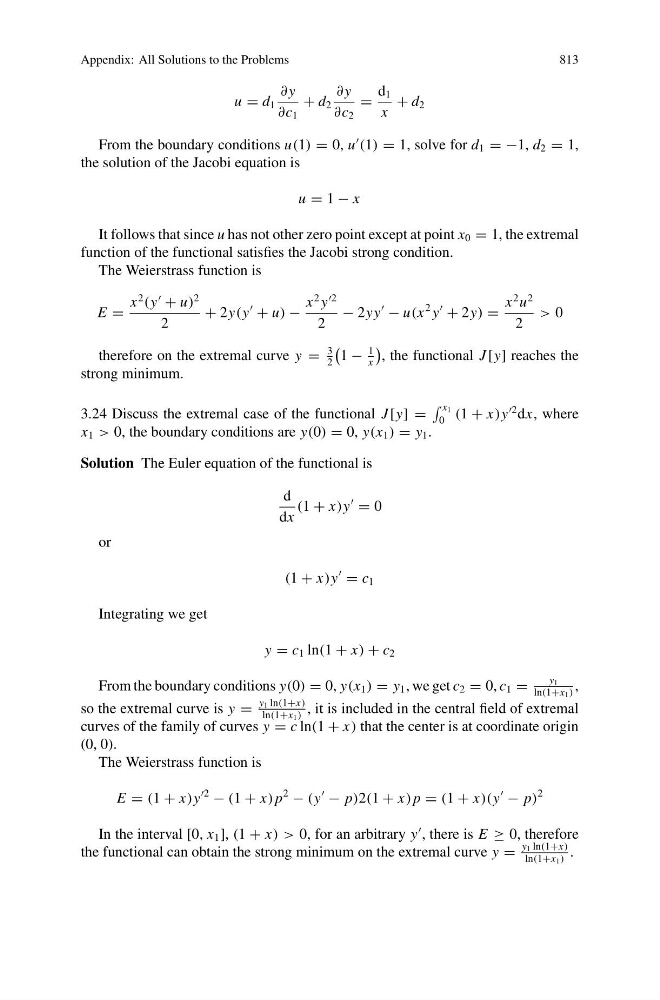
u = d 1
∂ y
∂c 1
+ d 2
∂ y
∂c 2
=
d 1
x
+ d 2
From the boundary conditions u(1) = 0, u
(1) = 1, solve for d 1 = −1, d 2 = 1,
the solution of the Jacobi equation is
u = 1 − x
It follows that since u has not other zero point except at point x 0 = 1, the extremal
function of the functional satisfies the Jacobi strong condition.
The Weierstrass function is
E =
x
2
(y
+ u)
2
2
+ 2y(y
+ u) −
x
2 y
2
2
− 2yy
− u(x
2 y
+ 2y) =
x
2 u
2
2
> 0
therefore on the extremal curve y =
3
2
1 −
1
x
, the functional J [y] reaches the
strong minimum.
3.24 Discuss the extremal case of the functional J [y] =
x 1
0 (1 + x)y
2 dx, where
x 1 > 0, the boundary conditions are y(0) = 0, y(x 1 ) = y 1 .
Solution The Euler equation of the functional is
d
dx
(1 + x)y
= 0
or
(1 + x)y
= c 1
Integrating we get
y = c 1 ln(1 + x) + c 2
From the boundary conditions y(0) = 0, y(x 1 ) = y 1 , we get c 2 = 0, c 1 =
y 1
ln(1+x 1 )
,
so the extremal curve is y =
y 1 ln(1+x)
ln(1+x 1 )
, it is included in the central field of extremal
curves of the family of curves y = c ln(1 + x) that the center is at coordinate origin
(0, 0).
The Weierstrass function is
E = (1 + x)y
2
− (1 + x) p
2
− (y
− p)2(1 + x) p = (1 + x)(y
− p)
2
In the interval [0, x 1 ], (1 + x) > 0, for an arbitrary y
, there is E ≥ 0, therefore
the functional can obtain the strong minimum on the extremal curve y =
y 1 ln(1+x)
ln(1+x 1 )
.