

812
Appendix: All Solutions to the Problems
J [u] =
¨
D
( pu
2
x + pu
2
y − 2 f u)dxdy
satisfies the fixed boundary condition u| Γ = g(x, y), g ∈ C(Γ ), where x = e
T is
the closed boundary curve of D, D = D + Γ ; p ∈ C
1
(D), f ∈ C(D), and p > 0,
u ∈ C
2
(D). Prove: u = u(x, y) makes J [u] obtain an absolute minimum.
Proof Since u = u(x, y) is the solution of J [u], there is δ J [u] = 0, and the second
variation of the functional is
δ
2 J = 2
¨
D
p[(δu x )
2
+ (δu y )
2
]dxdy ≥ 0
Therefore u = u(x, y) makes J [u] obtain the absolute minimum. Quod erat
demonstrandum.
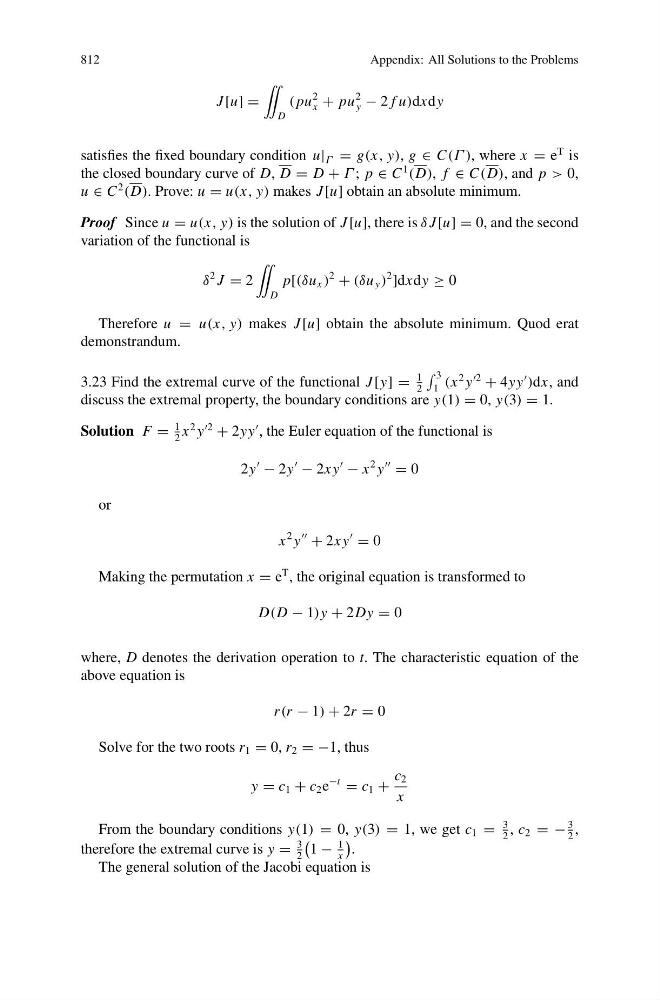
3.23 Find the extremal curve of the functional J [y] =
1
2
3
1 (x
2 y
2
+ 4yy
)dx, and
discuss the extremal property, the boundary conditions are y(1) = 0, y(3) = 1.
Solution F =
1
2
x
2 y
2
+ 2yy
, the Euler equation of the functional is
2y
− 2y
− 2x y
− x
2 y
= 0
or
x
2 y
+ 2x y
= 0
Making the permutation x = e
T , the original equation is transformed to
D(D − 1)y + 2Dy = 0
where, D denotes the derivation operation to t. The characteristic equation of the
above equation is
r (r − 1) + 2r = 0
Solve for the two roots r 1 = 0, r 2 = −1, thus
y = c 1 + c 2 e
−t
= c 1 +
c 2
x
From the boundary conditions y(1) = 0, y(3) = 1, we get c 1 =
3
2
, c 2 = −
3
2
,
therefore the extremal curve is y =
3
2
1 −
1
x
.
The general solution of the Jacobi equation is