

Appendix: All Solutions to the Problems
811
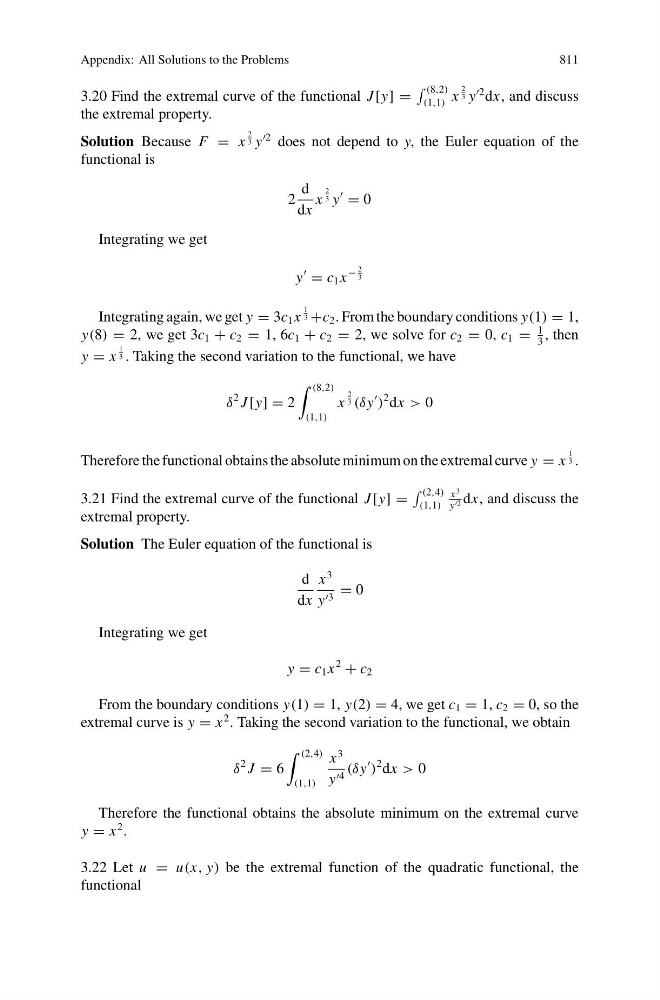
3.20 Find the extremal curve of the functional J [y] =
(8,2)
(1,1) x
2
3 y
2 dx, and discuss
the extremal property.
Solution Because F = x
2
3 y
2 does not depend to y, the Euler equation of the
functional is
2
d
dx
x
2
3 y
= 0
Integrating we get
y
= c 1 x
−
2
3
Integrating again, we get y = 3c 1 x
1
3 +c 2 . From the boundary conditions y(1) = 1,
y(8) = 2, we get 3c 1 + c 2 = 1, 6c 1 + c 2 = 2, we solve for c 2 = 0, c 1 =
1
3
, then
y = x
1
3 . Taking the second variation to the functional, we have
δ
2 J [y] = 2
(8,2)
(1,1)
x
2
3 (δy
)
2 dx > 0
Therefore the functional obtains the absolute minimum on the extremal curve y = x
1
3 .
3.21 Find the extremal curve of the functional J [y] =
(2,4)
(1,1)
x
3
y 2 dx, and discuss the
extremal property.
Solution The Euler equation of the functional is
d
dx
x
3
y 3 = 0
Integrating we get
y = c 1 x
2
+ c 2
From the boundary conditions y(1) = 1, y(2) = 4, we get c 1 = 1, c 2 = 0, so the
extremal curve is y = x
2 . Taking the second variation to the functional, we obtain
δ
2 J = 6
(2,4)
(1,1)
x
3
y 4 (δy
)
2 dx > 0
Therefore the functional obtains the absolute minimum on the extremal curve
y = x
2 .
3.22 Let u = u(x, y) be the extremal function of the quadratic functional, the
functional