

810
Appendix: All Solutions to the Problems
δ J =
1
0
−8(y
2
− 1)y
δy
dx = 8
1
0
[(y
2
− 1)y
]
δydx − (y
2
− 1)y
δy
1
0
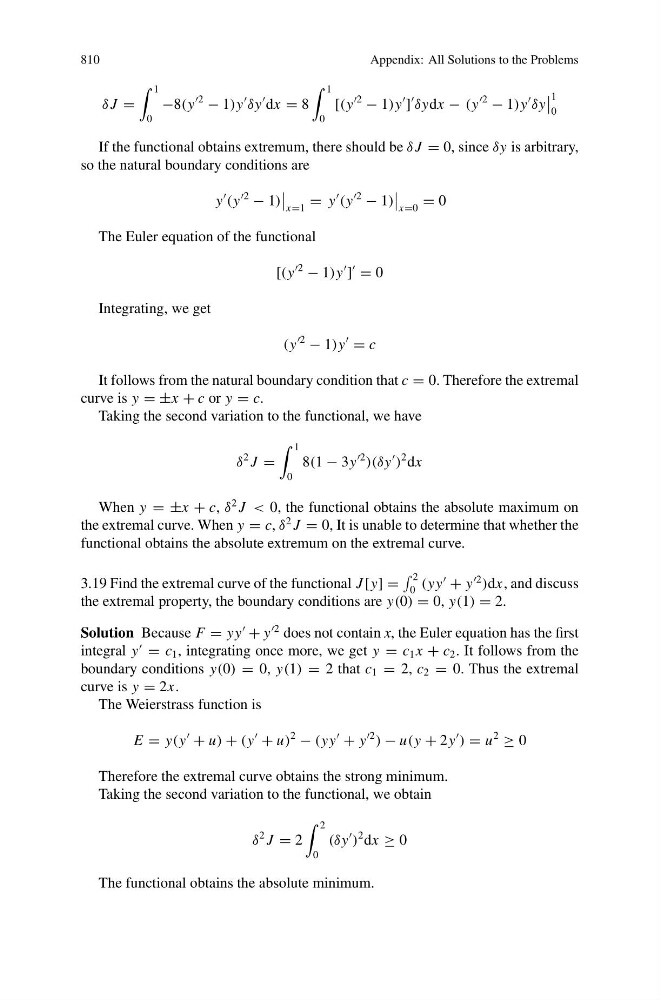
If the functional obtains extremum, there should be δ J = 0, since δy is arbitrary,
so the natural boundary conditions are
y
(y
2
− 1)
x=1
= y
(y
2
− 1)
x=0
= 0
The Euler equation of the functional
[(y
2
− 1)y
]
= 0
Integrating, we get
(y
2
− 1)y
= c
It follows from the natural boundary condition that c = 0. Therefore the extremal
curve is y = ±x + c or y = c.
Taking the second variation to the functional, we have
δ
2 J =
1
0
8(1 − 3y
2
)(δy
)
2 dx
When y = ±x + c, δ
2 J < 0, the functional obtains the absolute maximum on
the extremal curve. When y = c, δ
2 J = 0, It is unable to determine that whether the
functional obtains the absolute extremum on the extremal curve.
3.19 Find the extremal curve of the functional J [y] =
2
0 (yy
+ y
2
)dx, and discuss
the extremal property, the boundary conditions are y(0) = 0, y(1) = 2.
Solution Because F = yy
+ y
2 does not contain x, the Euler equation has the first
integral y
= c 1 , integrating once more, we get y = c 1 x + c 2 . It follows from the
boundary conditions y(0) = 0, y(1) = 2 that c 1 = 2, c 2 = 0. Thus the extremal
curve is y = 2x.
The Weierstrass function is
E = y(y
+ u) + (y
+ u)
2
− (yy
+ y
2
) − u(y + 2y
) = u
2
≥ 0
Therefore the extremal curve obtains the strong minimum.
Taking the second variation to the functional, we obtain
δ
2 J = 2
2
0
(δy
)
2 dx ≥ 0
The functional obtains the absolute minimum.