

Appendix: All Solutions to the Problems
815
2y − 2εy
= 0
or
y
−
1
ε
y = 0
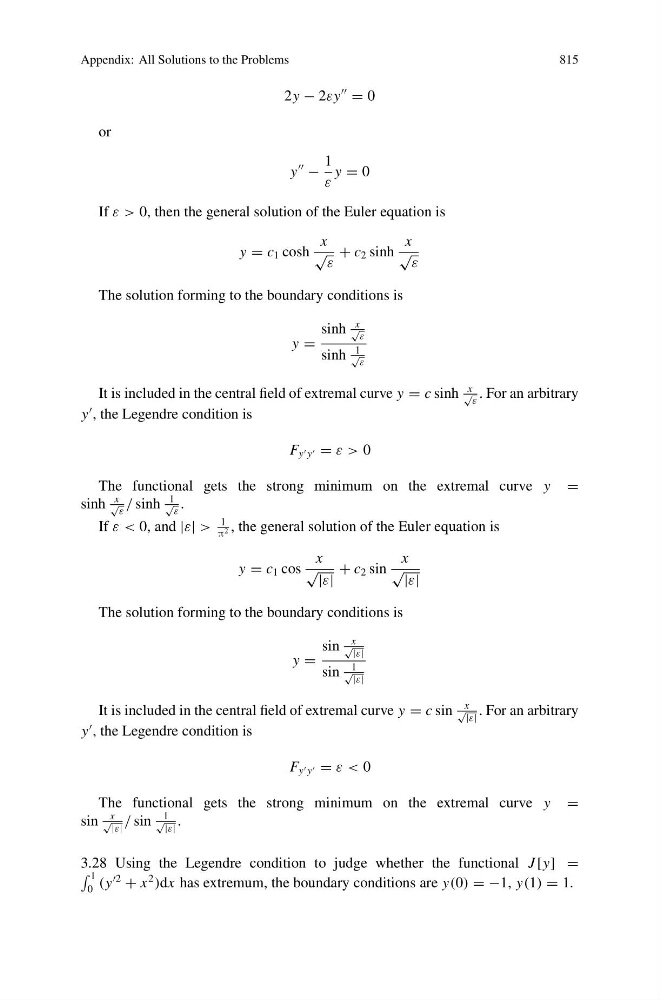
If ε > 0, then the general solution of the Euler equation is
y = c 1 cosh
x
√ ε
+ c 2 sinh
x
√
ε
The solution forming to the boundary conditions is
y =
sinh
x
√
ε
sinh
1
√
ε
It is included in the central field of extremal curve y = c sinh
x
√ ε
. For an arbitrary
y
, the Legendre condition is
F y y = ε > 0
The functional gets the strong minimum on the extremal curve y =
sinh
x
√ ε
/ sinh
1
√ ε
.
If ε < 0, and |ε| >
1
π 2 , the general solution of the Euler equation is
y = c 1 cos
x
√
|ε|
+ c 2 sin
x
√
|ε|
The solution forming to the boundary conditions is
y =
sin
x
√ |ε|
sin
1
√ |ε|
It is included in the central field of extremal curve y = c sin
x
√
|ε|
. For an arbitrary
y
, the Legendre condition is
F y y = ε < 0
The functional gets the strong minimum on the extremal curve y =
sin
x
√
|ε|
/ sin
1
√ |ε|
.
3.28 Using the Legendre condition to judge whether the functional J [y] =
1
0 (y
2
+ x
2
)dx has extremum, the boundary conditions are y(0) = −1, y(1) = 1.